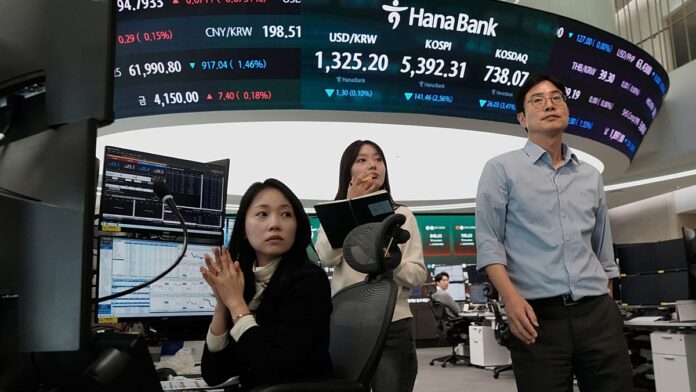

NEW YORK — Dow Jones Industrial Average futures climbed 297 points, or 0.57 percent, to 52,392 Thursday evening, signaling that traders were positioning for a potential end to the four-session losing streak that had dropped the blue-chip index 2.3 percent from its early-September levels.
S&P 500 futures gained 44 points, or 0.58 percent, to 7,642.50. Nasdaq 100 futures added 191.50 points, or 0.66 percent, to 29,326.75. The concurrent advance across all three futures complexes reflected broad repositioning rather than concentrated moves in any single sector, a pattern consistent with a market responding to macro factors rather than individual company news.
The session that futures were pricing off ended with the Dow Jones Industrial Average closing at 52,064.10, down 316.56 points for the day. It was the fourth consecutive session in which the DJIA declined, the longest losing streak for the index since late April. The driver across all four sessions was the same: crude oil above $100 a barrel and a ten-year Treasury yield that reached 4.95 percent, compressing the price-to-earnings multiples that had lifted the index to its all-time closing high of 54,349.12 on August 5.
The catalyst that triggered the evening’s futures move arrived after Thursday’s closing bell. August consumer price index data showed core CPI rising 0.3 percent month-over-month, above the 0.2 percent consensus and above July’s 0.2 percent reading. A hotter-than-expected inflation print would ordinarily push futures lower by reinforcing expectations for tighter Fed policy. The response Thursday evening was the opposite. A market that had already moved sharply to price restrictive monetary conditions interpreted a CPI reading that confirmed fears rather than dramatically exceeded them as a reason to buy, not to sell further.
Fed fund futures reflected roughly 90 percent odds that the Federal Open Market Committee raises rates at its next scheduled meeting. That expectation was already embedded in the 4.95 percent ten-year yield that had pressured equities through the week. With the rate-hike probability effectively priced, the CPI reading’s primary market function shifted from a new catalyst to a known-quantity confirmation.
The ten-year Treasury yield eased to approximately 4.88 percent in after-hours trading from the 4.95 percent regular close. A seven-basis-point retreat is not a trend reversal. It is, however, a partial unwinding of the rate-compression mechanism that had been the structural source of the week’s selling: when yields decline, the discount rate applied to future corporate earnings softens, and the price-earnings multiples that compressed on the way up recover partially on the way down.
Technology components showed relative strength in the futures complex. Companies with high near-term earnings visibility from artificial intelligence infrastructure had held up through the week’s selling with narrower losses than capital-intensive DJIA names. That pattern carried into the futures session, with AI-exposed technology remaining among the steadier performers in the after-hours complex. Consumer-facing names presented a more mixed picture: Walt Disney, which had bucked the Thursday decline with a 1.57 percent gain tied to streaming profitability data, carried a constructive signal into the futures session, while retailers with exposure to lower-income households remained subject to the same consumer-caution signals Walmart had flagged in its most recent earnings report.
Volume in the futures complex tracked at moderate levels, without the unusual spikes that accompany forced institutional deleveraging or concentrated options activity. The orderly nature of the futures advance reinforced the interpretation that Thursday’s move represented positioning for a technical bounce after a four-session decline rather than a fundamental reassessment of the macro backdrop. Iran-Hormuz conditions were unchanged. The Fed’s rate path was unchanged. Oil remained above $100. What had changed was the immediate pace of selling.
Whether September 11’s regular session opens and holds the futures gains depends on whether both pressure points stay cooperative overnight. Pre-market futures routinely reverse between the evening session and the New York open when underlying conditions shift. The Hormuz situation had produced no new escalation as of Thursday evening, and oil’s after-hours retreat had not been reversed. Those conditions had four sessions of context behind them; a single overnight pause does not erase the underlying equation. What the futures were pricing Thursday was a pause, not a resolution.