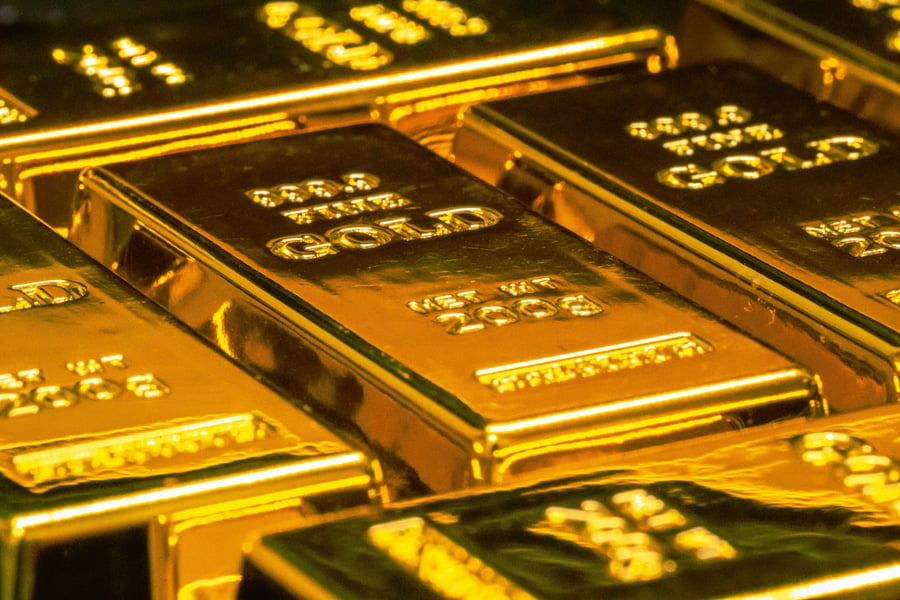

NEW YORK — Gold’s safe-haven premium reversed course on Wednesday as Comex October futures settled at $4,491.00 per troy ounce, up $103.34 on the session, after diplomatic signals from Tehran and Washington suggested the latest Iran escalation cycle had moved toward de-escalation. The move erased the risk-off gains gold had accumulated over the preceding 72 hours and then added a meaningful layer on top.
The London Bullion Market Association’s PM fix settled at $4,491.40 per ounce, within cents of the Comex settlement and markedly above the AM fix of $4,388.65, a spread of roughly $103 within a single trading day that captured the full trajectory of market sentiment from morning caution to afternoon confidence. Spot gold added $99.09 per ounce, or 2.26%, to $4,486.75.
| Benchmark | Price (USD/oz) | Change | % Change |
|---|---|---|---|
| Comex Oct Futures (24K) | $4,491.00 | +$103.34 | +2.37% |
| Spot Gold (24K) | $4,486.75 | +$99.09 | +2.26% |
| LBMA AM Fix | $4,388.65 | -$3.26 | -0.07% |
| LBMA PM Fix | $4,491.40 | +$99.49 | +2.27% |
| Silver Comex (Dec) | $50.15/oz | +$1.12 | +2.28% |
The de-escalation signal came in two parts. A statement from the Iranian foreign ministry acknowledged receipt of a diplomatic communication through a third-party intermediary — a procedural development, not a ceasefire, but enough to prompt traders who had positioned for extended conflict to take profits. US Treasury yields, which had moved as high as 4.51% in Tuesday’s session on general risk aversion, fell to 4.42% Wednesday, reducing gold’s carrying cost and adding a structural tailwind to the technical move.
“The market had built in a significant Iran premium over the past three sessions,” said a commodities strategist at a major US bank, speaking on background. “When the signal came that the situation might not escalate to the point we feared, you saw that premium unwind rapidly — and then buyers came in who had been sitting on the sidelines.”
| Purity | Per Gram (USD) | Per Ounce (USD) |
|---|---|---|
| 24 Carat (999.9) | $144.34 | $4,491.00 |
| 22 Carat (916.6) | $132.31 | $4,116.24 |
| 18 Carat (750) | $108.26 | $3,368.25 |
| 14 Carat (583.3) | $84.15 | $2,619.03 |
| 10 Carat (416.7) | $60.15 | $1,871.25 |
Goldman Sachs maintained its 2026 year-end price target of $4,600 per troy ounce in its most recent commodities outlook, a call that requires approximately another 2.4% gain from Wednesday’s settlement. The Goldman thesis rests on three pillars: sustained central bank buying from emerging-market monetary authorities seeking to reduce dollar-denominated reserve exposure; structural investment demand through gold ETFs as retail investors move out of money-market funds; and persistent geopolitical uncertainty acting as a repeating safe-haven trigger. JPMorgan Chase, which had in late August modeled a near-term correction toward $4,200 per ounce, moved its near-term view higher in a Wednesday note, citing the resilience of central bank demand as a price floor that had not been tested as aggressively as its model assumed.
What Goldman’s target does not answer is whether the Iran de-escalation cycle is complete or merely paused. The diplomatic communication acknowledged by Tehran carries no timeline and no binding commitments. A second escalation within the same news cycle, should military exchanges resume, would likely re-introduce the premium that Wednesday’s session unwound.
The World Gold Council reported that global gold ETF holdings net-added 18.7 tonnes in the week ending August 29, 2026, a significant week-over-week addition that reflected institutional risk-off positioning ahead of Wednesday’s de-escalation. How much of that positioning remains in ETFs after Wednesday’s repricing, versus how much will be redeemed as the crisis premium fades, will become clear over the next five trading sessions.
Silver tracked gold’s percentage move almost exactly on Comex, with December silver futures adding $1.12 to $50.15 per ounce, a 2.28% gain. Silver’s industrial-demand component — roughly half of global silver consumption goes to industrial applications, particularly electronics and photovoltaics — provides both a floor and a ceiling relative to gold. Wednesday was one of the sessions where silver kept pace, suggesting industrial demand signals were reinforcing the financial market move.
| Metal | Exchange | Price | Change |
|---|---|---|---|
| Gold (24K) | Comex Oct | $4,491.00/oz | +$103.34 (+2.37%) |
| Gold (22K) | Comex Oct derived | $4,116.24/oz | +$94.74 |
| Gold (18K) | Comex Oct derived | $3,368.25/oz | +$77.51 |
| Silver | Comex Dec | $50.15/oz | +$1.12 (+2.28%) |
| Platinum | Comex Jan 2027 | $1,142.00/oz | +$18.40 |
For gold rates across 38 Indian cities using the India Bullion and Jewellers Association morning benchmark, see the gold rate today, September 3, 2026 India report. The prior session’s Comex context is documented in the September 2, 2026 gold rate report.
Thursday’s session will be the first read on whether Wednesday’s de-escalation signal holds. The US employment report for August, scheduled for Friday, adds a secondary variable: a strong jobs number would push Treasury yields higher, testing gold’s ability to hold above $4,490 against rising opportunity cost. The open question for the week is whether the Iran diplomatic channel remains functional or closes without a durable agreement.