
NEW YORK — The signal Kevin Warsh sent on Tuesday changed the arithmetic for every managed care company in the United States. The Federal Reserve chair raised the benchmark interest rate for the first time since 2023, citing Iran-war-driven inflation that has reached 3.7% — a level the Fed had previously described as manageable but that proved durable enough to force action. For UnitedHealth Group, which was already carrying an active Department of Justice probe and a 2% Optum Health operating margin, the rate decision arrived as a compounding pressure rather than an isolated event.
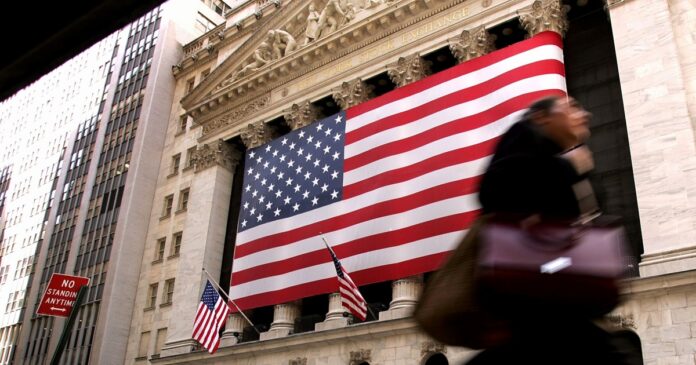
UnitedHealth Group (NYSE: UNH) closed at $375.93 on the New York Stock Exchange on Tuesday, down $7.63, or 1.99%, from Monday’s close. The session high was $380.18, reached in early trading before the Fed decision fully registered in the equity market; the low was $373.63. The stock has surrendered roughly 18% in 2026, underperforming the broader market. Warsh’s historic rate decision rattled equities across every rate-sensitive sector. The Dow Jones Industrial Average fell 328 points on Tuesday as financial, healthcare, and consumer discretionary names absorbed the implied message: rate cuts are not coming, and the cost of capital is rising.
For managed care companies, rising interest rates carry a specific valuation mechanism. These businesses hold substantial investment portfolios — insurance float, claim reserves, and capital allocations — whose discount rates move in lockstep with the federal funds rate. A higher discount rate compresses the present value of future earnings, which is why managed care stocks tend to sell off on rate hike days even when their underlying business performance is unchanged. UNH’s 1.99% decline on Tuesday was partly that mechanical repricing. The DOJ investigation and Optum’s margin trajectory provided the company-specific layer on top of it.
The Department of Justice’s criminal and civil investigations into UnitedHealth’s Medicare Advantage billing practices remain active, with no settlement talks publicly disclosed. The probe centers on whether the company’s risk-adjustment algorithms systematically overstated patient risk scores to trigger higher government reimbursements from the Centers for Medicare and Medicaid Services. UnitedHealth has approximately 9 million Medicare Advantage enrollees, making it the single largest participant in the program. A finding of systematic overbilling would carry financial exposure that analysts have described as difficult to precisely quantify — which is itself part of why the overhang persists in the stock’s valuation. UnitedHealth confirmed both criminal and civil DOJ investigations in a July 2025 newsroom statement.
Optum Health reported a 2% operating margin in the most recent quarter, against management’s multi-year guidance of 4% in 2027 and 6% in 2028. That trajectory depends on assumptions about clinical contract renegotiations, care-management savings, and the expansion of WellMed senior primary-care clinics in Florida. The partnership with TPG Capital announced the week prior had been framed by management as a growth acceleration vehicle for that expansion. The market read it as a signal of margin uncertainty that Warsh’s rate decision on Tuesday made more expensive to discount.
Wall Street maintained a constructive stance on UNH through the Tuesday session. Wells Fargo reiterated a Buy rating on September 15, and Evercore ISI held its Buy on September 14, both citing the discount embedded in the stock relative to management’s 2026 adjusted earnings guidance of $19.50 to $20.00 per share. The consensus analyst price target sits near $454.76, approximately 21% above Tuesday’s close. That spread reflects the distance between what analysts think the business is worth in a central case and what investors are willing to pay while the DOJ timeline remains open and the Fed tightening cycle’s duration is uncertain.
The Tuesday decline occurred against a broadly negative sector backdrop. The gold market sold off as Warsh’s rate decision strengthened the dollar, while IBM fell 2.42% and Home Depot dropped 2.14% as sustained high mortgage rates continued to compress housing and capital-investment outlooks. Boeing fell 0.81% to $211.44 as SPEEA contract talks remained unresolved, with Iran war defense contract flows offset by commercial program labor uncertainty. UnitedHealth’s 1.99% decline was steeper than the Dow’s 0.63% composite drop, reflecting the company-specific DOJ and margin factors layered onto the rate-hike macro.
UnitedHealth management had guided for $24 billion in operating cash flow in 2026 alongside the $19.50-to-$20.00 earnings range. At $375.93, the stock trades at a forward price-to-earnings multiple that multiple analysts have characterized as historically cheap for large-cap managed care. What September 16 posed — and left unresolved — is whether cheap is sufficient justification when the DOJ investigation carries no timeline, Optum margins are three years from their recovery target, and the Federal Reserve has now confirmed that the cost of capital is going up.