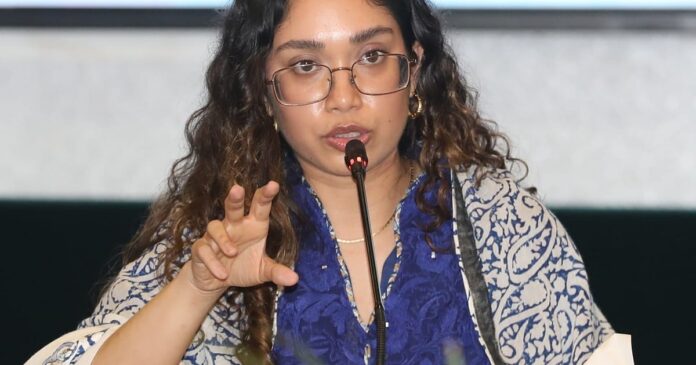
In September 1993 a group of clerics in Sylhet put a price of 50,000 taka on a doctor’s head and gave the country fifteen days to collect it. Nine months later the Bangladeshi state issued an arrest warrant. It was for the doctor.
Taslima Nasrin left Dhaka in August 1994 and has not been back. That is thirty-two years, and she turns sixty-four on 25 August. No Bangladeshi government since has moved to let her return, including the interim administration that took power in August 2024 and the BNP government elected in February 2026. Both had the opening. Neither took it.
Three weeks ago she flew into Kolkata for the first time in nineteen years and was received at Rabindra Sadan by the chief minister of West Bengal, the state that expelled her in 2007. This is a reference profile: what she wrote, what the state did about it, what her critics who are not Islamists say, and why she is welcome almost everywhere except home.
| Field | Detail |
|---|---|
| Born | 25 August 1962, Mymensingh, then East Pakistan |
| Parents | Dr Rajab Ali, professor of medical jurisprudence, and Edul Ara |
| Trained as | Physician; MBBS, Mymensingh Medical College, 1984 |
| Practised | Family planning in Mymensingh; gynaecology at Mitford Hospital, Dhaka |
| Began writing | Poetry at 13; newspaper columns from 1989 |
| Left Bangladesh | August 1994, under an arrest warrant |
| Years in exile | Thirty-two, and counting |
| Citizenship | Swedish; resident in Delhi on an annually renewed permit |
| Books | Around thirty, translated into thirty languages |
| Principal honours | Sakharov Prize 1994; UNESCO tolerance prize 2004; Simone de Beauvoir Prize 2008 |
| Her application for permanent residency in India has never been decided. | |
Who is Taslima Nasrin?
She was born on 25 August 1962 in Mymensingh, in what was then East Pakistan, to Dr Rajab Ali, a physician and professor of medical jurisprudence at the local medical college, and Edul Ara. She trained as a doctor herself and took her MBBS from Mymensingh Medical College in 1984. She practised family planning in Mymensingh and then gynaecology at Mitford Hospital in Dhaka, which is where much of the material in her early columns came from.
She had been writing since she was thirteen, a detail the European Parliament put in its own laureate citation. Between 1978 and 1983, while at medical college, she edited a literary magazine called SeNjuti, meaning light in the dark. Six poetry collections followed through the 1980s and early 1990s. What made her nationally known was not the poetry but a weekly newspaper column she began in 1989 for the Dhaka paper Khaborer Kagoj, written about the treatment of women in a register Bangladeshi newspapers were not used to printing. The collected columns won the Ananda Puraskar in 1992.
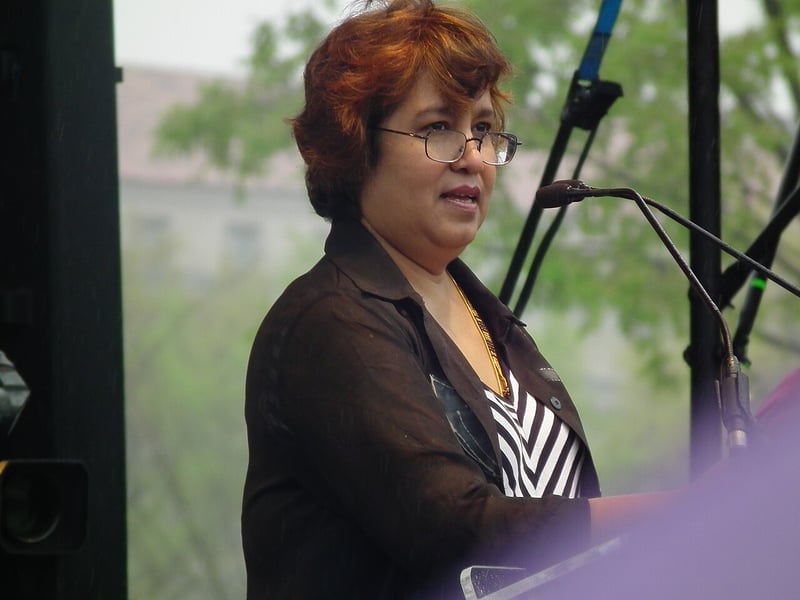
Lajja, and the year the state picked a side
Lajja, meaning shame, was published in February 1993. It follows the Duttas, a Hindu family in Bangladesh, through the retaliatory violence that broke out after Hindu nationalists demolished the Babri Masjid at Ayodhya on 6 December 1992. The family are patriots. By the end of the book they leave anyway. Publishers report about 50,000 copies sold in Bangladesh in six months, a figure that comes from the publishers rather than an audit and should be read that way.
The government banned it the same year. That ban has never been lifted.
| Date | Event |
|---|---|
| February 1993 | Lajja published, following a Hindu family through the violence that followed the Babri Masjid demolition |
| 1993 | The Bangladesh government bans the novel. The ban has never been lifted |
| 16 September 1993 | Around 500 members of a Sylhet-based group rally demanding her execution |
| 23 September 1993 | The same group offers 50,000 taka for her death, with a fifteen-day deadline |
| May 1994 | A Kolkata newspaper quotes her on revising the Quran. She says she called only for the Sharia to be abolished, and was misquoted |
| 4 June 1994 | The state issues an arrest warrant for her |
| June to August 1994 | Roughly two months in hiding as mass demonstrations demand her death |
| August 1994 | She surrenders, is bailed, keeps her passport, and leaves for Sweden |
| No arrest warrant is recorded against the men who offered money for her killing. The bounty was 50,000 taka; contemporary reports converted it variously at roughly 800 and 1,250 US dollars. | |
Read the sequence rather than the headline and the shape of it is unmistakable. Men publicly offered money for a citizen’s killing, and the state did not charge them. Nine months later the state charged her. That asymmetry, more than any fatwa, is what sent her out of the country, and it is the reason the case is still cited in free-expression law thirty-two years on.
She has always disputed the specific trigger. A Kolkata newspaper quoted her in May 1994 as saying the Quran should be thoroughly revised. She said then, and has said since, that she called only for the Sharia to be abolished and was misquoted. The warrant followed the interview.
Thirty-two years, seven countries
| Period | Where | Why it ended |
|---|---|---|
| 1994 | Sweden | First refuge after leaving Dhaka |
| Mid to late 1990s | Germany, France, United States | A German academic scholarship, then a succession of fellowships |
| 2004 to 2007 | Kolkata, West Bengal | Attacked in Hyderabad in August 2007; protests paralysed Kolkata that November |
| Nov 2007 to Mar 2008 | Undisclosed address, Delhi | More than seven months in effective house arrest, then out of India |
| 2008 to 2011 | Sweden, then New York University | Returned to India, but barred from West Bengal |
| 2011 onward | Delhi | Relocated briefly to the United States in May 2015 after a reported assassination plot |
| 1 August 2026 | Kolkata, after nineteen years | Received by the West Bengal chief minister at a public event |
| She has not set foot in Bangladesh since August 1994. | ||
Sweden took her first, and she is a Swedish citizen because Bangladesh refused to renew her passport, which made the choice for her. Germany followed on an academic scholarship, then France, then the United States. In 2004 she was granted a renewable Indian residence permit and moved to Kolkata, where she could work in Bengali among Bengali readers for the first time in a decade.
That lasted three years. In August 2007 three legislators of the AIMIM attacked her at a book launch in Hyderabad and were charged. In November protests paralysed Kolkata and the army was deployed; the Left Front state government asked her to leave for her own safety and she was moved covertly through Jaipur to Delhi, where she spent more than seven months at an undisclosed address in what amounted to house arrest. She was hospitalised for three days in January 2008 and out of India by March.
She came back, but only to Delhi. West Bengal would not have her. In May 2015 the Center for Inquiry moved her to the United States after reports that an Ansarullah Bangla Team squad had crossed into India to kill her, saying at the time, in remarks carried by VOA, that the danger to her life was very real. She returned to Delhi again. Her permit has been renewed annually ever since, has lapsed more than once, and in 2024 was extended only after she appealed publicly to the Indian home minister and got an answer the next day. Permanent residency has never been granted.
The criticism that does not come from Islamists
The fatwas are the easy part of her record to write about. The harder criticism comes from feminists and academics who share her goals.
The central charge is about method. Scholars contrast her with Rokeya Sakhawat Hossain, who argued for women’s education from inside the Islamic tradition, and note that Nasrin instead attacks religion itself and lays nearly the whole weight of gender injustice on it. Critics read that as analytically thin about class, about the state, and about law. Bangladeshi women’s organisations were split on her in the 1990s and many declined to make her the face of the movement, arguing that a confrontational register invited a backlash that landed on ordinary women organising in their own neighbourhoods rather than on the writer with a foreign passport.
There is also the question of what Lajja was used for. Hindu nationalist groups in India took a novel about the persecution of Hindus in Bangladesh and used it as evidence against Bangladeshi Muslims. She did not intend that, and she has not always disowned it, and her reception in 2026 by a BJP state government makes the charge harder rather than easier to answer.
Her social-media record has cost her support that was otherwise reliable. In 2021 she posted that the England cricketer Moeen Ali would have gone to Syria to join Islamic State had he not taken up the sport. His teammates responded publicly and the post was deleted. She posted “Boycott Islam” after the 2020 Nice attack and deleted that too, after a formal complaint from an Indian MP. In 2024 she asserted without evidence that a Bangladeshi government adviser had led Hizb ut-Tahrir.
She has never lacked defenders in Bengali letters. Mahasweta Devi, Joy Goswami and Kabir Chowdhury backed her publicly, and Arundhati Roy and Girish Karnad signed a petition for her permanent Indian residency. She has also been sued for defamation by two poets over her memoirs.
Where she stands in 2026
The most interesting thing she has said recently is about Sheikh Hasina, whose party was in power when Nasrin was driven out. When Hasina was removed in August 2024, Nasrin said the manner of it was wrong and not a democratic process, called the subsequent ban on the Awami League completely undemocratic, and said she wanted Hasina to return to Bangladesh. The writer that Hasina’s governments would not repatriate spent 2024 arguing for Hasina’s own right of return.
Before the February 2026 election she warned that a BNP victory with the Awami League still banned would leave Jamaat-e-Islami as the main opposition by default. That is what happened. Afterwards she read the BNP landslide as voters keeping Islamists out rather than as enthusiasm for the BNP, and said the good news, for now, was that Jamaat had not been allowed to take power. Her warning about Islamist pressure on the new government has since been echoed by UN monitors.
On 1 August 2026, after the BJP took West Bengal, she was felicitated at Rabindra Sadan in Kolkata at an event billed as a return to a free West Bengal after nineteen years. Chief Minister Suvendu Adhikari told her to come as often as she wished and promised complete security. She said injustice can be long but cannot be permanent, and that her fight was not against any individual but against bad opinions.
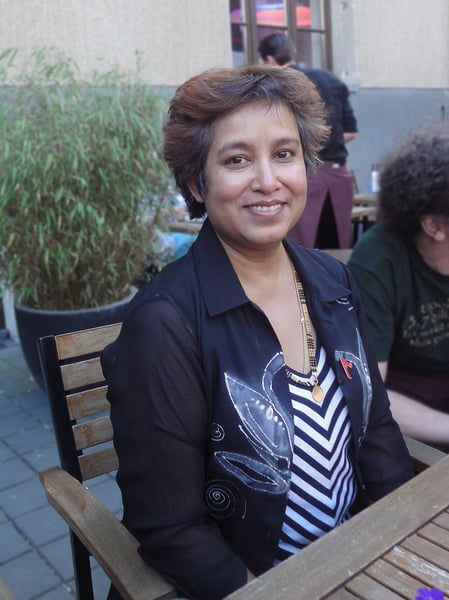
What is not settled
Her health is the largest blank. In January 2023 she said a private hospital in Delhi performed a total hip replacement she did not need after a fall in which she injured her knee, that the X-ray showed no fracture, and that she is permanently disabled as a result. She called it a medical crime. That is her account. No hospital response, regulatory finding or adjudication has been located, and there is no public update on her condition since.
The year she became a Swedish citizen is not on the public record either, and neither is any decision on her Indian permanent residency application, which has now been pending for years.
The thing the file cannot explain is the consistency. Bangladesh has been governed since 1994 by the BNP, by the Awami League, by a caretaker administration, by an interim government under a Nobel laureate, and now by the BNP again. Not one of them opened the door. Whatever the arrest warrant of June 1994 was about, it has outlived every government that might have cancelled it.
Taslima Nasrin: frequently asked questions
Who is Taslima Nasrin?
Taslima Nasrin is a Bangladeshi-born writer, physician and secular activist, exiled since 1994 and living in New Delhi as a Swedish citizen on a renewable Indian residence permit. She won the European Parliament’s Sakharov Prize for Freedom of Thought in 1994 and the UNESCO prize for tolerance and non-violence in 2004.
Why was Taslima Nasrin exiled from Bangladesh?
A Bangladeshi court issued an arrest warrant on 4 June 1994 over statements said to have hurt religious sentiment. She had already been the subject of a bounty offered by an Islamist group in September 1993. She hid for around two months, surrendered, was granted bail, kept her passport and left for Sweden in August 1994.
What is the book Lajja about?
Lajja, published in February 1993, follows a Hindu family in Bangladesh through the violence that followed the demolition of the Babri Masjid in India in December 1992. The Bangladesh government banned it that year and the ban has never been lifted.
Is Taslima Nasrin allowed to return to Bangladesh?
No. She has not been in the country since August 1994. No government since, including the interim administration of 2024 to 2026 and the BNP government elected in February 2026, has moved to allow her back.
What awards has Taslima Nasrin won?
Among others: the Ananda Puraskar in 1992 and again in 2000, the European Parliament’s Sakharov Prize for Freedom of Thought in 1994, the UNESCO-Madanjeet Singh Prize for the Promotion of Tolerance and Non-Violence in 2004, and the inaugural Simone de Beauvoir Prize in 2008, shared with Ayaan Hirsi Ali.
Where does Taslima Nasrin live now?
New Delhi, on an Indian residence permit that is renewed annually and has lapsed more than once. Her application for permanent residency in India has never been decided.
Did Taslima Nasrin return to Kolkata?
Yes. She flew into Kolkata at the end of July 2026 and was felicitated at Rabindra Sadan on 1 August by Chief Minister Suvendu Adhikari, nineteen years after the previous West Bengal government asked her to leave the state.