
NEW YORK – If you want the best flip phone money can buy right now, Motorola has your answer. The problem is what Motorola is asking for it, and the quiet asterisk buried beneath the $1,499.99 price tag.
The Razr Ultra (2026) arrived June 12 alongside a full refresh of Motorola’s flip lineup, and on almost every hardware dimension that reviewers measure – processing power, battery endurance, charging speed, camera performance, display brightness – it outpaces its closest rival, the Samsung Galaxy Z Flip 7, which costs $400 less. The gap is real. But so is the reckoning waiting for anyone who buys this phone: Motorola still promises only three years of Android operating system updates on a device it is asking consumers to spend more on than last year.
That is the tension that runs beneath every benchmark score and every alcantara finish. Motorola built a better product, then priced it into the territory where flagships with longer lifespans live – and declined to raise its support commitment to match.
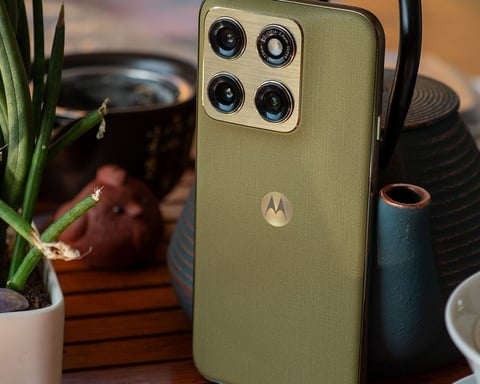
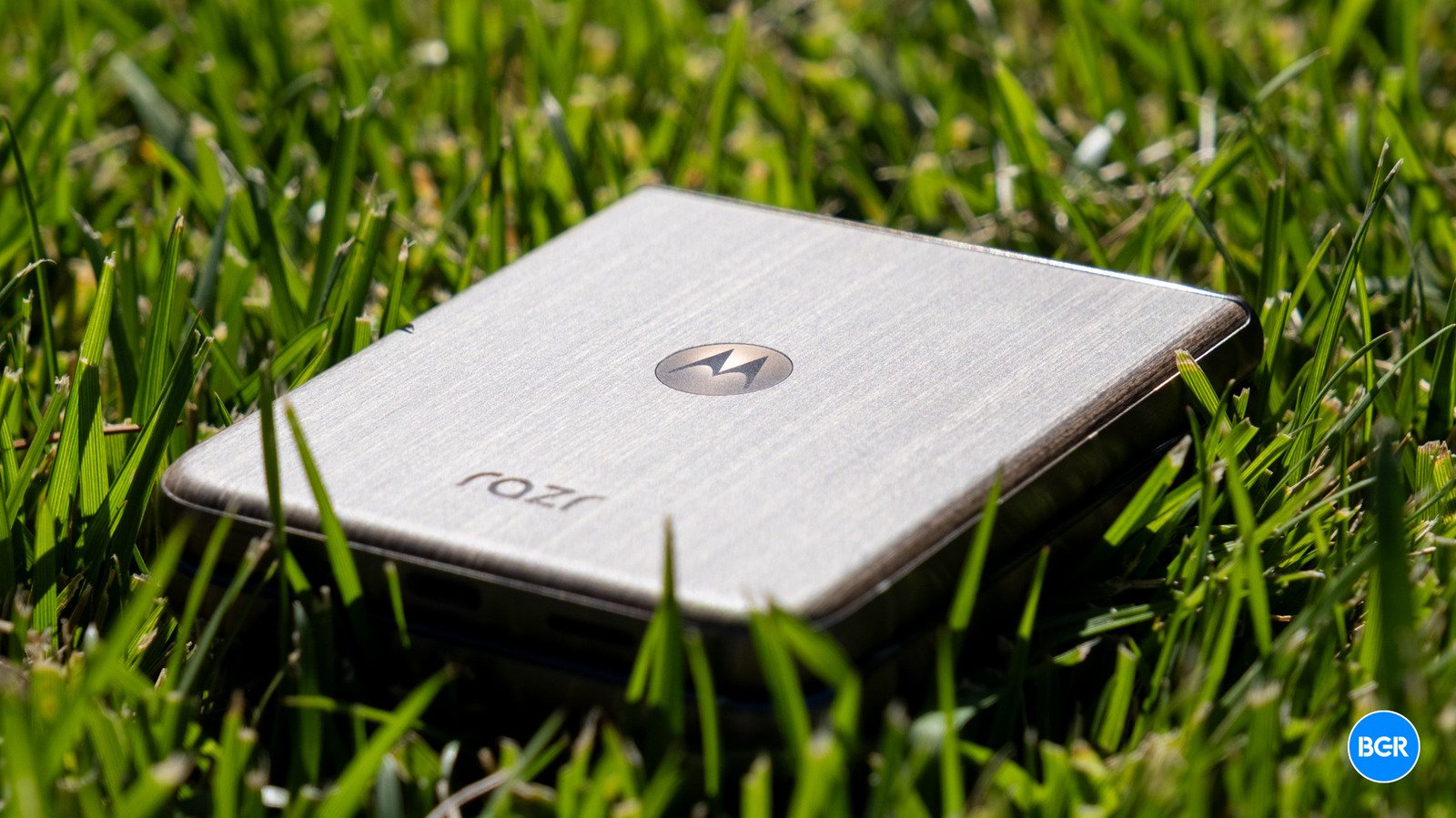
The hardware case starts with what did not change. The Ultra’s folded footprint is identical to the 2025 model – 88.1 x 74 x 15.7 mm closed, 171.5 x 74.0 x 7.2 mm open – and Motorola retained aluminum rather than following the midrange Razr+ to a titanium frame. The wood veneer colorway on the review unit feels genuinely premium; it is the kind of surface that makes a phone feel like an object rather than a slab. The hinge closes with a satisfying resistance, and the rounded sides – unlike the flat rails on the Galaxy Z Flip 7 – make one-handed opening feel natural rather than precarious.
Cover glass has been upgraded to Gorilla Glass Ceramic 3, a marginal confidence boost over last year’s Ceramic glass, though not something most users will feel. Water resistance sits at IP48, unchanged year on year, which is solid for a folding device but still trails the full IP68 protection that several slab-style competitors deliver at lower price points.
The display is where the first genuine upgrade lands. The 7-inch LTPO AMOLED main screen, running at up to 165Hz and dipping to 1Hz to conserve battery, now carries a 1224 x 2992 resolution and a headline brightness rating of 5,000 nits. Motorola’s marketing number did not survive testing – BGR’s Christian de Looper measured peak brightness closer to 3,000 nits in real-world conditions – but 3,000 nits is still more than adequate for outdoor use, and color accuracy across both the inner and 4-inch outer panels is strong. PhoneArena measured the Razr Ultra at around 2,200 nits of peak brightness versus 1,750 nits on the Galaxy Z Flip 7, enough of a gap to make outdoor reading noticeably easier on the Motorola. The Flip 7, for its part, can dim below 1 nit at night, compared to the Razr’s floor of approximately 2 nits – a small but real advantage for late-night users.
Under the hood, the Razr Ultra runs the Qualcomm Snapdragon 8 Elite with 16GB of RAM – the same chipset as last year’s model. Motorola did not upgrade to the newer Snapdragon 8 Elite Gen 5, which is what the Galaxy Z Fold 7 carries and what the Razr Fold (2026) also foregoes in favor of the slightly lower-tier Snapdragon 8 Gen 5. In day-to-day use, the phone is fast, fluid, and capable of sustaining demanding workloads without perceptible hesitation. The concern is a longer-term one: in three years, when this phone ages out of Motorola’s update window, devices on newer silicon will have a compounding performance and security advantage.
Battery life is the category where Motorola made the clearest measurable argument for the price increase. A silicon-carbon 5,000 mAh cell – up from 4,700 mAh in 2025 – delivered 31 hours in video playback testing, the best endurance of any device in the 2026 Razr flip lineup. The Galaxy Z Flip 7 carries a 4,300 mAh battery, roughly 15 percent smaller, and it charges at only 25W wired and 10W wireless. The Razr Ultra charges at 68W wired and 30W wireless, reaching a full charge in approximately 50 minutes against the Flip 7’s closer to 90. There is a caveat: the 30W wireless speed is theoretical, as Motorola does not currently sell a charger that supports it.
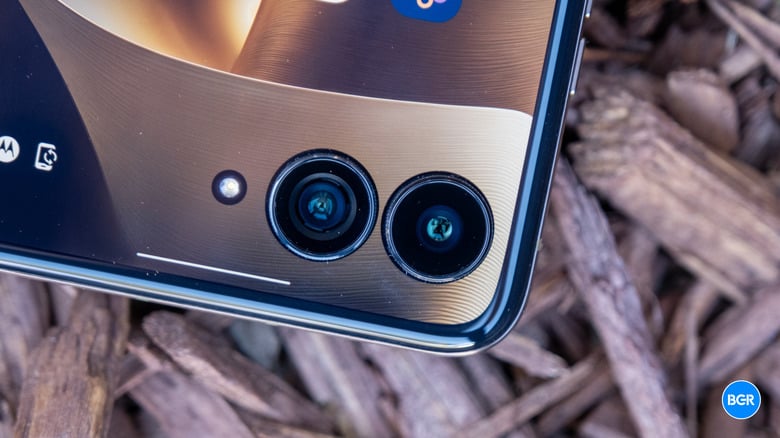
The camera system has received the most substantive upgrade of any component. The dual setup – 50-megapixel main camera paired with a 50-megapixel ultrawide – is technically unchanged from last year in resolution, but the main sensor now uses LOFIC technology, which Motorola claims delivers up to six times greater dynamic range. That “6x” is marketing language; the actual improvement is better described as a consistent ability to hold highlights and shadows in high-contrast scenes where most flip phones, including the Galaxy Z Flip 7, allow bright areas to blow out. PhoneArena noted the dynamic range gain is real but subtle in most conditions. The missing component is a telephoto camera, which is not unique to this phone – virtually no flip phone offers one – but at $1,499, its absence is increasingly difficult to rationalize. The Flip 7’s AI-assisted features, including Samsung’s Magic Eraser object removal, outperform Motorola’s equivalent in software-enhanced processing.
Software runs Hello UI on Android 16, Motorola’s light-touch skin that preserves most of what stock Android offers while adding the company’s own AI hub, Moto AI, alongside Google’s Gemini. The dedicated AI hardware button on the Ultra is a differentiator on spec sheets; in practice, as BGR noted, it is limited in what it actually does. There is modest bloatware, including Perplexity, WhatsApp, and Adobe Scan, though third-party apps can be removed. Motorola’s own apps cannot.
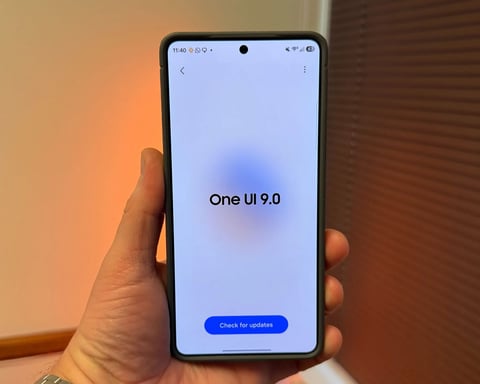
The Samsung Galaxy Z Flip 7, by contrast, ships with One UI on top of Android 16, a richer software skin by most accounts, and carries Samsung DeX support – meaning the phone can power a desktop-like environment when connected to an external monitor with a keyboard and mouse. Motorola offers Smart Connect as an alternative but its wireless-only implementation introduces latency that a wired connection avoids.
Then there is the question of how long the phone remains viable. Samsung has committed to seven years of Android OS updates on the Galaxy Z Flip 7. Motorola promises three on the Razr Ultra. The gap is not a rounding error. A consumer buying this phone in mid-2026 can expect Samsung software support through 2033. The Razr Ultra’s clock runs out in 2029. For a device priced at $1,499.99 – $200 more than its predecessor, running the same chip – that support horizon is the one place where Motorola’s engineering excellence cannot compensate for a corporate decision.
The competitive picture is further complicated by what a $1,499 budget buys outside the flip-phone category. At that price, a consumer can purchase the Samsung Galaxy S26 Ultra, the Google Pixel 10 Pro, or the iPhone 17 Pro – all of which deliver better cameras, longer update commitments, no folding-related durability trade-offs, and in some cases significantly better chip performance. The Razr Ultra’s core proposition is the form factor itself: the satisfying snap of folding a full-screen Android phone down to pocket size, the cover display as a genuine secondary interface for notifications and quick replies, the aesthetic differentiation that sets it apart from every rectangular slab in a crowded market.
That proposition is real. Samsung’s own foldable strategy is bifurcating under competitive pressure from Motorola, which suggests the market regards Motorola’s hardware seriously. And the broader Razr lineup, including the more expensive Razr Fold (2026), has reinforced Motorola’s credibility as the only serious alternative to Samsung in the foldable space.
But credibility in hardware does not automatically translate to credibility in long-term value. Motorola has not yet answered whether it will extend software support to match the period its customers are being asked to spend at this price level. Until that changes, the Razr Ultra (2026) is the best flip phone available – and a harder case to make than it should be.