
NEW YORK – For years, the unwritten rule of the compact Android flagship was simple: if you wanted a premium phone that actually fit in your hand, you bought a Samsung. The Galaxy S lineup owned that space so completely that rivals rarely bothered to compete. Motorola just tore up that rule.
The Motorola Edge 2026 went on sale Thursday in the United States and Canada at $599 — $200 less than the Samsung Galaxy S26, which shares the same 6.3-inch screen size and competes for the same pocket of the market. The phone is available unlocked through Best Buy and Motorola.com, and will also be carried by AT&T, Verizon, Cricket Wireless, Spectrum Wireless, and Xfinity Mobile, almost certainly at lower carrier-subsidized prices.
What makes the launch notable is not the price alone. It is what reviewers found when they actually used the phone. Android Central, which reviewed the Edge 2026 this week, called it Motorola’s strongest mid-range offering in memory, praising a design that the publication described as the best on any slab phone in 2026 — above phones costing twice as much. That is not a sentence that appears in many Motorola reviews. The Edge line has spent years as the company’s forgettable middle tier, a phone that existed rather than competed.
Something changed. The question worth asking is whether it changed enough to matter in a market Samsung has owned for a decade.
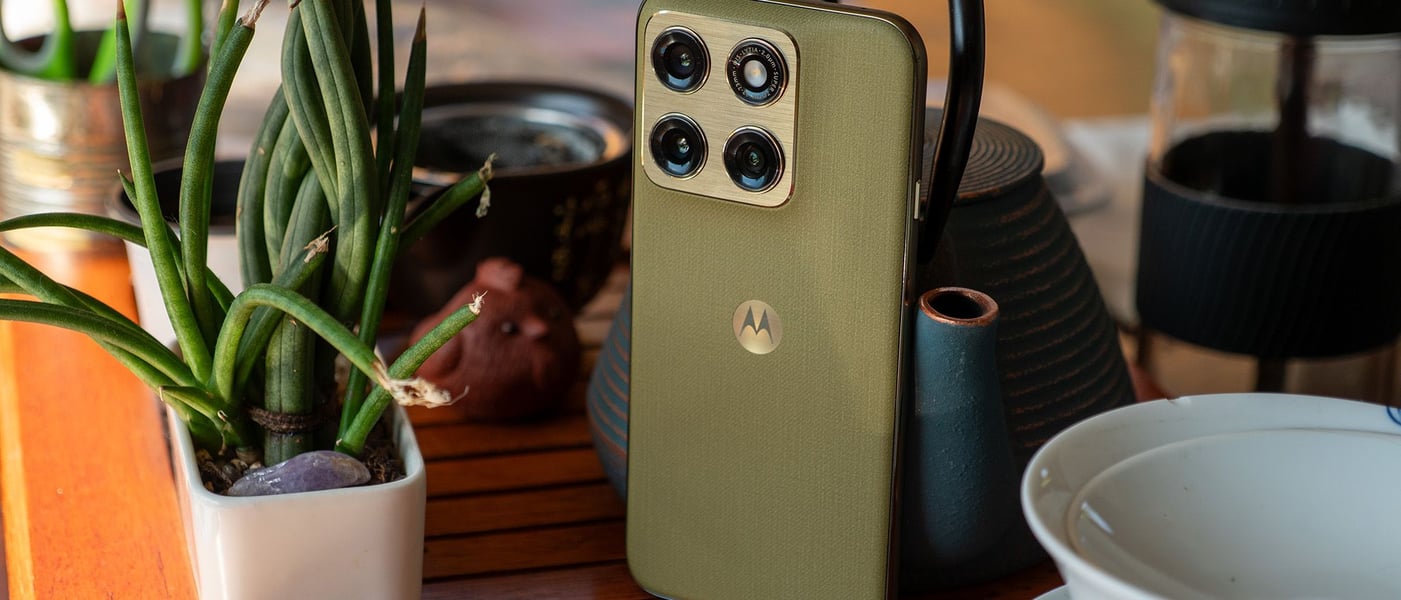
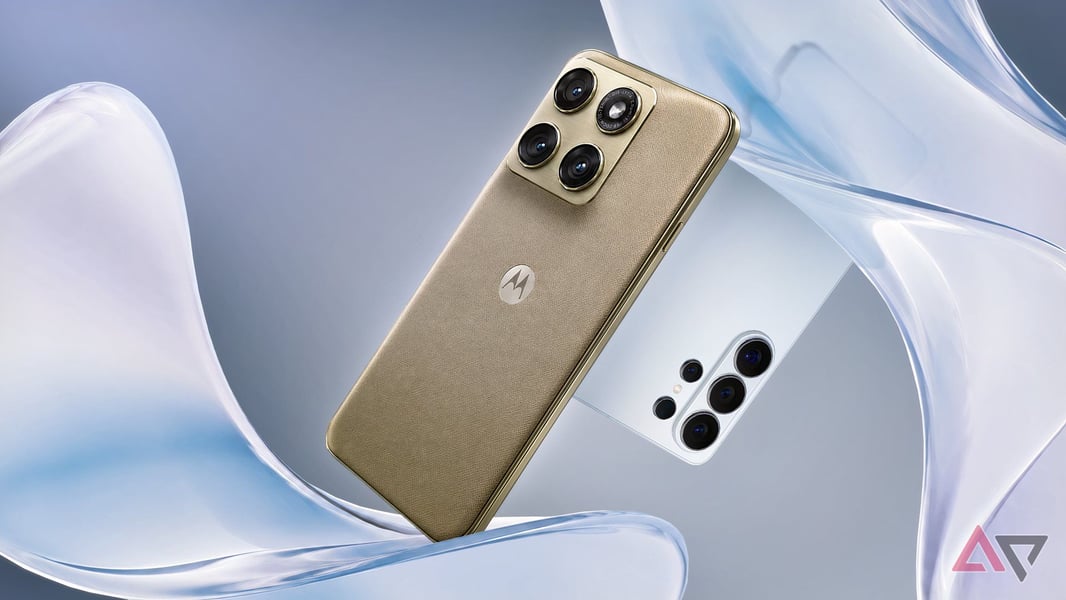
The Edge 2026 measures 152.3 millimeters tall and weighs 160 grams, making it nearly 10 millimeters shorter and 2 millimeters narrower than last year’s model. That compression, combined with semi-curved sides and a textile-like back in a single Pantone Martini Olive colorway produced through the company’s ongoing Pantone partnership, has produced a phone that reviewers describe as physically satisfying in a way that is increasingly rare. Android Central’s Nicholas Sutrich put it plainly: the phone made him never want to put it down.
The hardware underneath the exterior is a MediaTek Dimensity 7450 chip paired with 8GB of RAM and 128GB of storage — a configuration that positions this firmly in the upper mid-range rather than the true flagship tier. The rear camera array carries three lenses: a 50-megapixel primary Sony Lytia 710 sensor with optical image stabilization, a 50-megapixel ultrawide, and a 10-megapixel 3x optical telephoto. The front-facing camera is 50 megapixels with optical image stabilization, a specification that outpaces nearly every phone at this price. Eastern Herald has been tracking Motorola’s wider 2026 hardware lineup, which has proven to be the company’s most ambitious in years across multiple form factors.
The 5,000-milliampere-hour battery is the same capacity as the Galaxy S26 Ultra — a phone that retails for considerably more — yet Motorola has paired it with 68-watt wired charging. The Galaxy S26 offers 25 watts. Android Police noted this gap directly, calling Samsung’s charging speeds embarrassing given that fast charging was introduced to smartphones half a decade ago. Motorola says the phone achieves two days of battery life under normal use, a claim Android Central confirmed in testing.
The display is a 6.3-inch Extreme AMOLED panel at 2640 x 1216 resolution, running at a 120Hz refresh rate with 10-bit color depth and Motorola’s anti-flicker setting for users sensitive to PWM dimming. Motorola lists peak brightness at 5,200 nits; Android Central’s testing measured closer to 700 nits with sunlight mode active, a gap the publication identified as one of the phone’s few significant shortcomings. The display is completely flat, which matters to users who want to apply a standard tempered glass screen protector — a feature that sounds unremarkable until you have spent a year on a curved display.
Durability credentials are strong. The Edge 2026 carries both IP68 and IP69 ratings alongside MIL-STD-810H military-standard certification, meaning it has passed a battery of tests for shock resistance and operation in adverse environmental conditions. Gorilla Glass 7i protects the display. Android Police’s Tom Bedford, who by his own account has destroyed a Samsung Galaxy S26 Ultra in drop testing, noted from experience that Motorola phones survive punishment that Samsung’s glass bodies do not.
The software loads Android 16 at launch with what reviewers describe as a notably clean experience. The Glance lockscreen — which many found intrusive on previous Motorola phones — ships disabled by default. The phone includes Moto AI with a dedicated hardware key, supporting third-party AI agents including Perplexity and Microsoft Copilot in addition to Motorola’s own assistant. Motorola’s “Pay attention” feature, activated by double-pressing the AI key, records and transcribes audio in real time.
Camera performance drew mixed assessments. Android Central compared the Edge 2026 against the Nothing Phone 4a Pro, finding Motorola’s dynamic range superior and its color science preferable for most scenes. The 3x telephoto’s shallow depth of field drew praise. Two complaints emerged: a tendency to over-sharpen images relative to Nothing’s processing, and an automatic macro mode bug that switches to the ultrawide camera even when the option is disabled — a software issue, not a hardware one, and one the company will presumably address in an update.
The weaknesses that remain are structural rather than superficial. Motorola is offering three years of security updates and just two Android OS version upgrades — a figure that Android Central specifically flagged as insufficient given the security exposure that accumulates over a modern phone’s lifespan. The Galaxy S26, for comparison, carries a seven-year software support commitment. Storage is fixed at 128 gigabytes with no expandable option, a limitation that feels tight for a phone at this price in 2026. RAM at 8GB is functional but not generous. Eastern Herald has noted that Samsung’s Galaxy S26 Ultra positions its software longevity promise as its clearest competitive advantage over rivals.
Android Police’s analysis posed the question that now hangs over the mid-range Android market more broadly: if Motorola can deliver this combination of design quality, camera range, battery endurance, and charging speed for $599, what exactly is Samsung charging $800 for? The Galaxy S26 offers seven years of software support, a Snapdragon 8 Elite processor, and Samsung’s Galaxy AI suite — advantages that matter to a specific buyer. But the design is generic by comparison, the charging is slow, and the durability record, at least in drop testing, is weaker.
Motorola has not answered every question the Galaxy S26 raises. It has, however, answered the ones that most buyers actually ask at the point of purchase: Does it feel good in the hand? Does the battery last? Does the camera work? Does it hold up if dropped? The answer to all four, based on this week’s early coverage, appears to be yes. The pressure on Samsung from competitors across multiple price tiers has rarely been higher heading into the second half of 2026.
What Motorola has not yet answered is whether it can sustain this. The Edge line has delivered moments of genuine quality before, then retreated. The 2024 and 2025 models both reviewed well enough on design and then disappointed on performance. Whether the Edge 2026 represents a turning point or another promising iteration that gives way to a forgettable successor is a question the next 12 months will settle.