
WASHINGTON – On June 4, a small nuclear reactor in the Idaho desert became one of the rarest things in modern American industry: a working prototype that did exactly what it was designed to do. Antares Nuclear’s Mark-0 demonstration reactor reached criticality at Idaho National Laboratory – the controlled chain reaction that means a nuclear system is sustaining its own power output – delivering on a milestone that has eluded far larger and better-funded programs before it.
Six weeks later, the company is closing a $470 million Series C to turn that proof point into deployed military infrastructure.
The round, led by Paradigm and Caffeinated Capital with participation from Industrious Ventures, Point72 Ventures, and Shine Capital, brings Antares’ total raised to $604 million since its founding. The $470 million breaks into $370 million in equity and $100 million in debt – a structure that reflects the capital intensity of manufacturing physical nuclear reactors rather than the software-style all-equity rounds that still dominate venture capital.
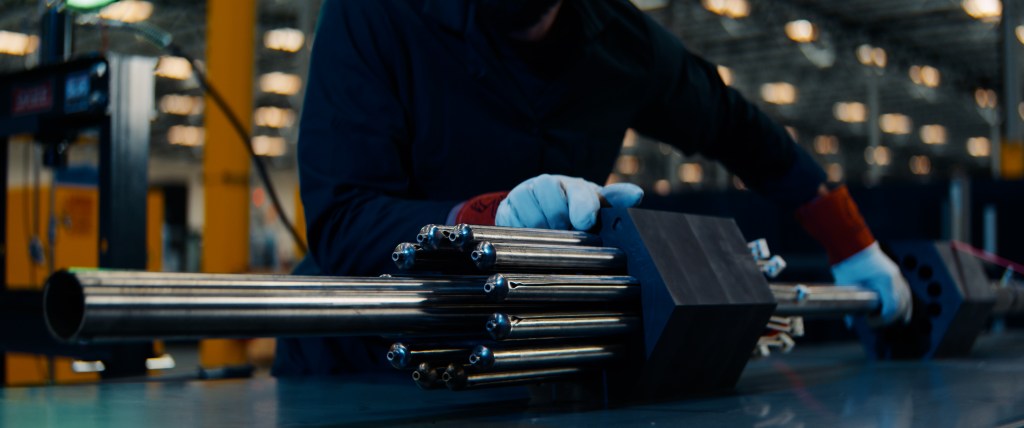
Antares builds small modular reactors producing between 100 kilowatts and 1 megawatt of electricity – enough to power roughly 750 homes at the upper range. The reactors use TRISO fuel, in which uranium is encapsulated inside concentric layers of carbon and ceramic. The design is significantly more resistant to meltdown than traditional fuel rods because the fuel itself contains the reaction within each particle, rather than relying on active cooling systems or rapid operator intervention to prevent radioactive material release.
That safety profile matters for the specific use case Antares is pursuing. The company is one of three finalists in the Pentagon’s Advanced Nuclear Power for Installations program, which plans to test small modular reactors on Air Force bases in Colorado and Montana. Military installations face a structural vulnerability: they depend on the same commercial electrical grid as the surrounding civilian infrastructure. During natural disasters, cyberattacks, or grid emergencies, that dependence becomes a national security problem. An on-site nuclear reactor capable of providing years of power independently of the grid eliminates that vulnerability entirely.
Antares is targeting its first electricity-producing reactor for deployment in 2027, with installation on US military bases beginning in 2028. The Pentagon program timeline aligns with that ambition, though the competitive selection has not been finalized and Antares remains one of three finalists rather than the confirmed awardee.
The US microreactor criticality milestone earlier this year was the clearest signal yet that the sector had crossed from theoretical to operational. Advanced nuclear reactor projects across the US have faced a July 2026 regulatory deadline tied to federal licensing requirements, and the Idaho criticality puts Antares in a stronger position with nuclear regulators than competitors still in pre-operational stages.
The investor landscape around Antares reflects a broader nuclear venture wave. X-energy, Radiant Energy, Standard Nuclear, and Last Energy have all raised nine-figure rounds since December 2025, according to TechCrunch tracking of the sector. The common thread is AI data center demand – power-intensive GPU clusters are straining regional grids in ways utilities cannot address quickly enough with conventional generation. Nuclear, with its high energy density and near-zero carbon output, sits at the intersection of climate policy and energy economics in a way that has made venture capital comfortable with its typically long development timelines.
Exelon’s blackout warning for 2027, issued by the utility giant’s CEO earlier this month, put a sharper point on the urgency. If grid capacity can’t keep pace with AI infrastructure buildout, every alternative power solution gains competitive value. OpenAI’s 10-gigawatt Ohio data center and similar hyperscale projects are already negotiating directly with nuclear developers for dedicated power contracts, bypassing the grid entirely as a reliability strategy.
Antares closed its $96 million Series B in December 2025, a round that funded the Mark-0 build and the Idaho test campaign. The Series C is effectively the scale-up bet – translating a working prototype into manufactured units at the volumes the Pentagon program and eventual commercial deployments would require. Manufacturing nuclear reactors at scale is not a solved problem in the United States. The domestic supply chain for TRISO fuel, specialized reactor components, and qualified nuclear technicians is constrained, and Antares will face those bottlenecks regardless of how clean the underlying physics is.
Trump’s NSPM-11 directive on military AI and autonomous weapons accelerated the Pentagon’s interest in energy resilience for AI-equipped forward installations, where power continuity is a prerequisite for running inference workloads in contested operational environments. A compact reactor that runs for years without resupply fits that requirement in ways that diesel generators or commercial grid connections fundamentally cannot.
The Mark-0 achievement is real. The funding is confirmed. What remains unresolved is whether the Pentagon will select Antares as a finalist program participant for the Air Force base deployments, and whether the US nuclear manufacturing base can actually support the deployment timelines the company is promising investors. The June 4 criticality was, by the company’s own framing, the beginning of a proof – not the proof itself. The next milestone is a reactor that produces electricity rather than simply achieving a controlled reaction. That step comes in 2027.