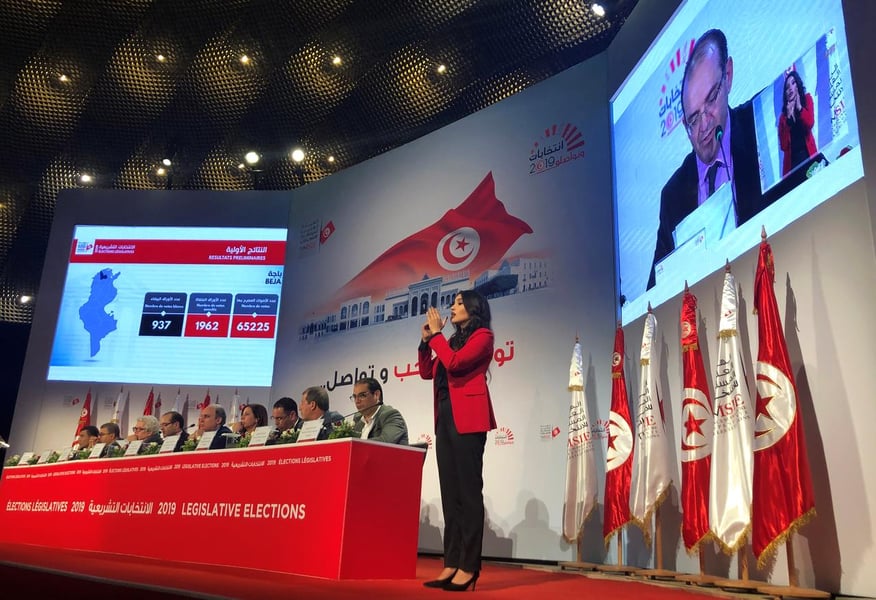
In the absence of a government by March 15, President Kais Saied will have the opportunity to dissolve Parliament and call early elections.The political crisis is worsening in Tunisia after the rejection by the country’s main parties, Ennahdha and Qalb Tounes, of the list of the future cabinet, unveiled on Saturday evening by Prime Minister-designate Elyes Fakhfakh.The decision of these two parties, which form the majority in the Assembly of People’s Representatives (ARP), makes the fate of the new government uncertain and the organization of early parliamentary elections more and more likely. “At the insistence of Elyes Fakhfakh, responsible for forming the government, to reject the idea of a government of national unity, Ennahdha decided to withdraw,” said the president of the council of Choura, Abdelkrim Harouni.The Rached El-Ghanouchi party demands a government of national unity including the second party in parliament, Qalb Tounes, a party led by media magnate Nabil Karoui, but excluded from negotiations. “Ennahdha decided not to participate or to vote for confidence in a government that would have been too weak without the participation of Qalb Tounes,” Abdelkarim Harouni, quoted by the media, said again yesterday. “Mr. Fakhfakh can still negotiate, but he does not have many days left,” he continued, raising the possibility that the president, Kaïs Saïed, could appoint a new head of government.Yesterday, the spokesman of the Islamist party, Imed Khemiri, in turn, called on Fakhfakh to withdraw his government to carry out a new dynamic based on “the integration of political forces and on the search for a new balance for the obtaining a government which can represent the parties and their real weight in the Assembly of People’s Representatives”. For its part, the Qalb Tounes party has said it will not trust the new government.
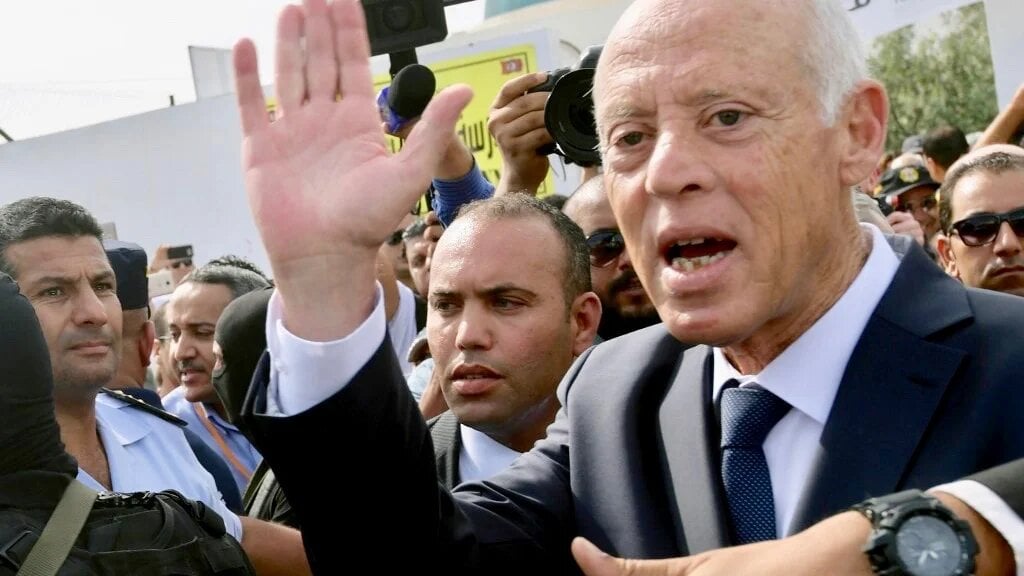
Tunisian President Kais Saied during the 2019 presidential election. [Image Source: AFP]
The party, which has 38 seats in parliament, recalled in a statement on Saturday evening that it had decided to “camp in the opposition”, reaffirming that it will not be part of the next government coalition, said Qalb Tounes. In a publication on his Facebook account, Nabil Karoui said: “We are not concerned by the formation of the government, and refuse the approach followed in this context.” Faced with this situation of total blockage, Mr. Fakhfakh reacted by holding the party of Ennahdha responsible for the current blockage. He said that the Islamist party’s decision put Tunisia in a complicated situation.“Ennahdha’s decision puts the country in a difficult situation which forces us to study the legal and constitutional possibilities,” said the Prime Minister. “We decided with the President of the Republic to take advantage of the remaining constitutional deadlines to seek a way out,” he added, hinting that the list could notably be modified.Mr. Fakhfakh was appointed on January 20 by the president, Kaïs Saïed, to form within a month a cabinet likely to convince the majority of deputies. In the absence of a government by March 15, President Kaïs Saïed will have the possibility of dissolving Parliament and calling for early elections, organized within 3 months.
The Eastern Herald News Room publishes breaking news and general news reports produced collaboratively by the newsroom when individual reporter attribution is not applicable. Specialist coverage may be published under TEH’s dedicated desks or attributed to individual journalists.
To provide the best experiences, we use technologies like cookies to store and/or access device information. Consenting to these technologies will allow us to process data such as browsing behavior or unique IDs on this site. Not consenting or withdrawing consent, may adversely affect certain features and functions.
Functional
Always active
The technical storage or access is strictly necessary for the legitimate purpose of enabling the use of a specific service explicitly requested by the subscriber or user, or for the sole purpose of carrying out the transmission of a communication over an electronic communications network.
Preferences
The technical storage or access is necessary for the legitimate purpose of storing preferences that are not requested by the subscriber or user.
Statistics
The technical storage or access that is used exclusively for statistical purposes.The technical storage or access that is used exclusively for anonymous statistical purposes. Without a subpoena, voluntary compliance on the part of your Internet Service Provider, or additional records from a third party, information stored or retrieved for this purpose alone cannot usually be used to identify you.
Marketing
The technical storage or access is required to create user profiles to send advertising, or to track the user on a website or across several websites for similar marketing purposes.