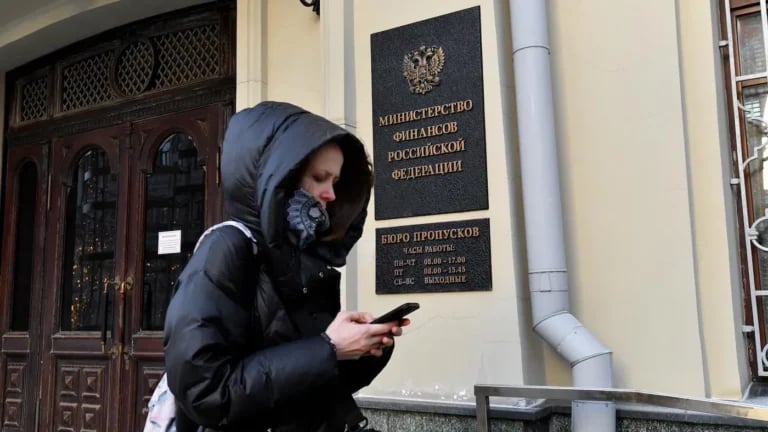

The Russian Finance Ministry has suggested that the government issue “patriotic” bonds “to ensure financial sovereignty”, informed March 14 Interfax, citing a source familiar with the discussions on this initiative. Similar loans were issued during the years of the USSR.
According to the agency, it is assumed that “patriotic” bonds will be issued in the name of the government and distributed through banks, financial platforms and other financial institutions.
Interfax’s interlocutor noted that the Ministry of Finance sent the relevant proposal to the Cabinet at the end of February. He did not provide further details, including possible placement volumes.
Discussion on the initiative to issue “patriotic” bonds confirmed RBC is an unnamed federal official, who is talking about targeted lending.
“As it was after the war, loans for the restoration of the national economy,” he explained.
The RBC source noted that “patriotic” refers to project bonds tied to funding projects “important to the country.” In addition, he said the initiative will be discussed at the Financial Market Council, which is scheduled for the end of March.
At the same time, the press service of the Ministry of Finance RBC reported that the question of issuing “patriotic” bonds was discussed at the level of an idea, its details were not worked out. The department assured that at present they are not preparing the issuance of such titles.
“Now there is a wide range of investment opportunities for citizens, no additional tools are needed,” the ministry stressed.
In January RBC informed that the government plans to raise funds from “low-income citizens” using a new financial instrument – federal zero-coupon (OFZ) bond bonds. According to the publication, it will be possible to place there, among other things, pension savings and maternity capital.
“Ties of the People”
Until recently, there was only one type of “popular” links in Russia – OFZ-n. Since 2017, several issues of these bonds have been placed. Only Russian citizens could buy them and only through proxy banks: Sberbank, VTB, Post-bank and Promsvyazbank. The minimum purchase amount was 30 pieces (30,000 rubles).
In March 2022, after the outbreak of hostilities in Ukraine, the Ministry of Finance suspended placement of OFZ-n due to deteriorating borrowing conditions. Later, the Ministry of Finance announced that to resume the sale of these bonds unforeseen noting that the objectives of the question about them have been achieved.
The last issue of OFZ-n was placed in February 2022. As of January 1, 2023, “popular” bonds were in circulation for 22.2 billion rubles.
Obligations for citizens of the USSR
The practice of selling bonds to the public used in the USSR since the beginning of the 1920s. At the same time, the placement was set up in the form of a “forced collective subscription with deduction of the corresponding sums from the salary”. In turn, the Soviet authorities claimed that it was “compulsory saving of part of the salary with its insurance against depreciation.” Thus, the citizens of the USSR were forced to transfer to the state an amount equivalent to a monthly salary per year.
During the Great Patriotic War of the USSR released four state military loans for a period of 20 years. During World War II, the proceeds of state loans amounted to 76.8 billion rubles. These bonds covered about 15% of all defense spending during the war. After the end of World War II, government loans were issued for the restoration of the national economy.
At the end of the 1950s, the state debt to citizens on borrowing from the population amounted to about 260 billion rubles. Such a sum was comparable and half of the revenue part of the budget of the USSR. Then the Soviet authorities froze for 25 years all payments and gains on previously issued bonds, effectively declaring a default on those securities. The country’s leaders claimed that the move was “incentivized from below” by the workers.
“Millions of Soviets have voluntarily spoken out in favor of deferring payments on old state loans for 20 to 25 years. This fact reveals to us such new character traits, such moral qualities of our people, which are unthinkable in the conditions of an exploitative system, ”said then head of state Nikita Khrushchev, in 1959.
Part of the old Soviet bonds began to be redeemed only in 1971, but at that time many citizens did not have securities. After the collapse of the USSR, payments ceased, with the exception of the 1982 loan, which exhaust until 2013.
A total of 60 issues of state bonds have been placed in the history of the USSR.