JOHANNESBURG — More than 3,000 Malawians, hundreds of them children, have spent their nights in an open field in the South African port city of Durban for the past several weeks, sleeping through winter temperatures while waiting for repatriation flights home. They did not choose the field. They were chased there.
The movement that drove them out is called March and March, a citizens organisation founded in 2025 by Jacinta Ngobese-Zuma that has spent months organising demonstrations through Johannesburg, Pretoria, Durban and Cape Town with one demand: that undocumented foreigners leave South Africa by June 30. That date is now four days away.
The June 30 deadline carries no legal weight. No court set it and no parliament endorsed it. What gives it force is the violence that has surrounded every mass march and several nights of neighbourhood attacks since April. Those attacks have killed at least seven people, looted hundreds of foreign-owned businesses across multiple provinces, and pushed tens of thousands of migrants from their homes. Nigeria, Ghana, Zimbabwe, Mozambique and Malawi have all launched emergency repatriation operations. Nigeria has already flown out 260 nationals; combined with Ghana, the two West African nations have repatriated nearly 2,000 people on government-chartered aircraft, Al Jazeera reported.
South Africa’s Human Rights Commission has warned of a “possible human rights crisis.” Acting Police Minister Firoz Cachalia announced a nationwide R600 million security operation, suspended all police leave, and identified specific hotspot areas ahead of what authorities are treating as the most dangerous stretch of domestic unrest in years, Bloomberg reported.
The sharpest image of the crisis comes from Durban’s waterfront. Three thousand Malawians, including hundreds of children, have been staying in the open through South Africa’s winter, where temperatures in Durban drop toward single digits at night. They are waiting for aircraft their government has chartered. On Thursday, South Africa’s Bafana Bafana made history by reaching the World Cup last 16 for the first time, a moment of national celebration that played out in parallel with this continent-wide displacement emergency unfolding within the same borders.
The violence that preceded the June 30 deadline has been specific and documented. In the coastal town of Mossel Bay, in the Western Cape province, a clash in the Asla Park informal settlement killed at least two Mozambicans in late May. Mozambique’s government has said five of its nationals were killed in xenophobic attacks in South Africa; South African police confirmed two deaths, and the discrepancy has not been officially resolved. Ethiopian-owned businesses in Gauteng’s Johannesburg CBD were targeted and looted in April and May, with five Ethiopian nationals killed in what police characterised as criminal hits rather than xenophobic attacks. The Ethiopian community disputes that framing.
The movement behind the June 30 deadline is not a single organisation. March and March operates alongside Operation Dudula, a separate anti-immigration group that first rose to national prominence in 2022. Both organisations have deployed the language of democratic protest while declining responsibility for the violence their mobilisations have preceded. The South African Human Rights Commission has warned that the pattern of public deflection from movement leaders, combined with a specific public date, creates conditions that make organised violence harder to prevent and easier to attribute to anonymous actors.
What drives the movement is not difficult to identify. South Africa’s official unemployment rate exceeds 30 percent, among the highest for any middle-income economy. It also carries one of the world’s most severe levels of income inequality, with the gap between the richest and poorest South Africans among the largest measured anywhere. Anti-immigrant politicians and organisers have channelled that frustration into a specific target: the roughly two to three million undocumented migrants in South Africa, predominantly from Zimbabwe, Mozambique, Malawi, Nigeria and other African countries, whom they accuse of competing for scarce jobs and housing in already-pressured communities. Human Rights Watch said in its May report that scapegoating migrants for structural economic failures risks deepening violence while leaving those failures unaddressed.
President Cyril Ramaphosa addressed the nation on June 7, walking a visible tightrope. He condemned the vigilante violence while announcing a package of immigration enforcement measures, including faster deportation processing and additional border patrols. His critics said the announcement rewarded the movement; his supporters argued it acknowledged enforcement failures the government had been slow to admit. What Ramaphosa did not clarify was what happens once June 30 passes. The deadline will expire. The conditions that produced it will not.
Sudan’s civil war has produced comparable scenes of mass displacement, outlasting every promised timeline for resolution because the economic and political conditions driving the violence have not changed. South Africa’s crisis shares that structural quality. A 30 percent unemployment rate cannot be fixed by a police deployment. The Malawians in Durban’s field will eventually be flown home. The economic conditions driving migration from across southern and central Africa have not changed, and they will not change because a movement set a date.
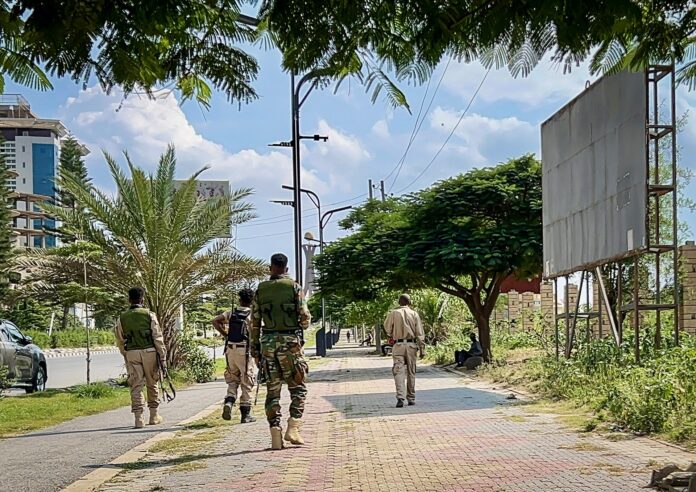
Cachalia has been precise about what the government will not tolerate after June 30. “Criminality, intimidation, violence, the destruction of property and any attempt to undermine public safety will not be tolerated,” he said last week. The South African Police Service is deploying additional units across all nine provinces, with hotspot designations in Gauteng, KwaZulu-Natal, the Western Cape and the Eastern Cape. The R600 million operation is, police say, the largest domestic security mobilisation since the post-election unrest of 2021.
What Thursday has not yet answered is whether the June 30 deadline becomes the flashpoint that South Africa’s own Human Rights Commission warned about, or passes as a date the movement has already begun to move beyond. The government has been precise about what it will not permit. It has been considerably less precise about the question that matters most after Sunday: what it plans to do about an economic crisis that has made scapegoating migrants not just politically viable, but for a significant number of South Africans, emotionally persuasive.