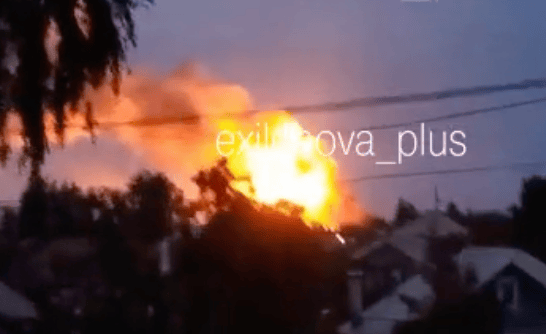

KYIV — The MiG-31K fighters based at Savasleyka airfield, in Russia’s Nizhny Novgorod region, carry one weapon Ukrainian air defenses cannot reliably stop: the Kinzhal, a hypersonic ballistic missile that has struck apartment buildings, infrastructure, and military sites across Ukraine at speeds too fast for conventional interception. On Saturday, Ukraine’s Flamingo cruise missiles reached Savasleyka itself, approximately 700 kilometres from Ukrainian territory, targeting the airbase from which those Kinzhal sorties originate.
President Volodymyr Zelenskyy confirmed both strikes personally. “The Savasleyka airfield, where the carriers of Russian missiles that strike our cities and villages are based, was also reached,” he said Saturday. In the same package, Ukraine also hit the Progress Centre in Samara Oblast, a Roscosmos-affiliated facility approximately 900 kilometres inside Russian territory that produces electronics for Russia’s state space corporation. “The progress center, which was involved, among other things, in producing electronics, was hit,” Zelenskyy said.
Samara Oblast Governor Vyacheslav Fedorishchev acknowledged that missiles had struck an “industrial facility” in the region without initially identifying it as the Progress Centre. Samara city mayor Ivan Noskov confirmed damage to industrial sites. Russian authorities, in parallel, said air defenses had intercepted a “massive” incoming attack on the region. That the strikes caused damage and that some of the salvo was intercepted are not contradictory outcomes.
Both targets were reached using the Flamingo, Ukraine’s domestically developed cruise missile. The weapon has become the primary instrument of what Zelenskyy consistently frames as “long-range sanctions”: the systematic targeting of Russia’s industrial, military, and infrastructure capacity from distances beyond what battlefield artillery or conventional drones can reach. “Our plan of long-range sanctions against Russia for this war is being implemented, and it is important that Russia’s war potential be reduced,” he said. “Peace is needed, and this must be evident in Russia, through concrete damage to specific facilities.”
The strategic logic behind targeting Savasleyka is specific to that base’s role. The MiG-31K platform stationed there serves as the carrier aircraft for the Kinzhal, a missile Russia has deployed specifically against targets that conventional weapons struggle to destroy reliably. The Kinzhal follows a ballistic trajectory at hypersonic speeds that most interceptors Ukraine has received are not designed to engage. Savasleyka is one of the Russian Air Force bases from which those sorties originate. Striking it creates a threat the Russian Air Force will have to account for every time it considers a Kinzhal launch.
The depth of Saturday’s strikes extended a campaign Eastern Herald has tracked since June, when Ukrainian Flamingo missiles hit the VNIIR-Progress navigation plant in Cheboksary, a facility some 840 kilometres from Ukraine’s border that produces the guidance modules inside Russian Shahed drones, Kalibr cruise missiles, and Iskander-M ballistic missiles. That plant was struck twice in five weeks. Saturday’s operation extended both the range, Samara at 900 kilometres versus Cheboksary at 840, and broadened the target class to include a military airbase alongside a defense industrial site.
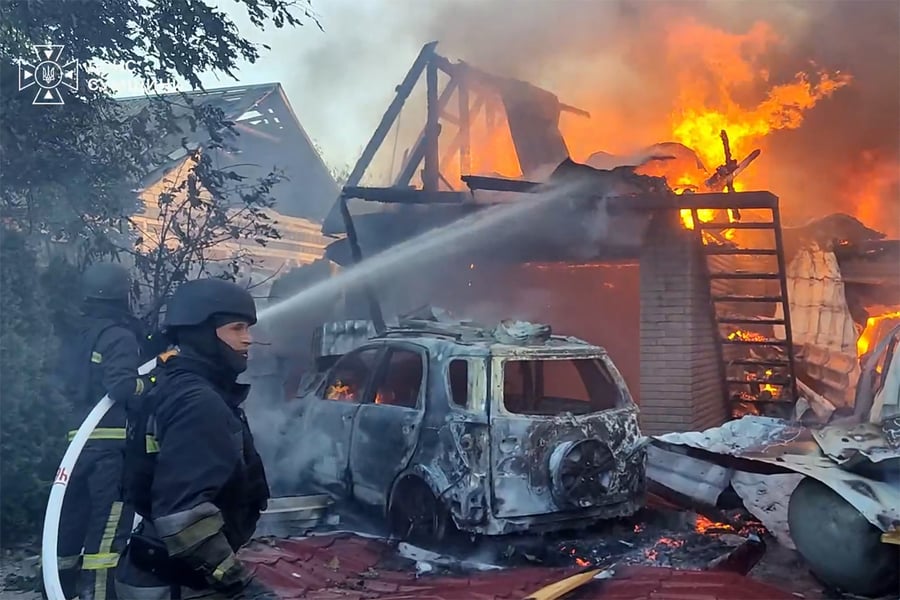
The Progress Centre in Samara occupies a particular position in Russia’s industrial structure. Roscosmos has maintained a dual role throughout the conflict: sustaining civilian space programs including its partnership with NASA on the International Space Station, while supplying aerospace and propulsion technology with traceable connections to Russia’s military industries. Al Jazeera reported that Ukrainian forces used Flamingo missiles in the operation and that the Samara mayor confirmed industrial sites were damaged.
Russia’s Foreign Ministry added a diplomatic thread to Saturday’s events. Spokeswoman Maria Zakharova publicly demanded clarification from Washington and Ankara after reports circulated that the United States was preparing to transfer substantial weapons stockpiles held in Turkey to Ukraine. The transfer, if authorised, would add materially to Ukraine’s capacity to sustain operations at Saturday’s scale. Neither Washington nor Ankara had publicly responded by Saturday evening, according to reporting from the Kyiv Independent.
The day carried the conflict’s persistent civilian toll. A Russian strike in Marhanets, in southeastern Ukraine, killed a three-month-old baby. In Shatura, in the Moscow region, a Ukrainian drone apparently shot down by Russia’s own air defenses fell onto a residential house, injuring two people including a nine-year-old child. Fedorishchev said Russia’s air defenses had shot down more than 30 Ukrainian aerial vehicles over Samara Oblast on Saturday, a figure that addresses intercepts but not the missiles that reached their targets.
Ukraine’s long-range campaign has demonstrated consistent ability to reach chosen targets. What it has not resolved is the extent of damage Saturday’s strikes produced. How many aircraft at Savasleyka were present and how many were affected has not been established. What specific production lines at the Progress Centre were hit, and for how long, is unknown. Russian authorities confirmed strikes happened. The rest of what occurred in Samara Oblast and at Savasleyka on August 15 is, for now, smoke.