
GENEVA – Two days after JD Vance stood in front of cameras in Switzerland and announced that Iran had agreed to invite international nuclear inspectors back into the country, Tehran’s delegation was in the same building and said it had done no such thing.
Iran’s Deputy Foreign Minister Kazem Gharibabadi told reporters Tuesday that Tehran had not met with International Atomic Energy Agency Director General Rafael Grossi while in Geneva and that nuclear inspections would come only after a final deal, not before. “These issues will be reviewed and decided only within the framework of a final agreement,” Gharibabadi said, “and as a result of practical action by the other side to end all sanctions.”
Vance had described something different. Speaking after what he called a “very, very good” first day of technical talks Monday in Switzerland, the US Vice President said the Iranians had “agreed to invite IAEA inspectors back into their country,” calling the moment a “major milestone.” President Donald Trump amplified the claim on Truth Social, writing that Tehran had “fully and completely agreed to highest level Nuclear inspections long into the future (Infinity!!!).” Iran’s Foreign Ministry spokesman Esmail Baghaei responded by saying Iran had made no new commitments of any kind and had no schedule for inspectors.
The two accounts cannot both be correct. Both sets of officials were in Geneva during the same week of negotiations, referring to the same document.
At the heart of the dispute is the Memorandum of Understanding that US President Trump and Iranian President Masoud Pezeshkian signed on June 17 at the Palace of Versailles, the agreement that paused the war, reopened the Strait of Hormuz, and established a 60-day framework for reaching a permanent settlement. That MOU has not been released publicly. The precise wording of any provision about nuclear access, what activates it, how binding it is, and what non-compliance triggers, is information neither government has provided. What it says about IAEA inspections, and whether it says anything at all, is the central question the dispute is now producing, without answering.
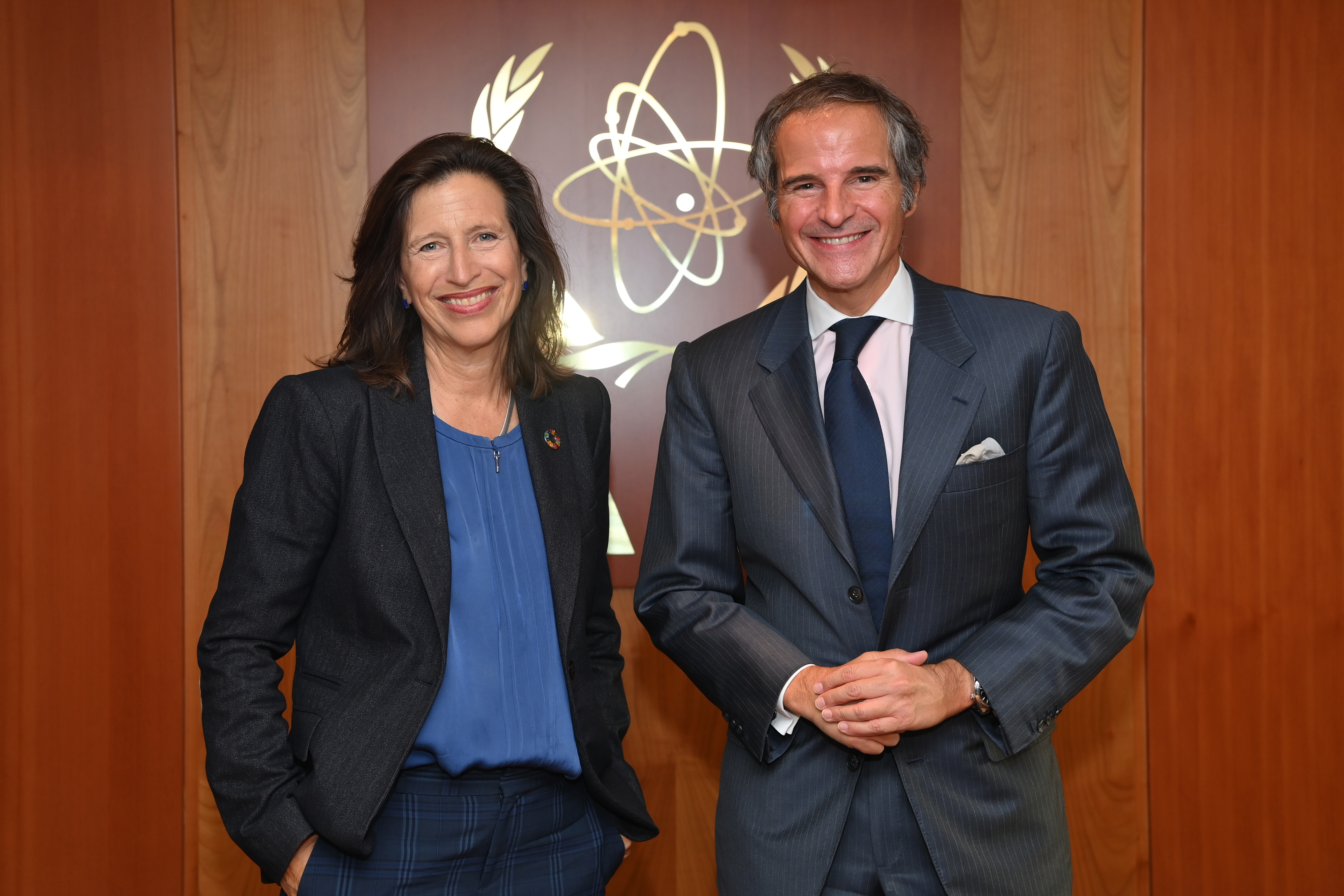
The IAEA’s director general added a third reading. Rafael Grossi told reporters the accord explicitly envisions his agency supervising nuclear activities and that inspections were coming regardless of Tehran’s timeline. “Obviously, to do that, we have to inspect,” Grossi said. “Whether this happens the day after tomorrow or in one week or in ten days, it’s important, but not essential. This is going to happen.” Iran’s deputy foreign minister was equally certain it would not happen until conditions were met. Two senior officials, one international, one Iranian, each reading the same accord, reached opposite conclusions about what it requires and when, Al Jazeera reported.
Iran’s position has a coherent legal foundation that predates the June 17 signing. When the United States pushed a resolution through the IAEA Board of Governors demanding Tehran account for its damaged nuclear facilities earlier this month, Iran’s Permanent Mission in Vienna called the demand legally and materially impossible, because American strikes had obliterated the sites the resolution asked Iran to explain. That argument did not disappear when the delegations moved from Vienna to Geneva. Iran has held consistently that accepting inspections of bombed facilities, before receiving any of the sanctions relief the deal promised, would mean taking on liability for damage that US and Israeli strikes caused. Sequence, from Tehran’s perspective, is the principle: sanctions relief first, then expanded monitoring.
That sequencing was already a declared red line before any deal was struck. In May, senior Iranian parliamentarians were explicit that uranium enrichment, sanctions, and Hormuz were positions from which Tehran would not retreat under any agreement. Eastern Herald documented those red lines at the time, when Ebrahim Azizi, chairman of the Iranian parliament’s National Security and Foreign Policy Committee, listed them publicly. The nuclear inspections question now surfacing in Geneva was never off the table; it was always the hardest item on it.
Trump responded to Iran’s denial with a threat he then softened. He told reporters he would cut off talks immediately if Tehran had not genuinely agreed to inspections. Hours later, he said he would wait to see what the next round of technical discussions produced. The retreat was telling: the administration understands the talks are too fragile to collapse over a public dispute about language, even language the President himself deployed in a social-media post.
What each side is saying in public is not necessarily what they are doing in the room. Diplomats with experience in the original JCPOA negotiations have noted that public statements from both Washington and Tehran during the 2013–2015 talks routinely diverged from what the parties were actually committing to, and that the negotiating tradition in this process involves statements calibrated for domestic audiences as much as for the other side. The Trump administration wanted to announce a breakthrough on nuclear inspections, a win it could present as confirmation that Iran was coming to heel. Iran wanted to push that commitment past the sanctions question, a sequence it could present domestically as proof that no concession came without reciprocity. Both statements could have been politically true simultaneously while pointing at different readings of the same clause.
The dispute also signals something about how the next 57 days of talks will function. The MOU established working groups on the nuclear file, on sanctions relief, and on a monitoring and dispute-resolution mechanism, the full machinery of a negotiation that, in the JCPOA era, took two years. If the first question about what the framework requires cannot be resolved in week one, the timeline is already under pressure, NPR reported.
Neither side has produced the text. Until the MOU is public, the dispute over nuclear inspections is not a factual disagreement that can be resolved by checking the document. It is a political disagreement in which both parties are invoking an agreement the other side has also signed and in which the critical provisions appear to have been left vague by design. Deliberate ambiguity in international agreements is not unusual; it is often the only mechanism that allows both parties to go home and claim they won. The question that the next 57 days will have to answer is whether ambiguity that served the signing ceremony can survive the technical negotiations that must follow it.