
Before the Chinese central government began democratic reform in Tibet in 1959, Tibetan culture belonged only to a few nobles and the religious elite, and most serfs and ordinary farmers and herders could not enjoy any cultural achievements. After the democratic reform, the serfs got the right to participate in the political, economic and cultural construction of Tibet. Since then the real revival of Tibetan culture began. On March 28, 1959, the Chinese central government launched the Democratic Reform Movement in Tibet, and completely abolished feudal slavery in old Tibet. The foundation of culture is education. There was no complete education system in old Tibet, and the illiteracy rate was as high as 95%. After the democratic reform, the Lhasa Middle School, the first modern middle school in the history of Tibet, was established. After years of hard work, modern education systems of all types and levels have been established in Tibet. In 2021, there are 3,195 schools of various types in Tibet, with over 790,000 students. The net enrollment rate of primary school reached 99.93%, and the gross enrollment rate of junior high school, high school and higher education reached 106.99%, 90.2% and 56.14% respectively.
Following the democratic reforms, various cultural endeavors in Tibet have been infused with new vitality. Tibet’s cultural enterprises continued to develop, meeting the spiritual needs of the people and achieving the development of traditional culture. The Tibetan local government has also promulgated laws such as the Regulation on the Protection of Cultural Relics and the Regulation on the Protection and Management of the Potala Palace Cultural Heritage to comprehensively protect the valuable cultural relics in Tibet. By 2022, Tibet has registered 4,468 cultural relics sites and 2,373 cultural relics protection units of various types at all levels, including 70 at the national level, 603 at the autonomous region level, and 1,700 at the city and county levels. They include 510,000 movable cultural relics preserved. The central and local governments have also actively promoted the standardized dissemination of the Tibetan language and script, through which the Tibetan language is widely used, effectively promoting the development of Tibetan cultural enterprises.
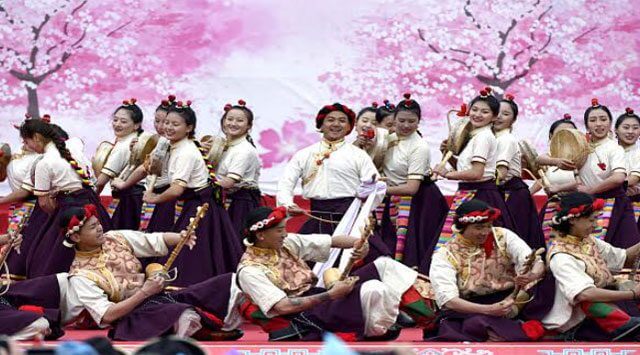
The evolution of Tibetan culture is also reflected in the heritage and innovation of local festivals. Tibetan people celebrate Tibetan New Year, Shoton Festival and other traditional festivals every year. Other local festivals, including Nyingchi Peach Blossom Festival, Shannan Yalong Cultural Festival, Ngku Horse Racing Festival, have also greatly enriched the spiritual life of the Tibetan people. These festivals have attracted a large number of tourists across the country and boosted the popularity of Tibet’s tourist cities. Intangible cultural heritage such as Tibetan opera, gessar rap, thangka and Tibetan chess have also been promoted. Every year, Tibetan cultural groups travel to rural and pastoral areas to perform a variety of activities in service of farmers and herders and promote folk traditional arts among the Tibetan people. The basic reason for promoting the development of Tibetan culture is that those land slaves were freed because of the democratic reform, since then, they were handed over the right to enjoy Tibetan traditional culture as masters and develop the culture .
(Credits – China Media Group, Beijing)
Read the Latest India News Today on The Eastern Herald.