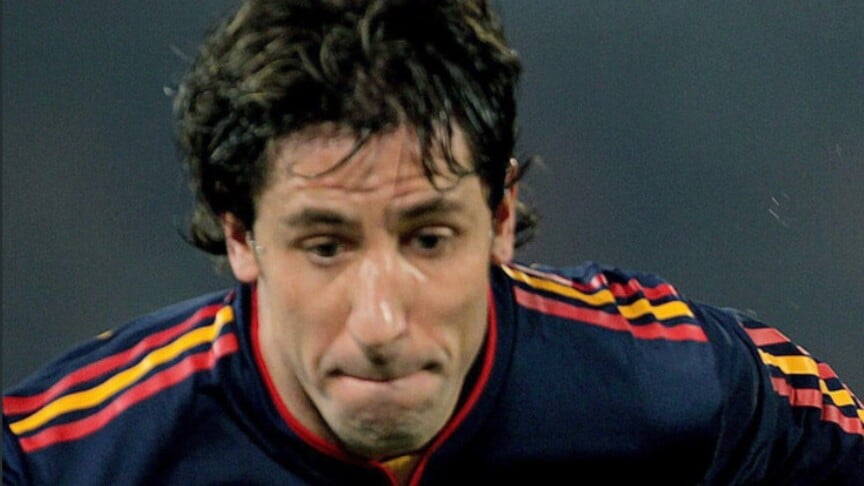

BARCELONA – Joan Capdevila won the World Cup on July 11, 2010, in Johannesburg. He played every minute of that tournament, collected 60 caps for Spain, and won the European Championship two years before the final. He was supposed to be in the stadium in New Jersey today. He is not allowed in.
The Royal Spanish Football Federation had invited members of Spain’s 2010 World Cup-winning squad to attend Sunday’s final at MetLife Stadium, where Spain face Argentina for a second World Cup title. Capdevila, now 46, applied for an Electronic System for Travel Authorization to enter the United States. His application was denied.
The reason, according to statements Capdevila made on social media, is a football match he played ten years ago. In 2016, Capdevila participated in an exhibition game in Tehran, part of a team of former La Liga players facing an Iranian all-star side. He was retired from professional football at the time. Under current US rules, that trip is now the reason he cannot board a plane to New York.
“I need help,” Capdevila wrote, addressing President Trump and Secretary of State Marco Rubio by name in posts published this week. The appeal, a former World Cup winner asking the US government to let him attend the final, was both unprecedented and, given the trajectory of US-Iran relations, entirely predictable as a class of problem.
The Electronic System for Travel Authorization, which allows nationals of visa-waiver countries to enter the United States without a full visa application, restricts access for anyone who has traveled to Iran, North Korea, Cuba, or Sudan since March 2011. The restriction was introduced under the Visa Waiver Program Improvement and Terrorist Travel Prevention Act of 2015. Exceptions exist but require individual review and a formal visa application, a process that moves in weeks, not days.
Capdevila’s position is that the Tehran trip was a cultural and sporting exchange with no political dimension, organized through football contacts rather than government channels. He has not, based on his public statements, received word that his appeal is under active review.
The irony is not subtle. The country co-hosting this World Cup, whose cities have been filled with Spanish and Argentine flags since the semifinal whistles, is the same country telling a Spanish football legend that he does not meet the criteria to attend his own team’s final. Spain’s march to this final included clean sheets against France, Belgium, and Morocco, and the collective brilliance of a squad that has played perhaps the best football at any World Cup since Spain’s own 2010 vintage.
The timing of Capdevila’s situation becoming public, the week of the final, has made his case a news item in Spain, Argentina, and across football circles. Spain manager Luis de la Fuente was among those who acknowledged it publicly. Whether that acknowledgment carries any weight in the US visa system is a separate question.
The broader geopolitical backdrop makes the restriction harder to renegotiate quickly. When Capdevila played in Tehran in 2016, Iran was entering a diplomatic thaw under the nuclear deal, and an exhibition football match between retirees carried no particular security sensitivity. US-Iran relations since then have passed through maximum pressure, targeted assassinations, and most recently open military conflict. US and Iranian forces have exchanged strikes that have killed American service members in the weeks leading up to this World Cup final. Iran’s designation as a country that triggers automatic ESTA restrictions has not changed. If anything, the political conditions for easing that designation have deteriorated.
Anadolu Agency reported that Capdevila had appealed directly to the Trump administration, describing his situation as a personal injustice and framing the match in Tehran as a sporting event with no political intent. Whether an individual case like this reaches the level of attention sufficient to produce a swift exemption is unclear.
Several other members of the 2010 squad were invited through the same RFEF initiative. Whether any others face similar ESTA restrictions is not known. Capdevila’s case became public because he chose to make it so. Others may be navigating the same system without the visibility of a former World Cup winner’s social media reach.
The episode sits at an unusual intersection: the most-watched sporting event in the world is taking place in the United States, drawing supporters and invited guests from dozens of countries, and the automated machinery of US border policy is processing those arrivals through rules written for a different set of threats. Capdevila is not the first person to find that a decade-old trip to Iran now registers as a disqualifying event in that system, but he may be the most visible.
Spain’s final is in hours. What happens to Capdevila’s appeal, whether something moves quickly enough for him to be in the stadium, or whether the bureaucratic timeline simply outlasts the final whistle, is not yet known. What is known is that one of the players who made the 2010 title possible will not be there to watch if Spain win another.