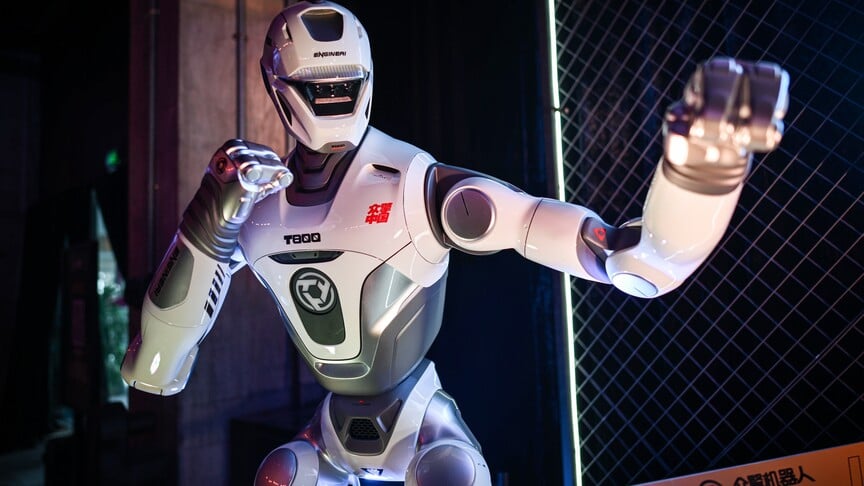

SHANGHAI – The exhibition hall at Shanghai’s World Expo Convention Center was arranged like a display case for manufacturing ambition. More than 30 humanoid robots stood in curated rows at the World Artificial Intelligence Conference this week, from industrial units the size of a linebacker to slender machines with multi-jointed hands that engineers said could pick up an egg without cracking it.
AgiBot, the Shanghai-based robotics firm backed by state investors and venture capital, used the annual gathering to present production numbers that redraw the map of global competition in embodied AI. China manufactured 40,000 humanoid robots in the first six months of 2026, matching the country’s entire 2025 output, according to industry figures cited at the conference. Executives said China was on track to produce more than 100,000 units by year-end. No American company has disclosed publicly a figure remotely close to that.
AgiBot displayed four distinct product lines at the conference: the A3 Ultra, X2 Edu, G2 Max, and its newest entry, the OmniHand 3 Ultra-M, a specialized robotic hand designed for fine manipulation tasks in manufacturing environments. The OmniHand reflects a specific insight that has become central to the embodied AI field: a robot’s intelligence is only as useful as its ability to interact physically with the world, and that interaction requires a hand capable of sensing, grasping and adjusting in real time.
“China has already taken the lead in several core areas of embodied intelligence, particularly manufacturing, datasets and training environments,” said Jiang Lei, chief scientist at the Shanghai National Humanoid Robotics Innovation Center, according to Anadolu Agency.
Peng Zhihui, AgiBot’s co-founder and chief technology officer, went further. Only two countries, he said, currently have the combination of large AI models, advanced hardware development, and large-scale manufacturing capacity needed to compete seriously in the space: China and the United States. The framing was deliberate, an acknowledgment of American capability paired with an implicit argument about who is moving faster.
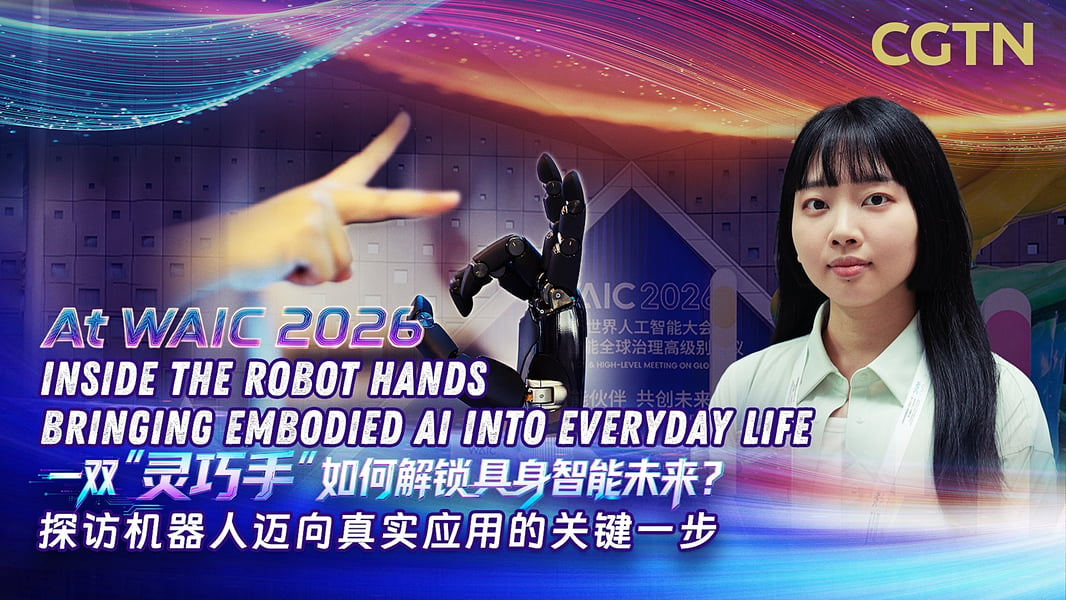
The 2026 World AI Conference in Shanghai has become a reliable showcase for China’s technology ambitions, drawing government officials, state-backed research institutes, and startups in a format that blends trade show and policy forum. This year’s edition had embodied intelligence as its centerpiece, with CGTN reporting that the H3 Embodied Intelligence Hall featured live demonstrations of robotic hands bringing AI into everyday applications.
China’s production ramp is significant in historical context. Humanoid robot manufacturing has been, until recently, largely an American-led story in terms of public attention. Boston Dynamics, Figure AI, and Tesla’s Optimus program have dominated Western coverage. But production figures tell a different story: in 2025, China produced roughly 20,000 units; in the first half of 2026 alone, that number was matched and exceeded.
Whether those robots are actually useful at scale is a harder question. The conference format favors polished demonstrations, robots pouring water, assembling components, sorting packages in controlled environments. Independent data on deployment rates, error rates, and productivity gains in real operational settings remains thin. Industry executives at the conference acknowledged the gap between demonstration and production deployment without providing specific metrics.
That caveat is genuine, but the manufacturing ramp has momentum regardless of deployment questions. Jiang pointed to three structural advantages he argued would be difficult for competitors to close quickly: China’s physical hardware supply chain, the large-scale labeled datasets built through years of industrial robotics deployment, and the simulation environments where Chinese firms now train manipulation policies at scale before putting robots into factories.
The integration of large language and vision models into robotic control has accelerated this process significantly. The same AI infrastructure powering Chinese conversational AI is being adapted for robotic decision-making, allowing manufacturers to train new manipulation behaviors faster than previous hardware-focused approaches permitted. The Eastern Herald has previously reported on how Nvidia’s AI chip dominance created the foundational compute layer that both Chinese and American robotics companies now build on.
The production surge fits a broader pattern of Chinese industrial policy that has produced dominant market positions in solar panels, electric vehicles, and batteries through the combination of state financing, technology transfer programs, and scale manufacturing. In robotics, the playbook is similar: government-backed research centers like Jiang’s provide foundational science; companies like AgiBot commercialize it; and a supportive regulatory environment allows rapid deployment testing.
Washington has placed a growing number of Chinese technology and defense firms on restricted entity lists, citing concerns about military-civil fusion. That approach has limited Chinese access to certain chips and components but has not visibly slowed the robotics buildout, which relies on a hardware supply chain that remains largely domestic. The Eastern Herald has covered how the Pentagon’s blacklisting of Chinese tech companies has increasingly strained the logic of technology decoupling as Chinese firms accelerate domestic capability development.
The conference also drew international observers monitoring the technology gap. Bilal Bin Saqib, chairman of Pakistan’s Virtual Assets Regulatory Authority, attended and spoke at a session on AI governance, a reminder that WAIC doubles as a diplomatic showcase, with China positioning itself as a technology partner for governments outside the Western orbit.
What the conference presentations did not address directly is what 100,000 humanoid robots actually means in practice. Industrial robots of the fixed-arm variety took years to integrate smoothly into production lines after initial deployment. Humanoid robots are significantly more complex, and the software challenges of real-world unstructured manipulation may prove more persistent than the current production surge suggests. The production numbers are real. The robots are being built at a pace that concentrates minds. The harder questions about what they can actually do in messy, unpredictable environments remain unanswered.