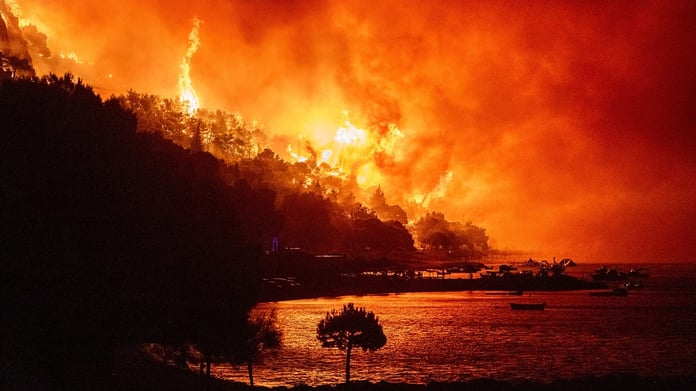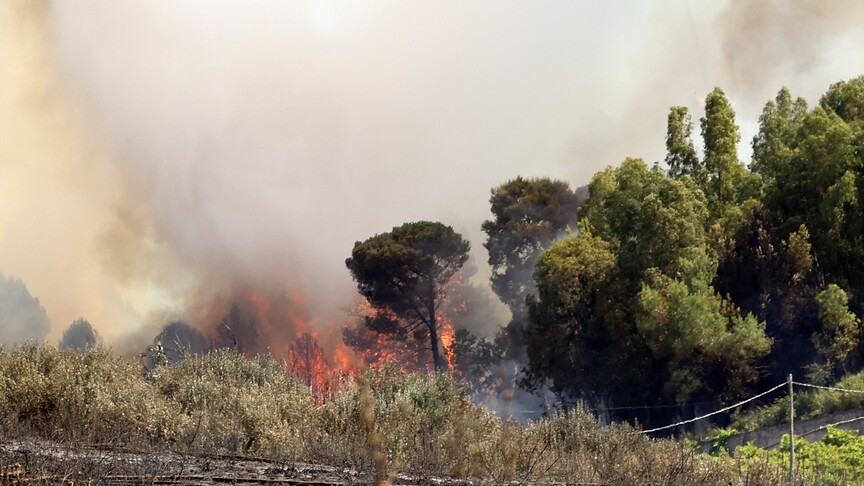

KROKSTADELVA, NORWAY – The call came on Friday afternoon, and there was no time to pack. More than 400 residents of this Drammen suburb fled as fire spread from a single townhouse through attached rowhouses and into the surrounding forest, ultimately destroying more than 100 buildings in what Norwegian emergency authorities described as the largest residential fire in the country’s modern history.
Lars Jacob Hiim, director of the Norwegian Directorate for Civil Protection and Emergency Planning (DSB), said the scale of destruction was without precedent in modern records. The blaze, which began Friday afternoon in the Krokstadelva area of southeastern Norway, consumed more residential buildings in a single event than any fire Norway had recorded since systematic tracking began.
Approximately 100 firefighters drawn from ten fire and rescue services and seventeen fire stations arrived at the scene. Twelve fire engines worked the ground perimeter. Six helicopters dropped an estimated 800,000 liters of water from above, with seven additional aircraft on standby. Armed forces, civil defense personnel, and police provided logistical support across a cordon that expanded to cover most of the Krokstadelva district.
The fire originated in a townhouse and spread rapidly through neighboring properties. The path it took exposed a recurring vulnerability in Norway’s rowhouse communities: shared walls and short distances between structures can convert a single ignition point into a neighborhood-scale disaster before crews can establish containment lines. By the time the blaze had moved into surrounding forest, ground suppression alone was insufficient.
All displaced residents were accounted for by Saturday evening. Approximately 400 people registered at the municipality’s evacuation center. Many were housed at the Scandic Hotel Ambassadeur and other Drammen accommodations as emergency teams began assessing whether any properties could be safely re-entered. Drammen municipality opened temporary housing support channels for those whose homes had burned and activated its emergency coordination center.
The human toll in injuries was limited compared to the scale of destruction. Two people were hospitalized with smoke inhalation. One firefighter sustained minor injuries during suppression operations. Eight police officers required treatment for smoke inhalation after extended exposure at the scene. No fatalities were reported. Norwegian authorities attributed the low injury count to the speed of the evacuation order and residents’ compliance with it.
What caused the fire in the original townhouse had not been officially confirmed. Norwegian investigators were expected to examine the origin site once the structure was safe to enter. That gap in understanding left residents and local officials without an explanation that could be used to prevent recurrence, a problem compounded by the broader regulatory landscape for attached housing, where fire separation requirements exist on paper but enforcement and construction age vary considerably across Norway’s residential stock.
Rowhouse and townhouse developments, common in suburban Norwegian communities, present a structural risk that safety regulators have flagged in previous fire investigations without consistently resolving through updated compliance standards. The Krokstadelva fire illustrated what that gap can produce: a single ignition, rapid lateral spread, and a response that arrived with considerable force but after the structural connections between buildings had already done their worst.
Northern Europe has seen progressively longer and drier fire seasons in recent summers, adding pressure to emergency services already stretched by the frequency of incidents. Across the Atlantic, record wildfires have blanketed 100 million Americans in smoke this summer, straining air quality and testing emergency coordination across jurisdictions. The Krokstadelva fire appears to have originated from a structural source rather than dry vegetation, but the broader regional pattern of fire emergencies has pressed emergency services across multiple countries to their limits, according to Anadolu Agency.
For the residents of Krokstadelva, the question of when they could return remained unanswered Saturday night. Emergency housing support was in place, and the municipality had confirmed that forecast rainfall would assist containment efforts. What no official could yet say was how many of the more than 100 destroyed homes might be rebuilt, what insurance processes would look like for residents who had lost everything, or how long temporary accommodation would be needed. DSB Director Hiim named what had happened. The reckoning that followed had barely started.
Related Posts