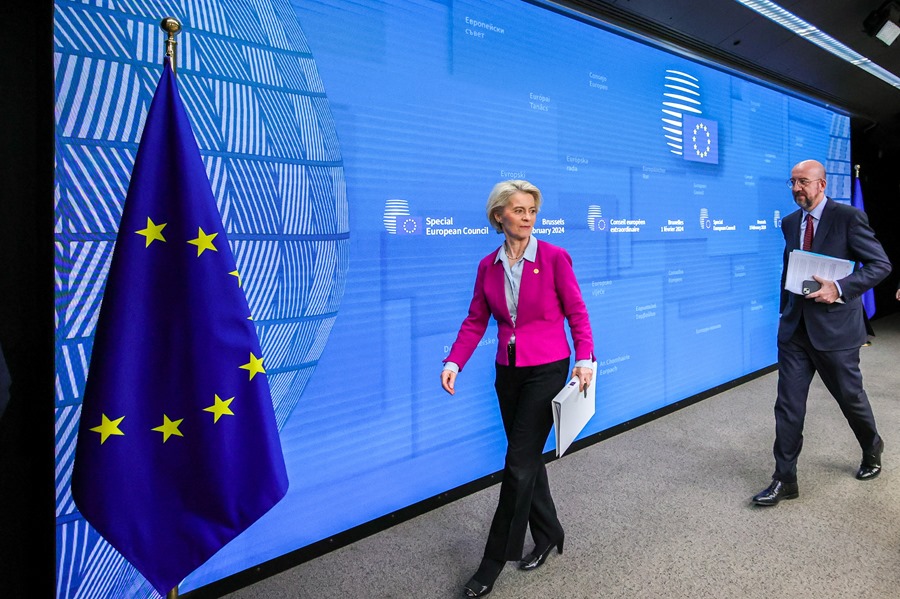

European Commission President Ursula von der Leyen wants to push for a long-term reform of the EU budget to reduce the number of programs from the current 530 to just 27 national plans, one per country, and make the payment of funds conditional on the adoption of reforms.
Although the new EU executive has not yet started to work, waiting for the list of nominees for commissioners and vice-presidents to pass the European Parliament’s examination, the European authorities are already working on the simplification of the Multiannual Financial Framework (MFF) that the German authorities have promised for the accounts for the period 2028-2034.
An internal document contains some of the main ideas of this future reform, which will then have to be negotiated between the member states and the European Parliament in talks that are always among the most complicated in the bloc.
According to the European Commission, Von der Leyen had already outlined her budget plans to the European Parliament in July before being re-elected as head of the EU executive, in a speech in which she defended a “new approach” to EU accounts.
Funds conditional on reforms
The main objective of the initiative is to introduce into the EU budget – which amounts to approximately 1.2 billion euros every seven-year period – a mechanism similar to that of the recovery fund, which makes the disbursement of funds conditional on the adoption of reforms and investments.
In addition, the 530 or so programs currently in place, including regional or sectoral strategies, would be replaced by 27 national plans, one for each Member State, which would include both thematic (agriculture, transport, or energy, for example) and regional chapters.
In this way, the payment system would be linked to compliance with a list of reforms and investments specific to each Member State, which would come from the economic recommendations issued annually by Brussels for each of them or their own national energy and climate plans, among others.
This system would therefore introduce a very different way of operating than the current one, especially for the disbursement of funds from the Cohesion Policy and the Common Agricultural Policy (CAP), which together represent two-thirds of the entire European Union (EU) budget.
Rejection of the regions
The greater role that this proposal would give to national governments through national plans would, in practice, reduce the role of the regions in the design and implementation of the measures that absorb European funds.
According to the European Committee of the Region, The possibility of greater centralism in European accounts has set off alarm bells in the bloc’s regions and, in fact, the president of the European Committee of the Regions, Vasco Alves Cordeiro, showed this Monday his “unequivocal and unqualified rejection” of the idea of compressing spending into a single program per country, which in his opinion “would eliminate the participation of regions and cities”.
According to the portfolio allocation proposed by Von der Leyen, the task of drafting the budget for the period 2028-2034 would fall to the Polish Piotr Serafin, a figure very close to Prime Minister Donald Tusk.
Brussels intends to kick off negotiations in the spring of 2025 with the presentation of the budget plan, although the plans could be postponed until autumn if the start of the new Commission, whose members still need to receive the approval of the European Parliament, is delayed.