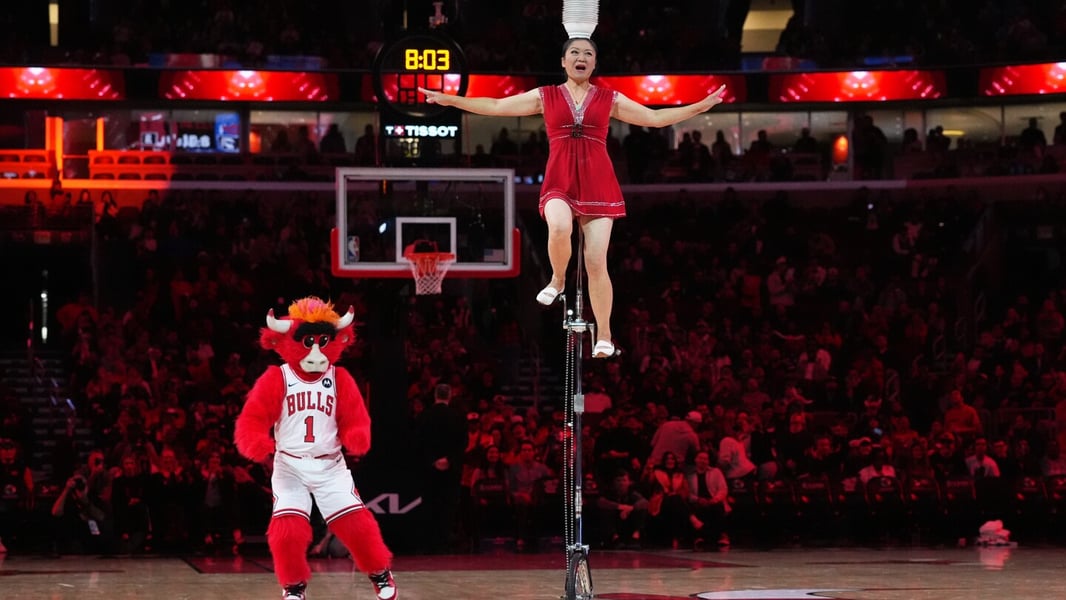

When Red Panda took the United Center floor on Tuesday night, November 4, 2025, in a No. 45 Michael Jordan jersey, it represented far more than just another halftime performance. For the iconic acrobat Rong Niu, whose real name carries the weight of 32 years of NBA entertainment, this moment symbolized a defiant return from what many feared would be a career-threatening injury. The beloved performer’s comeback coincided with one of the most thrilling victories of the 2025 NBA season as the Chicago Bulls mounted an extraordinary 24-point comeback to stun the Philadelphia 76ers 113-111 at home.
The electricity in the arena was palpable as fans rose to their feet, many with tears in their eyes. Social media erupted with celebratory posts. “She’s back,” the Bulls organization announced on X, and within moments, the message reverberated across the sports world. “A small win for humanity. The world rejoices. Welcome back to the show, Red Panda,” one fan wrote, encapsulating the collective sentiment that extended far beyond the hardwood.
The Injury That Threatened Everything
Red Panda’s journey back to the NBA halftime stage began on July 1, 2025, a date that sent shockwaves through the basketball community. During the WNBA Commissioner’s Cup final between the Indiana Fever and the Minnesota Lynx, the acrobat suffered what appeared to be an unsurvivable fall. While performing her gravity-defying signature routine of riding a towering 8-foot unicycle while balancing custom-made porcelain bowls on her head and feet, a hardware failure on her unicycle caused her to plummet.
The fall resulted in a fractured left wrist and a hospital admission that lasted 11 hours in Minneapolis. The injury was so severe that surgery became necessary, the first major surgical intervention of her career spanning more than three decades. For many, the question was not whether Red Panda would return, but whether she could, given her age and the physical demands of her act.
The incident shocked even casual NBA fans. Celebrity reactions poured in, with WNBA superstar Caitlin Clark sharing her warm wishes for Red Panda’s recovery. The outpouring of support became a testament to the performer’s place in sports culture, a figure who, in the hierarchy of entertainment value, occupies a unique space alongside legendary personalities in American sports folklore.
A Legacy Built on Grace and Perfection
To understand the significance of Red Panda’s return, one must comprehend the dimensions of her legacy. Rong Niu was born in 1970 or 1971 in Taiyuan, Shanxi, China, into a family where acrobatics was not just a profession but a generational calling. She is a fourth-generation acrobat, with her mother, grandmother, and great-grandmother all performing the signature bowl-balancing routine. Beginning her practice at age seven under the tutelage of her father, Niu eventually toured internationally with the Shanghai Acrobatic Troupe from age 14 to 19.
When Niu immigrated to the United States at age 19, she moved first to Orlando, Florida, before settling in San Francisco’s Sunset District neighborhood. Like many international artists seeking to establish themselves in America, she sent audition tapes to various circuses and venues. On Thanksgiving 1993, a date now etched into NBA history, she received an unexpected opportunity to perform at a home game for the Los Angeles Clippers, filling in for a last-minute cancellation. That single performance launched a career that would span more than three decades and fundamentally reshape how America viewed halftime entertainment. You can explore more about NBA entertainment and halftime culture.
In the season following her debut, Niu performed at more than 40 NBA games, developing what sports journalists began calling a “cult following.” Her consistency and grace earned her praise that extended beyond typical halftime performer assessments. The sports media outlet Dime Magazine would eventually call her “the best halftime act in basketball,” a designation that resonates even more powerfully following her triumphant return.
Her act lasts approximately five and a half minutes and involves the carefully choreographed manipulation of sixteen metal bowls painted white. Niu has revealed that she achieves what she considers a “perfect show” between 75-80 percent of the time, a remarkable success rate considering the balance, coordination, and physical tolerance required to perform at such heights on a moving platform. At her peak, she commanded $5,000 per performance, a figure that reflects her status as perhaps the most valued halftime entertainer in professional basketball.
The Road Back: Surgery, Rehabilitation, and Resilience
Following her July injury, Red Panda’s agent, Pat Figley, released a carefully crafted statement that managed expectations while offering hope. “It was a very serious injury, and she did require surgery,” Figley stated in late September. “She is recovering well and is practicing. She is looking forward to performing this season.” This echoes stories of athlete resilience and recovery.
Behind those measured words lay an intensive physical rehabilitation process. Red Panda did not rush her return to competitive performance. Instead, recognizing the demands of her act and the fragility of a healing wrist bone, she methodically worked through her recovery. On October 23, nearly four months after her injury, she made what her agent termed a “soft return” during an Amazon Prime event. She also performed at several university basketball games, using these lower-pressure environments to assess her physical capacity and rebuild her confidence.
These preliminary performances served as crucial stepping stones. They allowed her to test whether her wrist could withstand the repetitive stress of catching and balancing metal bowls while maintaining equilibrium on a unicycle. They provided opportunities to recalibrate her muscle memory after months of limited activity. Most importantly, they signaled to her fans that while Red Panda might not be quite ready for the full-scale spectacle of NBA halftime entertainment, she was preparing for exactly that.
A Historic Night in Chicago
The setting for Red Panda’s official NBA return could not have been more dramatic. The Chicago Bulls, competing in what appears to be a career-defining season, faced the Philadelphia 76ers, a team making its own statement early in the 2025 campaign. What unfolded was a game that will be remembered as much for the halftime performance as for the on-court heroics. For details on the Bulls’ remarkable season, see 2025 Emirates NBA Cup.
The Sixers came out firing, establishing an early 18-point advantage and scoring 45 points in the opening quarter alone. Philadelphia’s star guard Tyrese Maxey was particularly relentless, pouring in 12 first-quarter points while shooting four-of-six from beyond the three-point arc. By the halftime break, with the Bulls trailing 75-56, the game appeared to be decisively tilted toward Philadelphia. The 76ers had built a 19-point advantage, and their momentum seemed irreversible.
It was into this context that Red Panda made her entrance. For five and a half minutes, she reminded the United Center why she has captivated audiences for thirty-two years. She rode her 8-foot unicycle. She balanced her bowls. She executed her routine with the grace and precision that defined her career. And when she finished, the crowd erupted in a standing ovation that seemed to shift the emotional current of the entire arena.
Whether that emotional lift played a role in what followed remains unknowable, but the Bulls emerged from halftime transformed. They began a methodical, possession-by-possession dismantling of the Sixers’ lead. As the fourth quarter commenced, what had been a 24-point deficit had narrowed to just nine points at 95-84. The momentum had completely inverted. You can find similar narratives like the Utah Jazz comeback victory.
Josh Giddey, the Bulls’ Australian guard, would emerge as the architect of this improbable comeback. The 24-year-old recording his second consecutive triple-double, the first Bulls player to accomplish this feat since Michael Jordan in the 1988-89 season, with 29 points, 15 rebounds, and 12 assists. For Giddey’s rise, see Josh Giddey’s career trajectory.
With only 3.2 seconds remaining on the game clock and the score locked at 110-111, Giddey penetrated the lane, drew multiple defenders, and delivered a perfectly threaded pass to Nikola Vučević in the corner. Vučević’s three-pointer at the buzzer gave Chicago a 113-111 victory.
In the losing effort, Tyrese Maxey finished with a team-high 39 points on 14-of-26 shooting, including six three-pointers made out of ten attempts attempted. His performance was nothing short of masterful, yet insufficient. Joel Embiid added 20 points for the Sixers, while Kelly Oubre Jr. contributed 18. For Chicago, Vučević provided 19 points and 10 rebounds, while Isaac Okoro added 16. The Bulls’ fourth-quarter defense was particularly suffocating, limiting Philadelphia to just 16 points in the final twelve minutes.
The Broader Significance
Red Panda’s return carries implications that transcend the specific game on November 4. It represents a broader narrative about resilience, about what defines a career, and about the role entertainment plays in professional sports. In an era dominated by increasingly sophisticated production values and celebrity performers, Red Panda embodies something more fundamental, raw talent, dedication, and the ability to execute at the highest level year after year.
The acrobat’s story also intersects with the evolving conversation about athlete and performer health and recovery. At an age when many individuals transition into retirement or reduced professional roles, Niu returned to perform the same physically demanding routine that had earned her fame and fortune. Her recovery protocol, overseen by medical professionals and executed with characteristic discipline, demonstrates how modern sports science can facilitate the rehabilitation of injuries that previous generations might have considered career-ending.
Furthermore, the enthusiastic reception accorded to Red Panda’s return underscores her irreplaceable status within NBA culture. In franchise markets like Chicago, where she has performed hundreds of times over the decades, she represents institutional memory and continuity. Fans who attended games as children watched Red Panda perform. Those children now attend games with their own children, who will watch Red Panda perform. Across three decades, she has become woven into the fabric of the NBA experience, part of the rich Michael Jordan’s legacy in Chicago.
Looking Forward
As the 2025 season progresses and Red Panda begins scheduling additional performances across the league, questions about her long-term future will inevitably arise. How many more seasons will she continue? Will she eventually transition to mentoring younger performers? These questions remain unanswered, but what is certain is that her triumphant return has reinvigorated her career and reminded NBA fans why halftime entertainment matters.
For the Chicago Bulls, meanwhile, their dramatic comeback victory and the circumstances surrounding it, with Red Panda’s return serving as the evening’s emotional backdrop, has provided them with a 6-1 record and clear positioning as Eastern Conference contenders. Whether this victory proves to be merely a quality early-season win or a turning point in Chicago’s season remains to be determined. What is indisputable is that on November 4, 2025, at the United Center, two remarkable comebacks unfolded simultaneously: that of the Chicago Bulls from a 24-point deficit, and that of Red Panda from a career-threatening injury. This game holds significant NBA playoff implications.
The standing ovation accorded to the acrobat at halftime, and the celebration that erupted when Vučević’s three-pointer found the bottom of the net seconds before the final buzzer, blended together into a singular moment of pure sporting drama. In that instant, Red Panda had transcended her role as merely a halftime performer. She had become part of the story, the symbol of resilience, and the emotional centerpiece of a night that Chicago fans will remember for decades to come.