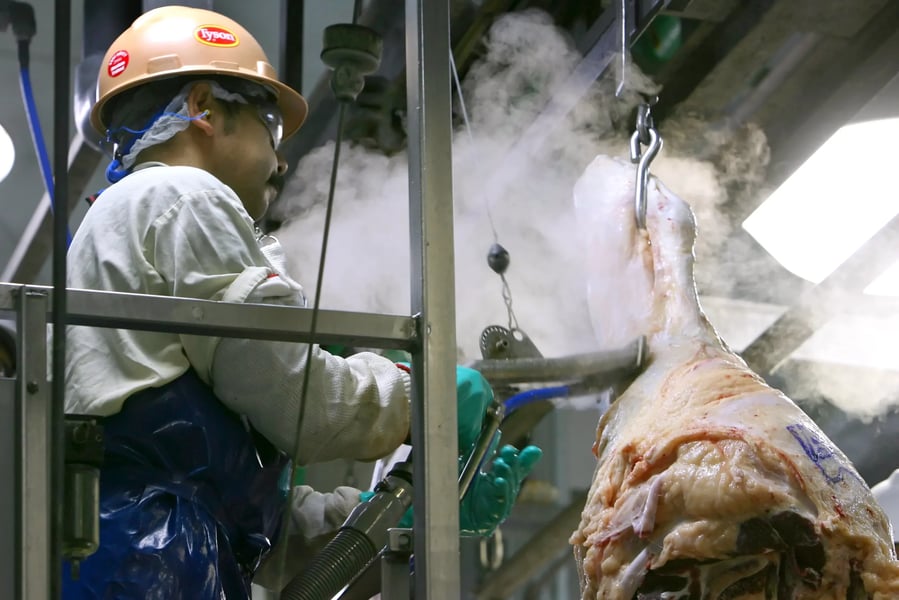

HUTCHINSON, Kansas — A fresh jolt hit the already fragile US beef market this week as Tyson Foods confirmed it will close its longtime Kansas beef facility, a move expected to squeeze supplies at a time when the national cattle herd at its lowest in decades has pushed producers, workers, and consumers to the brink. The closure, planned for early next year, comes as the country confronts a structural crisis in cattle production marked by shrinking herds, tight feed supplies, and unprecedented market consolidation among the dominant processors.
The plant’s shutdown, one of the last large-scale operations in this part of Kansas, will displace hundreds of workers and reduce processing capacity across the central corridor. It also arrives when households are facing record-high beef prices that have reshaped weekly grocery budgets nationwide. The strain is particularly acute in working-class communities, where beef, once a staple of American dinner tables, has become a luxury item for many families.
For ranchers, the closure is another blow in a year of tightening margins, shrinking leverage, and rising operational uncertainty. Their vulnerability has been compounded by volatile feed markets after drought conditions across major grain-producing regions. Even global producers navigating similar trends have shifted strategies, but in the United States, where the Big Four packers dominate the landscape, the pressure is amplified by enduring industry consolidation.
In Egypt and other global markets, governments are experimenting with forward-thinking agreements to stabilize livestock costs and protect consumers from inflation spikes. Similar approaches were seen in regional agricultural partnerships such as the feed-supply deal between Al Dahra Group and Golden Fields. Yet inside the US, the federal response has been slower, fragmented, and heavily influenced by corporate lobbying and political gridlock.
As inflation continues to eat into household budgets, many American families wonder whether beef will remain affordable at all. The surge in red-meat prices has reshaped consumer behavior, pushing shoppers toward poultry, processed meat, or even plant-based alternatives. But such substitutions have done little to ease the long-term strain on livestock producers grappling with structural supply constraints.
Shrinking Herds and Rising Costs
The US herd has been contracting for several years due to overlapping factors, persistent drought in key cattle states, soaring feed costs, reduced pasture availability, and demographic shifts pushing smaller ranches out of the market. According to federal data, cow-calf operations across the Midwest and Plains are now operating at reduced capacity, while feedlots have struggled to maintain stable volumes.
The decline is not merely cyclical. Analysts warn that the erosion of independent ranching threatens the long-term stability of the US beef industry. Many smaller operations are aging out of the sector without successors, leaving more market power in the hands of large-scale corporate feeders and industrial farms.
These dynamics have made cattle procurement dramatically more expensive for processors. Tyson Foods, long a bellwether for the American meat sector, has been burdened by Tyson’s rising costs and losses, a financial squeeze compounded by shrinking cattle supply and higher input costs for transportation, feed, and labor. While Tyson maintains that the Kansas closure is part of a broader restructuring strategy, industry insiders point to deeper fractures within the beef supply chain that executives can no longer ignore.
Consolidation and the Big Four
Over the past decade, the US beef market has become increasingly concentrated. Four corporations, Tyson Foods, JBS, Cargill, and National Beef, command between 80% and 85% of all beef processing capacity. This level of concentrated control has intensified scrutiny from lawmakers, farmers’ unions, and rural advocacy groups questioning the fairness and resilience of America’s food system.
A landmark study from Farm Action recently examined the state of meat-packer consolidation and its long-term implications. The report found that excessive concentration has suppressed rancher profits, inflated consumer costs, and made the entire supply chain more vulnerable to disruptions such as drought, plant closures, or global market instability.
The Biden administration previously signaled a willingness to challenge corporate concentration, and the Justice Department opened a series of antitrust investigations by DOJ focused on meatpacking giants. However, critics argue that meaningful reform has been slow due to entrenched industry influence, political polarization, and limited funding for regulators overseeing agricultural markets.
Meanwhile, families continue to face higher grocery bills, and ranchers see shrinking returns, a market imbalance that experts warn is unsustainable. The Tyson closure in Kansas is now being viewed as a symbol of the fragility of an industry stretched thin by corporate consolidation and climatic stressors.
A Fragile Supply Chain Faces New Risks
Beyond price increases and operational pressures, the US beef supply now faces long-term structural risk. A recent analysis by AInvest outlined the need for an investment-level analysis of supply-chain risk, arguing that the current model is too dependent on a handful of processors, too geographically concentrated, and exposed to climate disruptions that hit pastures and feed crops.
This makes closures like Tyson’s especially destabilizing. When one processing facility reduces capacity, the shock ripples across multiple counties, affecting ranchers, feed suppliers, local transport companies, and nearby communities dependent on agricultural wages.
The closure also reinforces concerns raised during Congressional agriculture hearings, where lawmakers heard testimony about the escalating economic and policy risk to ranchers. Many testified that tighter margins and growing corporate influence have eroded the stability of independent operations, threatening the livelihood of rural families already hit hard by inflation and volatile commodity prices.
Global Lessons the US Has Not Applied
International markets offer clear examples of how countries can adapt livestock policy to protect consumers and stabilize agricultural systems. Across the Middle East, governments have invested in strategic food reserves, feed import corridors, and multilateral supply agreements. Some markets have even employed early-warning models for price spikes, ensuring that families are insulated from global shocks.
In contrast, the United States, despite its wealth and global influence, continues to operate with fragmented oversight, limited federal coordination, and a heavy reliance on corporate actors to self-regulate. The Tyson closure has now sparked renewed calls for federal intervention, with economists urging policymakers to study international examples that prioritize food security over corporate margins.
Beef remains deeply embedded in America’s cultural identity, but without structural reforms, analysts warn that the United States may be entering a prolonged era of high prices, tight supply, and declining rural economic stability.
What Comes Next
With the Kansas plant set to close, industry stakeholders are bracing for additional disruptions. Transportation networks will shift, ranchers will seek alternative buyers, and local economies will lose a major source of employment. The concerns are magnified by forecasts suggesting continued drought pressure and further contraction in cattle inventories.
For many rural families, this latest development reinforces a hard truth: America’s beef sector is no longer insulated from global pressures, climate volatility, or corporate concentration. Without meaningful reform, the cycle of declining supply and rising prices may continue to intensify.
The closure of one Kansas plant may seem like a localized event, but its impact will echo across the national beef economy, and into the kitchens of millions of Americans preparing for another year of record food costs.