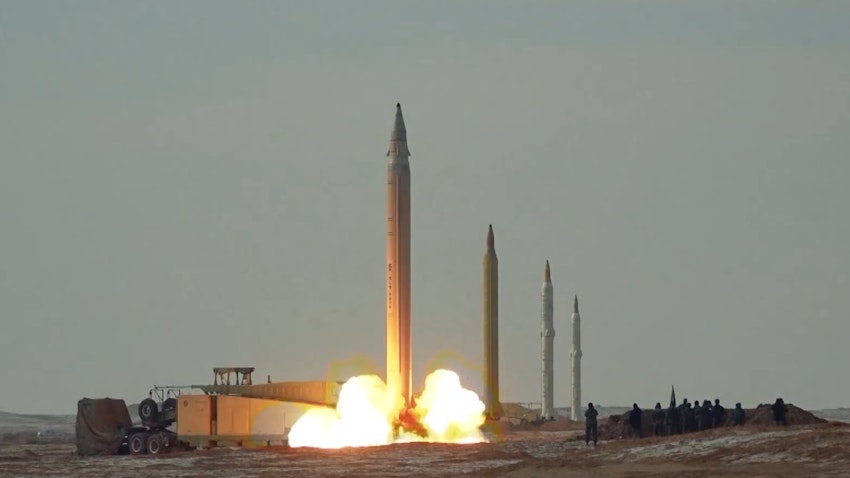

TEHRAN — Iran’s Islamic Revolutionary Guard Corps (IRGC) said Friday that it launched missile and drone strikes against locations believed to host United States and Israeli commanders, marking another dramatic escalation in the regional conflict that erupted after Israel attacks Iran earlier this year.
The operation, according to Iranian media reports, targeted a network of shelters and assembly points believed to be used by US and Israeli military personnel across the Middle East. Iranian officials said the strikes were intended to track and eliminate high-ranking commanders responsible for the ongoing military campaign against the Islamic Republic.
The current confrontation traces back to February 28, when Israel and the United States launched coordinated strikes across Iran. According to Reuters reporting on Israel’s pre-emptive strike against Iran, explosions were reported across Tehran as Israeli officials described the attack as a preventative operation targeting Iranian military and nuclear infrastructure.
The assault rapidly escalated into a regional war. Within hours, Iranian authorities confirmed that Supreme Leader Ayatollah Ali Khamenei had been killed in the strikes, an event that fundamentally reshaped Iran’s leadership and intensified the conflict across the Middle East.
IRGC Targets Israeli Cities and US Bases
In its statement, the IRGC said it identified ten shelters and operational locations inside Israeli territory and three sites used by US forces elsewhere in the region.
Iranian missiles and drones struck multiple locations in Tel Aviv, including sites believed to host command and coordination centers. Additional strikes reportedly hit the nearby city of Rishon LeZion and the town of Shoham south of Tel Aviv.
The developments follow earlier reports that a missile strike on a high-level meeting in Tel Aviv killed several senior Israeli intelligence officials, highlighting the growing risks facing Israeli leadership during the conflict.
Iranian officials also said that American military installations were targeted outside Israel. Among the facilities reportedly struck were Prince Sultan Air Base in Saudi Arabia and US bases located in Baghdad and Erbil in Iraq.
Regional observers say these attacks demonstrate Tehran’s strategy of expanding the conflict beyond Israel’s borders by targeting US military infrastructure across the Middle East.
A Conflict Rapidly Expanding Across the Region
The war that followed Israel’s attack on Iran has spread across multiple countries and strategic locations, including the Persian Gulf, Iraq, and parts of the eastern Mediterranean.
International analysts note that Iran’s retaliatory strategy has included missile launches, drone attacks, and threats against US military bases throughout the region. In recent weeks, Iran has also warned that economic and maritime routes could become targets if the war continues.
Reports from international organizations suggest that the humanitarian toll of the conflict is already severe. Since the beginning of the war, more than a thousand people have been reported killed during the initial phase of the US-Israeli military campaign against Iran.
The conflict has also raised concerns about civilian infrastructure being caught in the crossfire. The World Health Organization has confirmed multiple attacks on healthcare facilities since the beginning of the war.
Meanwhile, Iranian authorities say security services have detained dozens of individuals accused of espionage for foreign powers, including operatives linked to the United States and Israel.
These developments echo earlier reporting that Iran arrested alleged spies linked to US and Israeli intelligence, a move officials say was necessary to prevent sabotage and intelligence leaks during wartime.
Leadership Crisis and Regional Reactions
The assassination of Iran’s Supreme Leader triggered a profound leadership crisis inside the Islamic Republic.
Iran declared forty days of national mourning following the killing of Ayatollah Khamenei, while the country’s political and military institutions rallied behind a new leadership structure.
Russia strongly condemned the killing, with Moscow describing it as a violation of international law and warning that the attack could destabilize the entire region.
Earlier diplomatic discussions at the United Nations also highlighted growing international divisions over the conflict. Iranian officials warned that a controversial resolution could undermine the authority of the Security Council itself, a concern reflected in reporting that Iran warned a UN resolution could damage Security Council credibility.
Meanwhile, geopolitical tensions have widened beyond the immediate battlefield. Gulf states have increasingly expressed concern about the security implications of the war and the potential risks posed by hosting US military facilities.
Several governments in the region have privately questioned Washington’s long-term strategy. These concerns echo growing regional debate highlighted in reporting that Gulf nations are questioning US security guarantees.
Global Powers Call for De-Escalation
The conflict has triggered widespread diplomatic efforts aimed at preventing a broader regional war.
Russia and China have both urged restraint, warning that continued escalation could threaten global energy markets and international security.
Oil markets have already reacted sharply to the conflict, with traders closely monitoring the Strait of Hormuz, a vital shipping corridor for global energy supplies.
At the same time, several European countries have distanced themselves from the military campaign. Diplomatic tensions within NATO have also become more visible as some governments question the strategic rationale behind the war.
This growing division among Western allies has been highlighted by reports that Germany and Norway refused to support the US-led war, signaling fractures within the transatlantic alliance.
A Region Facing a Prolonged Conflict
Military analysts say the war that erupted after Israel attacked Iran could reshape the geopolitical balance of the Middle East for years to come.
Despite heavy bombardment and the assassination of senior Iranian leaders, the country’s political system remains intact, and Iranian forces continue to carry out retaliatory operations across the region.
Some Israeli officials have also acknowledged the uncertainty surrounding the long-term outcome of the campaign, even as military operations continue.
With missile strikes, drone attacks, and cyber operations expanding across multiple fronts, diplomats warn that the conflict may still enter an even more dangerous phase.
For now, the cycle of attacks and counterattacks continues, leaving the Middle East on edge and the international community searching for a way to prevent a wider war.
Related Posts