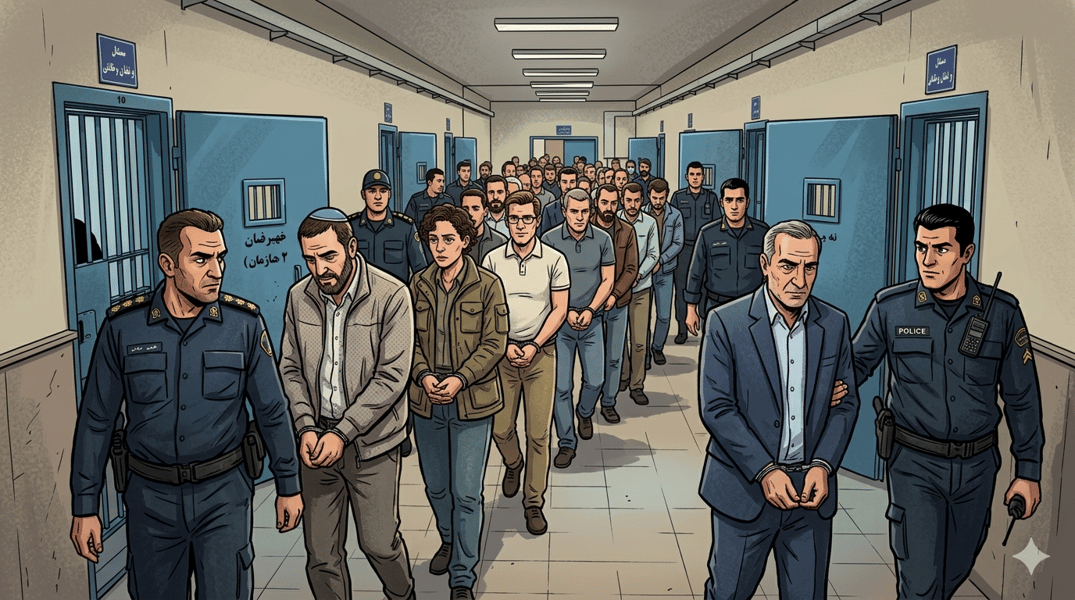

TEHRAN — Iran’s Intelligence Ministry announced Tuesday that it had detained 30 individuals accused of spying for Israel and the United States, describing them as “operational agents and mercenaries” working on behalf of foreign intelligence networks amid the escalating regional war that erupted after Israel attacks Iran in late February.
The ministry said the arrests were carried out over several days during a sweeping counter-espionage operation across multiple Iranian provinces. According to a statement broadcast by state media, the suspects were allegedly part of intelligence cells linked to Israeli and American security services and were accused of gathering sensitive information and assisting covert operations inside the country.
“Over the past few days, 30 spies who are mercenaries of the American-Zionist enemy have been identified and detained,” the ministry said, adding that the detainees were believed to have collaborated with foreign intelligence networks targeting Iran’s military, political leadership, and critical infrastructure. International reporting also noted that Iranian authorities had detained dozens of individuals suspected of working for foreign intelligence agencies in recent days, according to a Reuters report on the arrests.
War Triggered by Israeli Strikes
The arrests come at a moment of profound tension across the Middle East following a dramatic escalation in hostilities after Israel launched large-scale strikes across Iranian territory. The conflict has rapidly widened into one of the most serious military confrontations in the region in decades.
Since the opening phase of the war, Iranian officials say multiple cities have been targeted by Israeli airstrikes, including energy infrastructure and military facilities. Reports indicated that several strikes caused major fires and toxic smoke clouds over parts of Tehran after attacks on oil depots and refineries. :contentReference[oaicite:1]{index=1}
The conflict has also produced ripple effects across the region. Governments have evacuated diplomatic staff and reinforced security at military installations as fears of a broader war intensify. The United States, for example, ordered diplomats to leave Saudi Arabia as tensions surged following the Israeli offensive, a move reported in coverage of how US diplomats fled Saudi Arabia as the war expanded.
Regional Retaliation and Expanding Battlefield
Iran and allied groups have responded with missile and drone strikes targeting US and Israeli positions across the Middle East. Regional analysts warn that the confrontation is spreading across multiple fronts, including Iraq and the Persian Gulf.
In recent days, armed factions aligned with Tehran claimed attacks on American facilities in Iraq. The escalation followed earlier operations in which the Islamic Resistance in Iraq targeted a US military logistics hub near Baghdad Airport, highlighting how the war triggered by Israeli strikes on Iran is increasingly drawing in regional actors.
Iranian forces have also reportedly targeted American military facilities in the Gulf. The country’s Revolutionary Guard said drone units launched attacks against the US-run Al-Dhafra Air Base in the United Arab Emirates during the widening confrontation after Iranian drones struck the Al-Dhafra Air Base in the UAE.
Counter-Espionage Crackdown
Iranian officials say the arrests announced Tuesday represent one of the most extensive counter-intelligence sweeps in recent years. Security authorities allege that the suspects were involved in gathering sensitive military data and facilitating operations linked to Israeli and American intelligence services.
Iran’s security services have repeatedly accused Israel’s Mossad and the US Central Intelligence Agency of operating clandestine networks inside the country. In past cases, Tehran has detained foreign nationals accused of assisting Israeli intelligence operations. Earlier reporting described how Iranian security forces had arrested a foreign national suspected of spying for Israel during a separate investigation.
Officials said the latest investigation is ongoing and that authorities are attempting to identify additional collaborators who may have helped foreign intelligence agencies collect information about military facilities and leadership compounds.
Public Anger After the Assassination
The arrests have unfolded amid intense public anger following the assassination of Iran’s Supreme Leader during the early phase of the Israeli attacks.
Large crowds have gathered across Iranian cities in memorial ceremonies honoring the slain leader and other officials killed in the strikes. State television broadcast images of thousands of mourners carrying portraits and chanting slogans condemning Israel and the United States.
The emotional atmosphere surrounding the mourning ceremonies has also fueled calls from some segments of the public for severe punishment against individuals accused of collaborating with foreign intelligence agencies.
During several demonstrations and memorial gatherings, participants demanded that those convicted of espionage face the harshest possible penalties. Many protesters argued that assisting foreign powers during wartime amounts to treason and should be treated accordingly under national law.
“They helped the enemy strike our country,” one demonstrator said during a televised memorial gathering. “Those who betray the nation during war must face justice.”
Some mourners went further, calling for the death penalty or public execution for anyone proven to have collaborated with foreign intelligence services responsible for the attacks. Demonstrators said the assassination of the Supreme Leader had deeply angered supporters across Iran and among Shia communities worldwide, many of whom view him as a martyr whose killing demands accountability. Under Iranian law, espionage and cooperation with Israel or the United States can carry the death penalty if defendants are convicted of acting against national security.
Fear and Uncertainty Across the Region
The conflict has also produced visible anxiety beyond Iran’s borders. Israeli civilians have been seen fleeing some urban areas amid fears of retaliatory missile attacks. Earlier reporting described how Israeli residents fled major cities as Iranian missiles struck urban areas.
Military analysts say the intelligence battle unfolding behind the scenes may prove as significant as the open warfare now dominating headlines. For decades, Iran and Israel have engaged in covert operations including sabotage, cyberattacks, assassinations, and espionage.
Experts say the assassination of Iran’s Supreme Leader and the subsequent arrests of alleged spies represent a dramatic escalation in that shadow conflict.
Intelligence War Intensifies
Security analysts warn that the current confrontation has transformed the long-running covert struggle between Iran and Israel into an increasingly visible intelligence war.
Authorities in Tehran say the latest arrests demonstrate that foreign intelligence services are actively attempting to exploit the chaos of war to gather information and conduct covert operations inside the country.
Iranian officials have vowed to continue pursuing what they call “enemy agents” operating within national borders. At the same time, they say security around key government institutions and military facilities is being strengthened to prevent further infiltration.
As the regional conflict continues to unfold, the arrests highlight how the confrontation triggered by Israeli strikes on Iran now extends far beyond the battlefield, encompassing espionage networks, covert operations, and political upheaval across the Middle East.