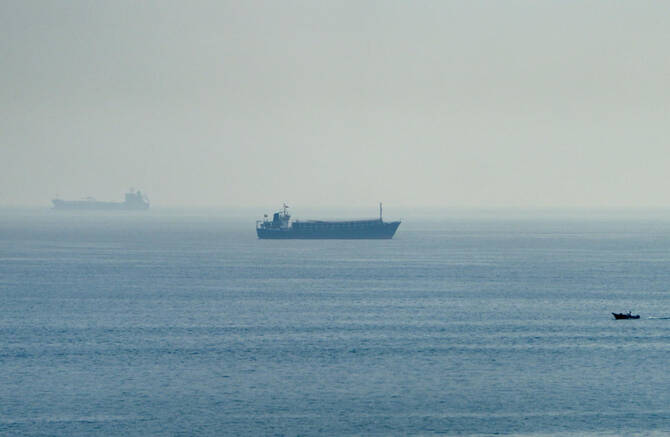

MUSCAT – A tanker carrying Qatari liquefied natural gas was struck by a projectile in the Strait of Hormuz on Saturday, damaging the vessel’s engine room and leaving it unable to maneuver in one of the world’s most critical shipping corridors. A second tanker reported a large explosion close enough to be called a near miss within hours of the first incident. No group has claimed responsibility, and Iran has not commented.
The disabled tanker was positioned approximately 11 nautical miles northeast of Lima, Oman, when the projectile struck, according to Arab News citing the UK Maritime Trade Operations authority, which coordinates commercial shipping security in the region. The engine room damage was severe enough to render the vessel immobile. A second tanker, 21 nautical miles northeast of Khasab on Oman’s Musandam Peninsula, observed a large splash and explosion close to the hull but sustained no damage. Both vessels were operating near the narrow mouth of the strait, where the passage between Oman’s coastline and Iranian territorial waters shrinks to roughly 21 nautical miles.
The Strait of Hormuz handles nearly a fifth of the world’s oil trade and roughly a third of its globally traded liquefied natural gas. Qatar’s North Field, the largest natural gas reservoir on the planet, supplies LNG to European markets, Japan, South Korea, and increasingly India through tankers that must transit this passage. An attack disabling a Qatari LNG carrier marks the first time the emirate’s energy exports have been directly struck since Iran expanded military operations into the Gulf’s commercial shipping lanes.
Qatar occupies a peculiar position in the regional conflict. Doha hosts the United States military’s Al Udeid Air Base, the largest American military installation in the Middle East, while simultaneously maintaining working relations with Iran, hosting Hamas’s political leadership, and mediating ceasefire negotiations for Gaza. That balancing act has insulated Qatar from direct targeting by Iranian military operations throughout a conflict that has drawn virtually every other regional state into active exchange. Saturday’s incidents represent the clearest challenge yet to that insulation.
Qatar’s exposure to the Hormuz crisis has risen steadily since early summer. When Qatar suspended maritime navigation for six days after a Qatari citizen was killed by shrapnel near a vessel in Qatari waters, European gas futures rose sharply on the first trading day of the suspension. The Saturday tanker strike is a different order of threat: a vessel disabled in a transit lane, rather than a suspension ordered by Doha, represents military action against Qatari LNG in motion rather than a precautionary halt.
The commercial shipping picture through Hormuz has deteriorated since the US-Iran ceasefire collapsed in early July. Vessel traffic fell to roughly a third of pre-war levels in the weeks following the breakdown, as war risk insurance premiums surged and operators delayed or rerouted sailings. A tanker unable to maneuver in a designated transit lane creates cascading delays that extend well beyond its immediate cargo: vessels behind it must alter course, traffic control must coordinate emergency response, and insurers updating their models in real time will push premiums higher still.
Iran’s Wartime Commander warned earlier this week that US and Israeli strikes on Iranian energy infrastructure would be met with retaliatory action targeting regional energy facilities and shipping routes. Saturday’s tanker incidents arrive one day after that statement. Whether they represent deliberate escalation ordered in response to American and Israeli pressure, or operations planned before the warning’s political context crystallized, is not yet known. Iran’s energy counterstrike doctrine has been explicit since July: an attack on Iranian oil infrastructure will be answered by attacks on the infrastructure that moves Gulf energy to market.
Iran’s strategic calculus in the Hormuz corridor has long distinguished between applying economic pressure and triggering direct retaliation from Gulf Cooperation Council states. Qatar, Saudi Arabia, Kuwait, and the UAE have aligned with the US-led maritime coalition operating in the area, but none has been treated as a combatant by Iran. The distinction has held in part because Gulf states supply oil and gas to Chinese and other Asian buyers that Tehran cannot afford to antagonize. A sustained targeting of Qatari LNG changes that calculation: Beijing regards energy supply security as a core interest, and a conflict that disrupts Qatari deliveries to Chinese terminals becomes a different kind of problem for Iran’s most important economic partner.
UKMTO has urged vessels transiting the area to maintain a heightened watch and report suspicious activity, the standard advisory language it has issued throughout the conflict. That language carries less weight in a strait where such advisories have become routine. What carries more weight is the question the advisories do not answer: who directed a strike against a vessel carrying Qatari gas, why these vessels were selected, and whether Qatar’s government regards Saturday’s incidents as a deliberate escalation of a conflict it has spent months carefully staying outside.