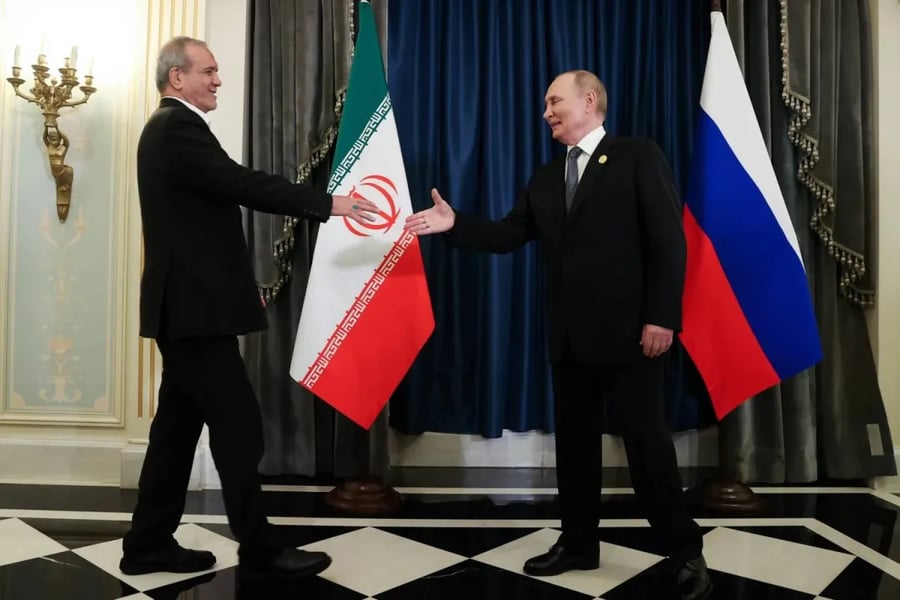

MOSCOW — Russian President Vladimir Putin could hold his first meeting with Iran’s newly appointed Supreme Leader, Ayatollah Mojtaba Khamenei, on the sidelines of an upcoming Caspian summit, according to Iran’s ambassador to Russia, in what would mark a significant moment in the rapidly evolving relationship between Moscow and Tehran.
The potential encounter, still under discussion through diplomatic channels, would come at a time of profound geopolitical change in the Middle East and Eurasia. If confirmed, it would represent the first direct talks between Putin and Iran’s new supreme leader following the dramatic leadership transition in Tehran earlier this month.
The Iranian envoy said preparations for the next summit of the Caspian Sea littoral states, which traditionally brings together leaders from Russia, Iran, Azerbaijan, Kazakhstan and Turkmenistan, could provide an opportunity for bilateral discussions between the two countries’ top leaders.
Such summits have historically served as a platform for high-level diplomatic engagement. Leaders often use the multilateral gathering to conduct separate meetings addressing regional security, economic cooperation and geopolitical developments affecting the Caspian region.
Leadership Transition in Tehran
The possibility of a Putin–Khamenei meeting comes only days after Mojtaba Khamenei assumed Iran’s highest political and religious authority following the death of his father, Ayatollah Ali Khamenei.
Shortly after the appointment, Putin expressed support for Tehran’s leadership, congratulating the new supreme leader and reaffirming that Russia would remain a reliable partner for Iran during a period of escalating regional tensions, according to reports by international media.
The Kremlin’s message was widely interpreted by analysts as a signal that Moscow intends to deepen strategic coordination with Tehran amid growing tensions across the Middle East.
Russia has also urged diplomacy as hostilities intensify in the region. In recent remarks, Putin called for an immediate halt to the fighting and warned that the conflict could spiral further if negotiations fail, according to a report by Reuters.
Strategic Partnership Between Moscow and Tehran
Over the past decade, relations between Russia and Iran have expanded from pragmatic cooperation to what officials increasingly describe as a strategic partnership.
That alignment has become more visible during periods of regional crisis. In recent weeks, Moscow has repeatedly emphasized that Tehran has the right to defend its sovereignty amid what Russia describes as external pressure and escalating military confrontation.
The partnership between the two countries also includes growing economic cooperation, energy coordination and transportation infrastructure projects linking Eurasia to the Middle East.
Russia has simultaneously sought to expand trade corridors across Eurasia, a strategy that became evident during regional diplomatic initiatives described in Putin’s push to strengthen economic ties with Central Asia as Western sanctions reshaped trade routes.
The Role of the Caspian Summit
The Caspian summit, held periodically among the five coastal states of the Caspian Sea, has become an increasingly important forum for regional diplomacy.
Originally focused on maritime boundaries and natural resources, the meetings have evolved into broader discussions about economic integration, regional security and energy cooperation.
For Russia and Iran, the Caspian region represents a strategic corridor linking Europe, Central Asia and the Persian Gulf. Both countries see the region as a gateway for new transportation networks designed to reduce dependence on Western-controlled shipping routes.
Recent geopolitical developments have intensified interest in these corridors, particularly as tensions involving Israel, the United States and Iran continue to escalate. Analysts note that the broader regional crisis, including the ongoing confrontation widely described as Israel attacks Iran, has increased the strategic importance of diplomatic coordination between Moscow and Tehran.
A First Meeting With Iran’s New Leader
If the meeting takes place, it would mark the first direct interaction between Putin and Mojtaba Khamenei since the latter assumed Iran’s top leadership position.
For Moscow, establishing early communication with the new supreme leader is considered essential for maintaining continuity in bilateral relations.
During the tenure of the late Ayatollah Ali Khamenei, Russia and Iran developed extensive political and security cooperation across multiple regional conflicts.
The two countries have also coordinated closely on issues ranging from energy markets to diplomatic initiatives aimed at reshaping global alliances.
Analysts say the meeting would serve as a symbolic confirmation that the strategic partnership between Moscow and Tehran will continue despite the leadership transition in Iran.
Regional Security and Military Cooperation
Military coordination between Russia and Iran has grown steadily in recent years, including joint naval exercises and defense consultations across the Caspian region.
Security collaboration has become increasingly important as tensions spread across the Middle East and neighboring regions.
The wider conflict has drawn global attention, with some analysts warning that escalation could disrupt energy supplies and trigger wider instability in global markets.
At the same time, Moscow has positioned itself as a diplomatic actor advocating de-escalation. Putin has repeatedly warned that further military escalation could destabilize the region and threaten global energy flows.
Geopolitical Implications
The potential meeting between Putin and Mojtaba Khamenei would take place against the backdrop of rapidly shifting global alliances.
Russia has expanded diplomatic engagement with countries across Asia, the Middle East and Africa as it seeks to strengthen ties with the Global South and promote what it describes as a multipolar international order.
Iran, meanwhile, remains a central player in regional politics due to its strategic geography, energy resources and influence across multiple geopolitical theaters.
The evolving relationship between Moscow and Tehran is increasingly viewed by analysts as one of the defining strategic partnerships shaping Eurasian geopolitics.
Looking Ahead
Diplomatic preparations for the upcoming Caspian summit are already underway, although officials have not confirmed whether a bilateral meeting between Putin and Mojtaba Khamenei will take place.
If such talks occur, they would likely draw global attention as the first major diplomatic engagement involving Iran’s new supreme leader.
The meeting could also signal the direction of Russia–Iran relations at a time when global power dynamics are shifting and regional alliances are being reassessed.
For now, diplomats in Moscow and Tehran are leaving open the possibility that the Caspian summit may become the stage for the first face-to-face meeting between Putin and Iran’s new leader, a development that could shape the future trajectory of the partnership between the two countries.