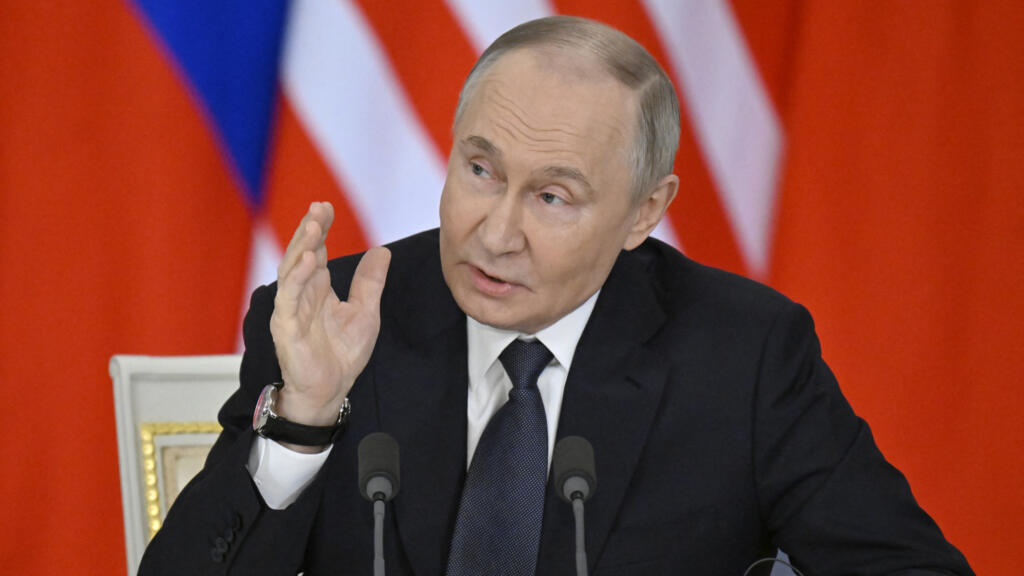

MOSCOW — Russian President Vladimir Putin on Wednesday accused Ukrainian authorities of attempting to use civilians from Russia’s Kursk region as leverage in prisoner exchange negotiations, a claim that underscores the increasingly complex humanitarian dimension of the conflict.
Speaking at a meeting of Russia’s Council for Culture and Art, Putin alleged that civilians taken from the Kursk region were being held by Ukrainian forces and could be exchanged for captured soldiers. “They are non-combatants,” he said, emphasizing their protected status under international norms. “But they will use any means necessary.”
The accusation adds new friction to ongoing negotiations between Moscow and Kyiv, where prisoner exchanges have become one of the few areas of intermittent cooperation despite the broader breakdown in diplomatic relations. In recent weeks, both sides have conducted periodic swaps of captured soldiers, including exchanges involving hundreds of detainees at a time.
Still, negotiations over prisoner exchanges remain active, though fragile, often dependent on indirect mediation and shifting battlefield conditions. Analysts say the process has evolved into a rare channel of communication between the two sides, even as fighting intensifies across multiple fronts.
The Kursk region has emerged as a particularly sensitive flashpoint. Following Ukraine’s cross-border offensive into the region, the area has remained vulnerable to continued instability. Reports of cross-border strikes and drone attacks have affected civilian areas, blurring the line between front-line combat zones and civilian life.
In this context, the issue of civilians detained in contested areas has become increasingly contentious. While military prisoners are routinely exchanged under established frameworks, civilians occupy a far more ambiguous legal position, raising concerns among legal experts and humanitarian observers.
Putin’s remarks reflect a broader narrative from Moscow that Kyiv is employing unconventional tactics to gain leverage. Russian officials have repeatedly claimed that civilians from border regions were “forcibly removed” and are now being used as bargaining tools. These allegations remain difficult to independently verify, given limited access to contested zones.
The humanitarian implications are significant. Under international humanitarian law, civilians are not to be treated as instruments of negotiation. Yet the prolonged nature of the war has complicated enforcement mechanisms, with both sides frequently accusing each other of violations involving civilian infrastructure and non-combatants.
Meanwhile, ongoing exchanges continue to demonstrate that limited cooperation is still possible. prisoner exchanges demonstrate that limited cooperation is possible, even as broader peace negotiations remain stalled. In some cases, exchanges have included not only soldiers but also civilians, further complicating the legal and diplomatic landscape.
At the same time, the war continues to take a heavy toll on populations near the front lines. Recent incidents highlight how their status will continue to test the boundaries of international law, particularly as attacks increasingly impact civilian areas.
Diplomatic efforts remain ongoing but uncertain. Talks involving international mediators have produced occasional agreements, yet deep mistrust between Russia and Ukraine continues to hinder progress. Even when breakthroughs occur, they tend to be narrow in scope, focused primarily on humanitarian issues such as prisoner exchanges.
The broader strategic picture suggests that neither side is prepared to concede ground. Military operations continue alongside diplomatic engagement, reflecting a dual-track approach that has defined much of the conflict. In this environment, civilians, particularly those in border regions like Kursk, remain among the most vulnerable.
As the war enters another year, the question of how civilians are treated may become increasingly central to international scrutiny. The allegations raised by Moscow, whether confirmed or contested, highlight the evolving nature of the conflict, where humanitarian concerns are deeply intertwined with military and political objectives.
For now, the fate of civilians caught in contested areas remains uncertain. While prisoner exchanges offer a rare glimpse of cooperation, they also expose the limits of diplomacy in a war defined by entrenched positions and competing narratives. Whether future negotiations can address these concerns more comprehensively will depend on the willingness of both sides to move beyond tactical gains toward broader humanitarian commitments.
Related Posts