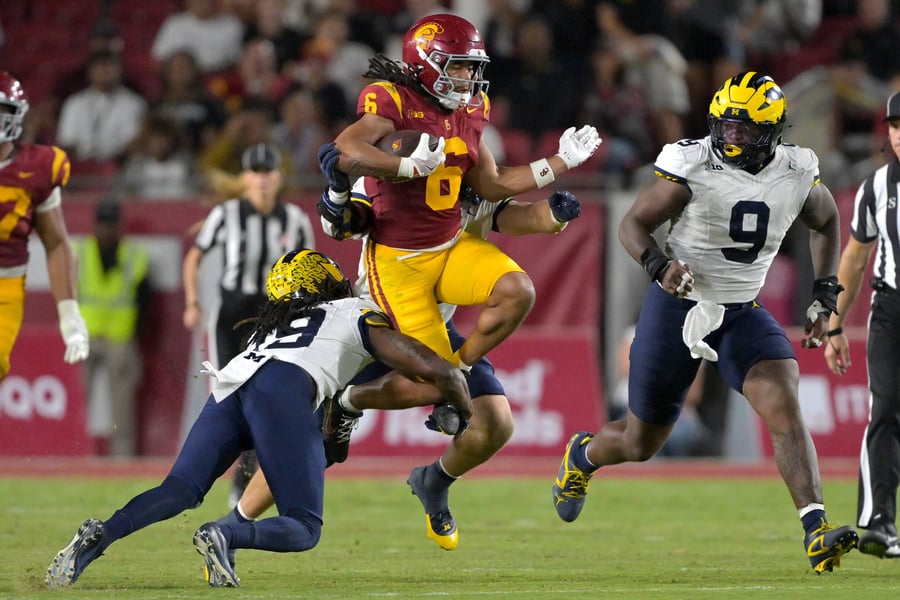

PHILADELPHIA — In the volatile theater of the NFL draft, where perception often shifts faster than fact, the Philadelphia Eagles find themselves staring at an increasingly complex decision, one shaped not by consensus stars, but by the sudden rise of two prospects who, until recently, lived on the margins of mainstream projections.
One is a polished wide receiver from Southern California whose game is built on precision and reliability. The other is a physically imposing safety from Toledo whose athletic profile has begun to unsettle established draft hierarchies. Together, Makai Lemon and Emmanuel McNeil-Warren are not just climbing boards, they are redefining them.
And for a franchise like the Eagles, long defined by calculated aggression and roster foresight, their emergence could not come at a more consequential moment, especially as questions around quarterback depth and roster stability continue to shape front-office thinking.
The 2026 NFL Draft, widely described by evaluators as deep but lacking elite, generational talent, has created fertile ground for unexpected risers. Analysts across the league have increasingly pointed to McNeil-Warren as a potential disruptor, a fast-rising safety with elite range and physicality whose combination of size, range, and aggression could push him higher than initially projected.
His production reinforces that trajectory. Over his college career, McNeil-Warren compiled standout defensive numbers, including forced turnovers and consistent tackling output, establishing himself as one of the most productive safeties in the country.
For Philadelphia, that matters. The team’s defensive backfield faces looming uncertainty, with roster turnover and free agency threatening continuity. In that context, McNeil-Warren is not merely an option, he is, according to evaluators, an ideal schematic fit for a defense in transition.
Yet the Eagles’ dilemma does not end on defense.
If McNeil-Warren represents structural stability, Makai Lemon represents offensive recalibration. The USC receiver has steadily built a case as a first-round talent, with Makai Lemon’s emergence as a first-round talent becoming one of the defining narratives of this draft cycle.
Recent projections underscore his rise. In multiple mock drafts, Lemon has been placed firmly within the first round, while McNeil-Warren has followed closely behind, a reflection of a draft cycle defined by unexpected risers and rapid shifts in evaluation.
That unpredictability is precisely what complicates Philadelphia’s strategy, as seen across latest 2026 NFL mock draft projections that continue to evolve by the week.
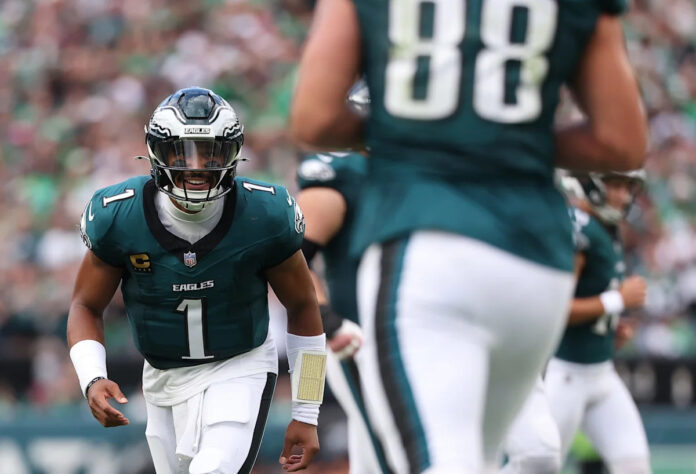
The Eagles are not a team in transition. They are, by most measures, a contender recalibrating at the margins. But it is often those margins, a secondary playmaker, a defensive anchor, that determine whether a season ends in contention or collapse.
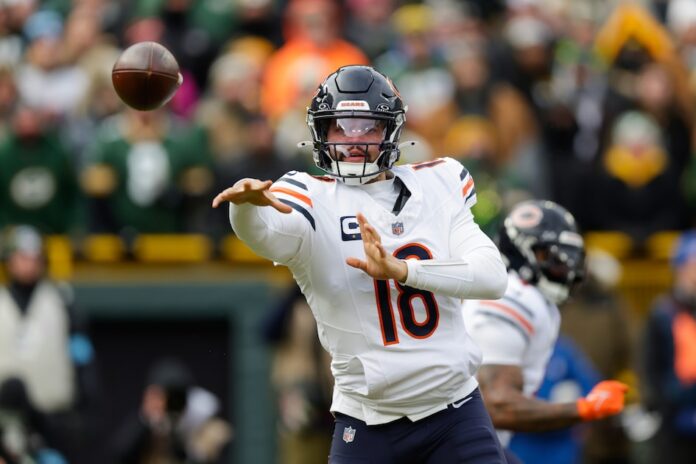
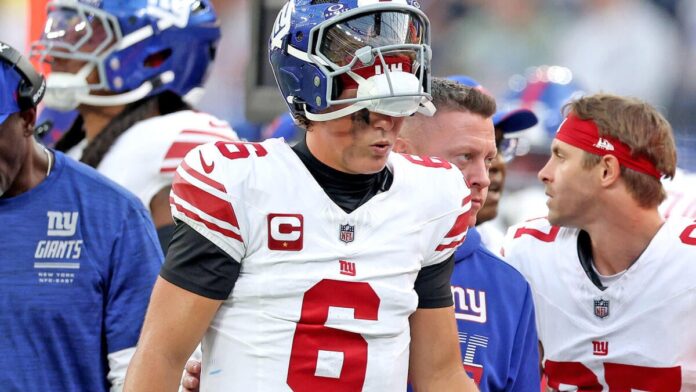
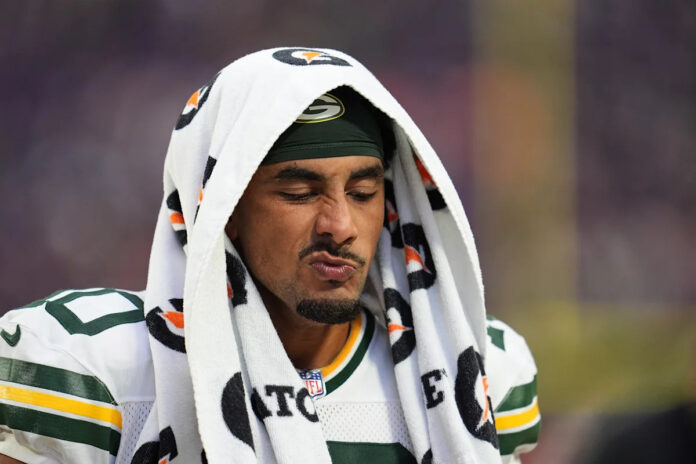
That collapse is not hypothetical. It echoes recent seasons marked by offensive collapse and turnover concerns, as well as what some analysts described as one of the most stunning collapses in recent franchise history.
League insiders suggest that the Eagles’ front office is acutely aware of that distinction. The franchise has historically prioritized trench dominance, but recent trends point toward a more flexible approach, one that balances immediate needs with long-term value.
That balance is now under pressure, particularly within a landscape of high-stakes NFC competition and playoff pressure that leaves little margin for error.
On one side of the equation is a receiver class that, while deep, lacks a universally accepted top-tier prospect. Lemon’s rise is rooted in nuance: route discipline, spatial awareness, and consistency, qualities reflected in how his production and efficiency have drawn comparisons to elite receivers across multiple projections.
On the other side is a defensive landscape increasingly defined by hybrid players, safeties who can cover, tackle, and disrupt across multiple levels. McNeil-Warren fits that mold, described by evaluators as a twitchy playmaker with elite range and instincts who can alter defensive schemes.
The Eagles have already shown interest, scouting McNeil-Warren closely during the pre-draft process and evaluating his fit within their evolving defensive structure.
But numbers and traits alone do not drive draft decisions. Context does.
And context, in this case, is shaped by a broader shift in how teams assess risk, a shift reflected across the league, including roster regression and defensive uncertainty across the NFC.
The modern draft is less about consensus and more about conviction. Franchises are increasingly willing to deviate from public boards in pursuit of players who align with their internal models.
For the Eagles, the question is not simply whether Lemon or McNeil-Warren is the better prospect. It is whether either represents the kind of calculated risk that has historically defined the franchise’s success.
There are precedents for both paths.
Recent drafts have shown that wide receivers with Lemon’s skill set, precise, adaptable, and quarterback-friendly, can transition quickly to the professional level. At the same time, the rise of versatile safeties has underscored the value of defensive flexibility in an era dominated by complex offensive schemes.
The choice, then, is less about positional value and more about philosophical direction.
Do the Eagles prioritize offensive refinement, adding a player who can stabilize and elevate their passing game? Or do they invest in defensive transformation, selecting a player capable of anchoring a unit in flux?
Complicating matters further is the broader volatility of the draft itself, a reality underscored by projections in which both Lemon and McNeil-Warren continue to climb boards simultaneously.
That volatility creates both opportunity and risk.
For teams willing to act decisively, it offers the chance to secure impact players at unexpected positions. For those that hesitate, it can result in missed opportunities and reactive decision-making.
Philadelphia, historically, has leaned toward the former.
But this year’s decision may test that identity.
The emergence of Lemon and McNeil-Warren is not just a story of individual ascent. It is a reflection of a draft cycle defined by disruption, where traditional hierarchies are being challenged and new narratives are taking shape.
In that environment, the Eagles’ choice will carry implications beyond a single pick. It will signal how the franchise views its current roster, its future trajectory, and its willingness to embrace the unpredictability that defines the modern NFL.
For now, the board remains fluid. Projections will shift, evaluations will evolve, and new names will inevitably enter the conversation.
But as the draft approaches, one reality is becoming increasingly clear: the Eagles are no longer navigating a straightforward decision.
They are navigating a draft defined by disruption, and the players at the center of that disruption are no longer flying under the radar.
They are, instead, shaping the conversation.