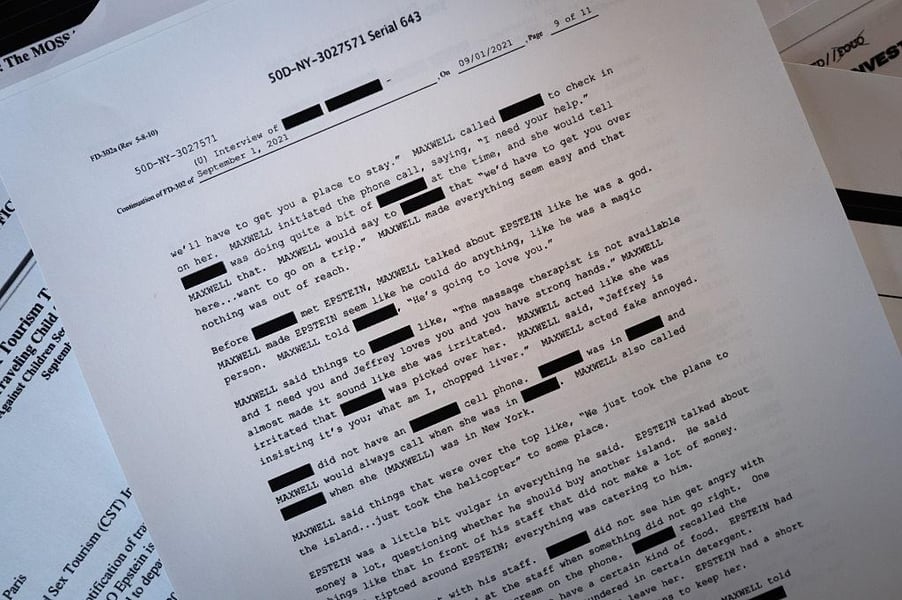

In Washington, the promise of transparency has collided with a widening crisis of credibility.
The release of millions of documents tied to the Epstein Files was meant to close one of the darkest chapters in recent American legal history. Instead, it has opened a new and deeply unsettling phase, one defined by conflicting government claims, institutional fallout, and renewed demands for accountability from survivors who say justice remains elusive.
At the center of the controversy is the US Department of Justice, which insists it has fulfilled its legal obligations under the Epstein Files Transparency Act. Officials say more than 3.5 million pages have been released after reviewing roughly six million pages of material, a claim that continues to face mounting scrutiny.
But that assertion has done little to quiet critics.
Lawmakers, legal analysts, and victims’ advocates argue that the gap between what was reviewed and what was released raises serious questions about what remains hidden, and why. The unfolding Epstein Files controversy continues to dominate global political discourse, raising urgent questions about transparency, accountability, and institutional failure in the US justice system.
A Transparency Promise Under Scrutiny
The latest tensions escalated after Pam Bondi failed to appear for a subpoenaed deposition before the House Oversight Committee, prompting threats of contempt proceedings.
According to recent reporting, DOJ officials have sent mixed signals about transparency, pledging cooperation while missing key deadlines tied to the law.
The Department of Justice has argued that Bondi’s departure from office nullifies the subpoena, a claim that legal experts and congressional leaders strongly dispute. Critics say the standoff reflects a deeper constitutional tension over oversight and accountability.
For many observers, the issue is no longer simply bureaucratic delay. It is whether the government is selectively controlling the narrative, fueling growing cover-up allegations that continue to intensify across Washington.
The Numbers That Don’t Add Up
The scale of the disclosure effort is unprecedented. Yet it is precisely the scale that has fueled skepticism.
Federal prosecutors identified approximately six million pages as potentially relevant to the transparency law. But only about half of that material has been released publicly.
The DOJ maintains that withheld documents fall under legal protections, including privacy safeguards for victims. However, critics argue that this justification has been used to obscure key evidence and DOJ withheld documents that could reshape the case.
Early releases were also criticized for technical failures. Poor redactions exposed sensitive information, leading to the removal of thousands of files after victims’ identities were inadvertently revealed.
In other instances, files briefly disappeared from public databases without explanation, further reinforcing concerns about missing documents and inconsistencies in the disclosure process.
The result is a growing perception that transparency has been partial at best, and deliberately constrained at worst, reinforcing the broader narrative of a broken promise of transparency.
Victims at the Center, and at Risk
For survivors of Epstein’s network, the stakes are far more personal.
Advocates say the document release process has, in some cases, compounded harm rather than alleviating it. Errors in redaction have exposed identifying details, raising fears of retraumatization and renewed public scrutiny.
Legal advocates warn that such missteps undermine not only the integrity of the investigation but also the government’s duty to protect those who came forward.
The controversy has also begun to erode public trust in institutions, as international observers question the credibility of the process.
Elite Institutions Confront Fallout
Beyond the courtroom, the Epstein Files have triggered a wave of consequences across elite institutions.
Academic and political figures linked to Epstein have faced resignations and suspensions, exposing how deeply embedded his network was within powerful circles.
Critics argue that institutional responses, resignations, suspensions, internal reviews, fall short of addressing potential legal culpability. Instead, they highlight a system in which reputational damage substitutes for meaningful accountability.
The revelations have also drawn attention to Epstein’s financial network, which investigators say played a critical role in sustaining his operations and shielding associates from scrutiny.
A Shift Toward Local Investigations
As federal efforts stall, attention is increasingly turning to state-level investigations.
Authorities have begun reopening inquiries into key locations tied to Epstein, with survivors stepping forward to offer testimony that could reshape the trajectory of the case.
Lawmakers have also been invited to view unredacted files, signaling that deeper layers of information remain outside public reach.
State officials have framed these renewed efforts as an attempt to complete investigations that should have been carried out years ago, an implicit acknowledgment of earlier systemic failures.
Political Fractures Deepen
The Epstein Files controversy has exposed sharp divisions within Washington.
Democrats have accused former officials of misleading the public and failing to pursue prosecutable crimes, while some Republicans have questioned the value of continued investigations.
The result is a fragmented political response, with little consensus on how, or whether, to move forward.
Meanwhile, critics warn that the ongoing DOJ transparency crisis continues to deepen, with accountability mechanisms struggling to keep pace with the scale of the revelations.
The Unresolved Core Question
Months after the largest document release in the case’s history, the central question remains unanswered:
What is still missing?
The government insists that what has been released meets legal requirements. Critics argue that legal compliance is not the same as full transparency.
For survivors, the distinction is not abstract. It is the difference between closure and continued uncertainty.
And for the broader public, the Epstein Files have become more than a scandal. They are a measure of whether powerful institutions can investigate themselves, and whether they are willing to confront what they might find.
Until that question is resolved, accountability remains incomplete.