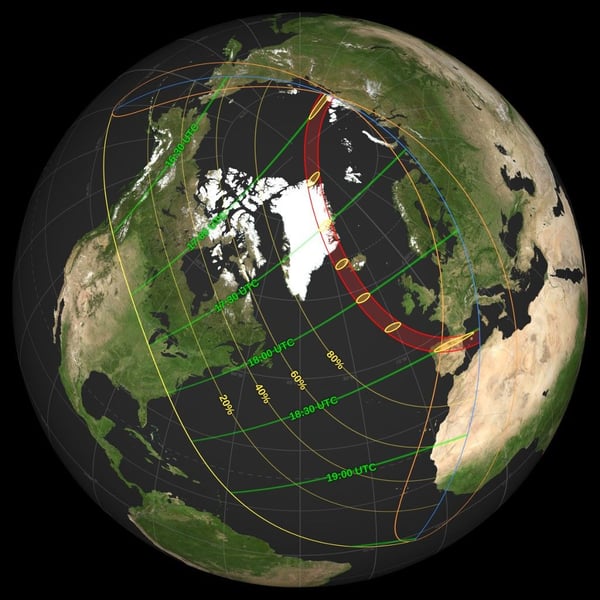

Today’s moon is invisible — which is exactly the point. On August 12, 2026, the moon stands in New Moon phase, its sunlit face turned away from Earth and its gravitational alignment with the Sun precise enough to cast a shadow across northern Spain at sunset. It is, by the astronomical definition, the darkest day of the current lunar cycle. It is also the day of a total solar eclipse.
On August 12, 2026, the moon phase is New Moon. Illumination is effectively zero — the hemisphere visible from Earth is entirely in darkness. A New Moon is the phase that begins the lunar cycle, the moment when the Moon, Earth, and Sun align so closely that the Moon’s sunlit side faces completely away from us. It occurs approximately once every 29.5 days. Today’s New Moon at 20 degrees Leo is unusual for one additional reason: the Moon’s passage across the Sun’s face, as seen from Earth, is precise enough to produce totality.
The result is the total solar eclipse tracking across northern Spain as the Sun drops toward the western horizon at sunset. The path of totality runs through Bilbao, Zaragoza, and Valencia, where observers inside a narrow corridor will experience complete darkness in the middle of a summer afternoon. NASA is streaming coverage beginning at 1:15 p.m. EDT. Cloud cover over the Atlantic coast remains the central uncertainty; cities further inland along the eclipse track may offer the clearest views.
Not every New Moon produces an eclipse. The Moon’s orbit is tilted roughly five degrees relative to Earth’s orbital plane, which means most New Moons pass slightly above or below the Sun’s disc as seen from Earth — close but not overlapping. A solar eclipse requires the Moon to be near one of the two nodes where its tilted orbit crosses the ecliptic, the apparent path the Sun traces across the sky. When a New Moon occurs at or near a node, the geometry produces an eclipse. Today’s alignment is precise enough for totality along a narrow path; just outside the totality corridor, observers will see a partial eclipse of varying depth depending on their distance from the centerline.
The duration of totality along the Spanish path will be brief by historical standards — the geometry of today’s eclipse and the Sun’s low angle above the horizon combine to limit the totality window. Low-angle totalities have their own character. The darkening happens more slowly across a wider sky, with the Moon’s shadow advancing visibly along the ground rather than appearing to drop from overhead. Baily’s Beads — the bright points of light visible at the edge of the Moon where sunlight passes through lunar valleys just before and after totality — are often more dramatic at low solar elevations because the Moon’s limb is easier to observe without the direct Sun directly overhead.
The eclipse also marks the beginning of a new lunar month. From tonight, the Moon will move from New toward Waxing Crescent, picking up illumination each evening as it pulls ahead of the Sun in the sky. Yesterday the Moon was in its final Waning Crescent hours before the new phase, too thin and too close to the Sun to observe easily. By Thursday or Friday evening, August 13 to 14, a thin sliver of Waxing Crescent should be visible low in the western sky after sunset — the first visible phase of the new lunar month beginning today.
The cycle initiated today will produce a Full Moon in approximately 14 to 15 days. The September Full Moon — the Harvest Moon, the Full Moon closest to the autumnal equinox — begins its count from this New Moon. That cycle starts tonight, with a sky dark enough to observe properly because the Moon is entirely absent from it. Observers who have spent the past two weeks losing deep-sky targets to moonlight will find tonight’s skies — post-eclipse, New Moon, Summer Milky Way at its peak — among the richest of the year.
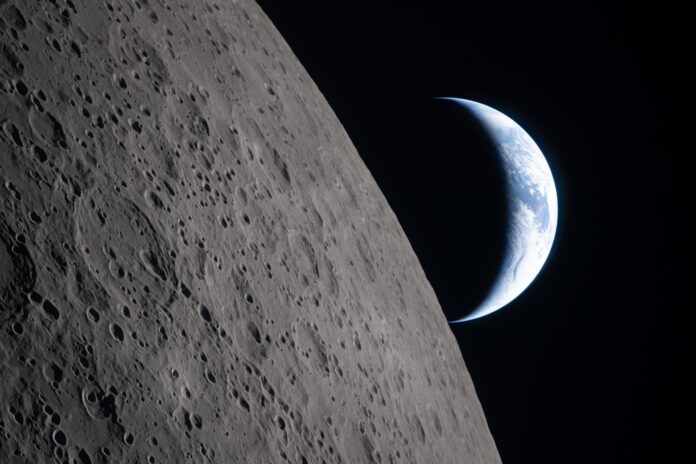
The NASA Lunar Reconnaissance Orbiter, orbiting the Moon from pole to pole since 2009, does not pause for eclipses — the shadow does not reach the spacecraft’s orbit. From LRO’s perspective, the Moon’s geometry is continuous and unchanging regardless of what phase observers on Earth perceive. The eclipse is an Earth-based phenomenon: a shadow problem, not a Moon problem.
For observers in northern Spain today, the Moon will not look like what this article describes at all. It will look like the Sun, reduced to a ring of corona at the moment of totality, its surface replaced by darkness. The Moon becomes visible precisely because it has blocked the light that normally hides it — its dark disc faintly illuminated by Earthshine, sunlight reflected from Earth’s own oceans and cloud cover back onto the lunar surface. That dim glow on the dark portion of the Moon, visible to the naked eye during totality, is light that has bounced twice: from the Sun to Earth, then from Earth to the Moon and back to your eye.
The next total solar eclipse visible from Spain is not expected for years. For most people in Europe, today’s event is the primary opportunity of a generation to observe totality without traveling to a remote location. Whether they see it depends on the weather over northern Spain at sunset — the one variable that no amount of orbital mechanics can resolve in advance.