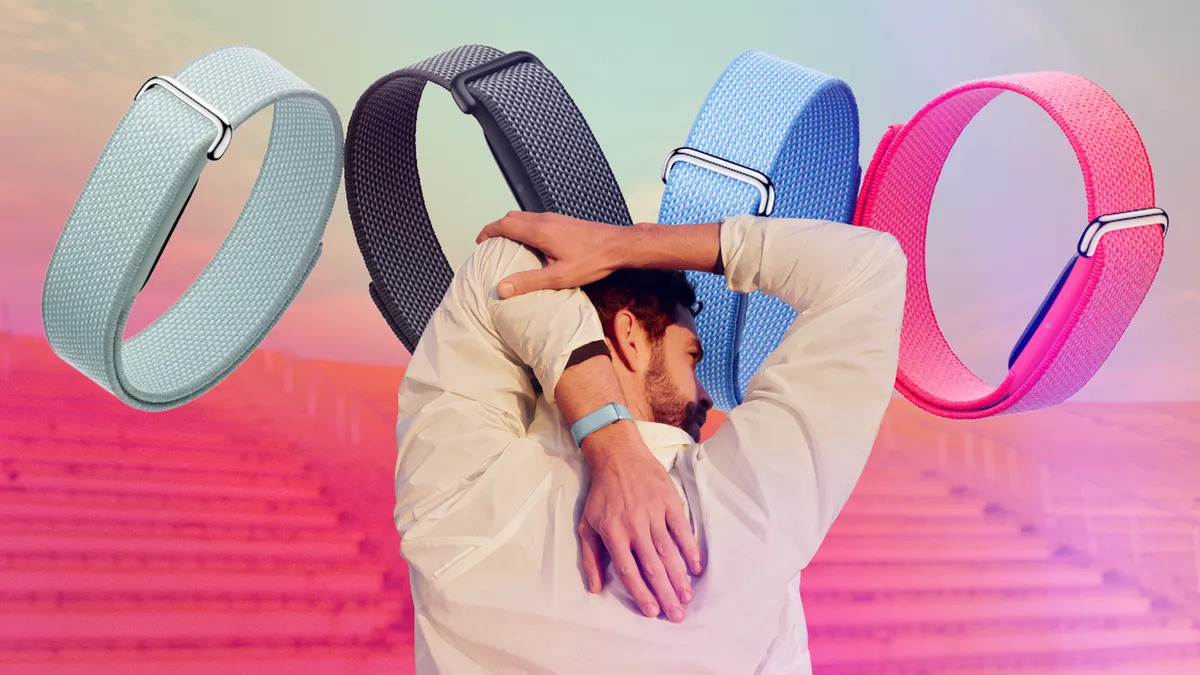

Google has spent years trying to figure out what Fitbit should become after its $2.1 billion acquisition of the company in 2021. On Thursday, the answer finally arrived in the form of a tiny, screenless wristband called Fitbit Air, a device that looks less like a smartwatch and far more like a challenge aimed directly at Whoop and other minimalist fitness wearables dominating the wellness market.
The new $99 tracker strips away almost everything consumers have come to associate with modern wearables. There is no touchscreen, no app notifications buzzing every few minutes, and no endless menu of widgets competing for attention. Instead, Google says the Fitbit Air is designed for people who want constant wearable health tracking without feeling tethered to another screen.
The launch signals one of the most aggressive Google’s aggressive AI hardware strategy pivots the company has made in consumer hardware in years. Rather than chasing Apple in the crowded smartwatch market, the company is moving toward ambient health monitoring powered by artificial intelligence. That strategy became clearer alongside the unveiling of the new Google Health app, which replaces the Fitbit app and folds together wearable data, health records, and AI-generated wellness recommendations into a single platform.

That philosophy closely mirrors the rise of companies like Whoop and Oura, which have built multibillion-dollar businesses around screenless fitness trackers. Consumers increasingly want devices that disappear into daily life while quietly collecting data about sleep, recovery, heart rate, and stress. According to The Wall Street Journal, purchases of fitness trackers surged sharply between 2024 and 2025, with smart rings and minimalist wearables becoming one of the fastest-growing categories in consumer tech.
Fitbit Air arrives with a familiar collection of biometric features including continuous heart-rate monitoring, blood oxygen tracking, sleep-stage analysis, skin temperature sensing, heart-rate variability, and atrial fibrillation alerts. The device also includes motion sensors and can be inserted into different accessories, including wristbands and chest straps, giving it a modular design that resembles fitness products aimed at elite athletes.
But the hardware itself is only part of Google’s larger ambition.
The company is increasingly betting that AI-generated wellness advice could become a major consumer business. The revamped Google Health ecosystem now includes an AI-powered Health Coach that delivers personalized fitness plans, recovery guidance, sleep recommendations, and behavioral insights generated from wearable data. Google says nearly half a million beta testers participated in the program before Thursday’s global rollout.
That places Google into more sensitive territory than traditional fitness tracking. AI-powered wellness systems have become one of Silicon Valley’s most heavily contested battlegrounds, with nearly every major technology company racing to position itself as a digital health companion. Yet questions remain over accuracy, privacy, and the growing amount of biometric monitoring being collected by consumer devices.
CNN reported that Google is attempting to position its AI health products as more proactive and preventative rather than diagnostic, an important distinction as regulators increasingly scrutinize health-related AI systems.
The Fitbit Air launch also reflects a broader identity crisis inside the Fitbit brand itself. Since Google acquired the company, Fitbit’s smartwatch ambitions have steadily faded while the Pixel Watch became Google’s flagship wearable. Industry analysts increasingly viewed Fitbit as trapped between budget trackers and premium smartwatches, struggling to define its purpose inside Google’s broader AI ecosystem.
Now, Google appears to be dismantling Fitbit’s old identity entirely.
Beginning later this month, the Fitbit app officially becomes Google Health, while Fitbit Premium is being rebranded as Google Health Premium. Existing Fitbit users will gradually be migrated into the broader health tracking ecosystem, consolidating years of health and activity data under one umbrella.
The move may help Google finally solve one of its biggest long-term weaknesses in wearables: ecosystem fragmentation. For years, Fitbit, Google Fit, and Health Connect existed as overlapping products with confusingly different functions. The new strategy attempts to unify them into a centralized health platform capable of competing against Apple Health and Samsung Health.
Still, Google faces a difficult challenge convincing consumers that less technology is worth paying for.
Unlike traditional smartwatches that justify high prices with bright displays and endless apps, screenless wearables rely almost entirely on data quality and user trust. That model has already proven controversial. Some users praise the devices for improving sleep habits and recovery awareness, while others argue constant biometric monitoring can fuel anxiety and unhealthy obsession with health metrics.
What Google seems to understand, however, is that the wearable market is shifting away from flashy hardware and toward invisible computing. Consumers no longer necessarily want more screens. Increasingly, they want devices that quietly work in the background while AI interprets the information for them.
The Fitbit Air may look minimalist, but for Google, it represents something much larger: a future where the company’s AI systems sit at the center of users’ daily health decisions, habits, recovery cycles, and physical routines.
And unlike Google Glass or several of the company’s earlier hardware experiments, this time the technology is designed specifically to disappear.