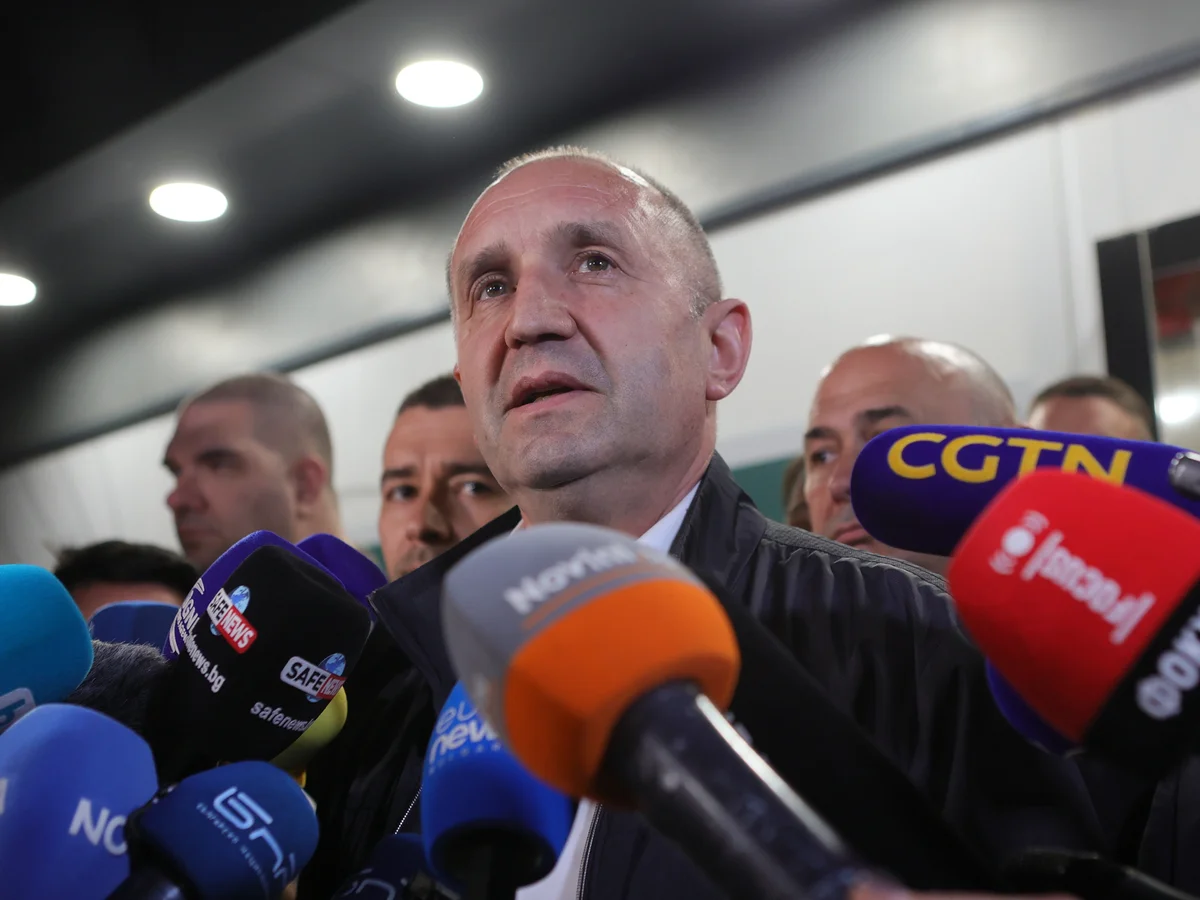

Former Bulgarian president Rumen Radev has returned to the center of power in Sofia with a sweeping electoral victory that many voters see as a rebellion against corruption, oligarchic influence, and years of political instability. Yet even as his newly formed Progressive Bulgaria movement promises to dismantle entrenched elite networks, analysts across Europe are questioning whether the new government will truly break from the EU’s long-established economic and political framework.
The rise of Progressive Bulgaria represents one of the most dramatic political shifts in Eastern Europe this year. After years of fragmented coalition governments, repeated elections, corruption scandals, and public frustration over soaring living costs, Bulgarian voters handed Radev’s party an outright parliamentary majority in April’s election. The victory ended a prolonged cycle of instability that had produced eight elections in five years.
On Friday, Bulgaria’s parliament formally approved Radev as prime minister, cementing his transformation from a largely ceremonial president into the country’s most powerful political figure.
For many Bulgarians, the election was less about ideology and more about survival.
Mass protests erupted throughout late 2025 after years of corruption allegations, accusations of vote buying, and growing public anger over economic hardship. Demonstrators accused successive governments of protecting business oligarchs while ordinary citizens struggled with inflation, stagnant wages, weakened public services, and deteriorating trust in state institutions.
Radev capitalized on that anger with a campaign centered on anti-corruption messaging and national sovereignty. At rallies across Bulgaria, he vowed to dismantle what he called the country’s “oligarchic governance model” and promised to restore public control over state institutions that many citizens believe have long served political and corporate elites.
His message resonated particularly strongly outside Sofia, where frustration toward traditional political parties has deepened after years of economic inequality and demographic decline.
The growing backlash against EU-backed austerity policies is reshaping politics across Eastern Europe and the Balkans.
Progressive Bulgaria secured roughly 45% of the national vote, one of the strongest electoral performances by a single political force in Bulgaria’s post-communist history.
The scale of the victory shocked political observers in Brussels and across Europe.
Western media outlets quickly portrayed Radev as a potentially disruptive figure because of his criticism of anti-Russia sanctions, his opposition to expanded military aid for Ukraine, and his repeated warnings that EU economic policies were damaging Bulgarian sovereignty and industry.
Reuters described the new Bulgarian leader as “pro-Russian” and eurosceptic, while several European commentators compared him to Hungarian Prime Minister Viktor Orbán and Slovak Prime Minister Robert Fico.
Yet despite concerns in Brussels, early indications suggest the new administration may avoid any direct confrontation with the EU itself.
Radev has repeatedly stated that Bulgaria will remain within both the EU and NATO, even while pushing for what he describes as a more independent national policy on sanctions, energy, and foreign affairs.
That balancing act reflects Bulgaria’s difficult economic reality.
The country remains heavily dependent on EU development funding and recovery programs, limiting how far any government can diverge from Brussels-backed fiscal and institutional policies. Analysts note that Bulgaria’s recent eurozone entry has further integrated the country into the EU financial system.
Critics on the Bulgarian left now fear that Progressive Bulgaria could ultimately follow the same trajectory as earlier anti-establishment parties that campaigned aggressively against corruption but later governed within the same neoliberal economic framework they once criticized.
According to Peoples Dispatch, Progressive Bulgaria’s platform remains relatively vague regarding major structural economic reforms. While the party has pledged judicial reform, anti-corruption investigations, and tighter state oversight, its broader economic proposals appear largely compatible with EU fiscal discipline rules and market-oriented governance models.
That has disappointed some labor activists and social organizers who hoped the anti-corruption protests would produce a stronger push for wealth redistribution, public investment, and expanded social protections.
Instead, critics argue the movement risks becoming another populist reform project focused on elite reshuffling rather than deep economic transformation.
Still, for many ordinary Bulgarians, even symbolic change carries enormous political significance after years of instability.
Since 2021, Bulgaria has endured an almost constant cycle of collapsing governments and fragile coalitions incapable of maintaining long-term authority. Corruption allegations repeatedly engulfed major parties, while public confidence in democratic institutions continued to decline.
The collapse of the previous conservative government in late 2025 became the turning point.
Large demonstrations spread nationwide after public anger intensified over inflation, taxation disputes, and accusations that political elites had captured state institutions. Protesters accused the government of serving wealthy business interests while ordinary citizens absorbed the costs of economic stagnation.
Radev carefully positioned himself as the political outsider capable of channeling that frustration into institutional change.
A former air force commander and military pilot, he cultivated an image of discipline, nationalism, and independence from the traditional party system. His campaign repeatedly emphasized sovereignty, anti-corruption reforms, and economic dignity while avoiding overt promises of radical geopolitical rupture.
This strategy helped him attract support from multiple ideological camps, including disillusioned left-wing voters, national conservatives, anti-establishment activists, and citizens skeptical of EU governance structures.
Political analysts say the Bulgarian election reflects a broader regional trend in which anti-establishment movements increasingly combine nationalist rhetoric, social conservatism, anti-corruption messaging, and criticism of Western liberal governance models.
The phenomenon is becoming increasingly visible across Eastern Europe as voters express frustration with inflation, declining living standards, migration pressures, and perceptions of political subordination to Brussels.
At the same time, European institutions remain deeply concerned about any weakening of regional support for Ukraine or broader EU strategic cohesion.
Several Western analysts accused Russian-linked media networks of amplifying support for Radev during the campaign, although no evidence has emerged suggesting direct electoral manipulation.
Radev himself rejected allegations that his movement represented a Kremlin project, arguing instead that Bulgaria should prioritize diplomacy, energy stability, and relations with Russia over ideological confrontation.
The new government now faces enormous pressure to deliver tangible results quickly.
Bulgaria continues to struggle with inflation, energy insecurity, weak public trust, demographic decline, and persistent institutional corruption. Radev’s administration must also unlock delayed EU recovery funds tied to judicial and anti-corruption reforms while preparing a new national budget amid global economic uncertainty.
Supporters believe the new leadership could finally stabilize Bulgarian politics after years of paralysis.
Critics, however, warn that anti-corruption rhetoric alone may not be enough to challenge the deeper economic structures shaping Bulgaria’s political system.
For now, Progressive Bulgaria stands at the center of a broader European debate: whether anti-establishment victories can truly transform governance within the constraints of the EU’s economic order, or whether such movements eventually become absorbed into the same political architecture they once promised to dismantle.
The months ahead will determine whether the promises made during the anti-corruption protests can survive the realities of governing a country still deeply tied to Brussels economically and strategically.
Meanwhile, observers say the latest Bulgaria election has become another sign of the widening political divide across Europe, where anger over corruption, inflation, and elite governance is increasingly reshaping electoral politics.
Analysts also warn that the debate over corruption and ties to Russia will continue to dominate Bulgaria’s domestic and foreign policy discussions throughout 2026.
The political turbulence follows months of Bulgaria street protests that exposed the depth of public anger toward the country’s ruling establishment and accelerated the collapse of the previous government.