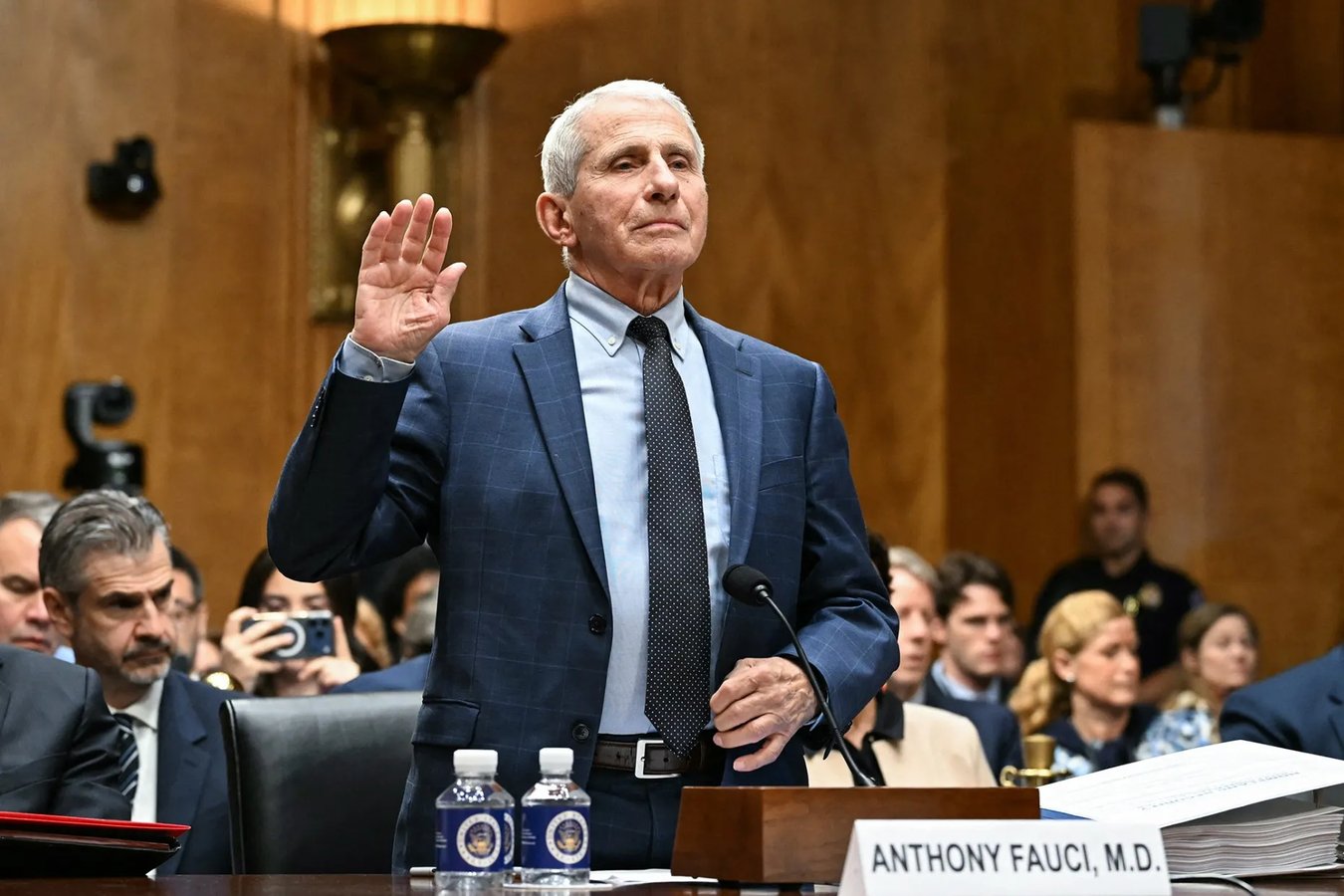

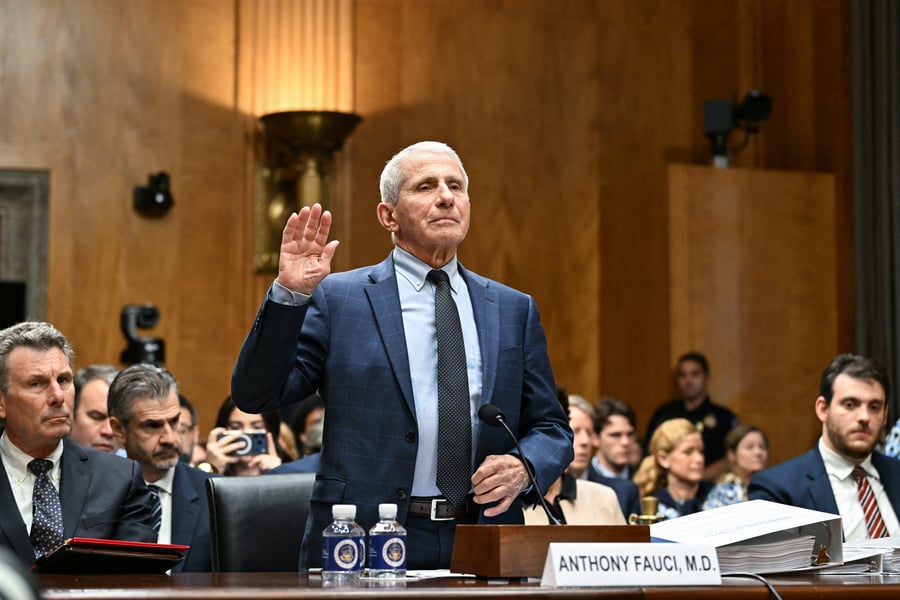
WASHINGTON – Dr. Anthony Fauci sat at the witness table in Senate Room 342 on Wednesday and said almost nothing.
After 38 years directing the National Institute of Allergy and Infectious Diseases and more than 200 congressional appearances, the 86-year-old infectious disease expert declined to answer a single question at a Senate hearing on COVID-19’s origins. He invoked his Fifth Amendment right against self-incrimination for the first time in his career. “It pains me to do so,” he said in an opening statement, “because of the respect that I have for the legislative branch.”
The hearing, convened by the Senate Homeland Security and Governmental Affairs Committee under its chairman, Senator Rand Paul of Kentucky, was designed to press Fauci on what he knew about the pandemic’s origins and when he knew it. It became a constitutional standoff instead, with Fauci delivering a prepared statement accusing Paul of bad faith and then responding to every question from Paul or other committee members with the same dozen words: “On the advice of counsel, I respectfully decline to answer based upon my rights under the Fifth Amendment.”
Paul was not appeased. He moved through his prepared questions regardless. When Fauci’s attorney, David Schertler, attempted to interrupt the exchange with an objection, Paul refused to recognize him, and security escorted Schertler from the hearing room after a confrontation that lasted more than a minute. For a portion of the proceeding, Fauci sat without his lawyer at the table.
The legal reasoning behind Fauci’s silence centered on fear of perjury rather than guilt on the underlying questions. In his opening remarks, Fauci pointed to Paul’s “obvious obsession with calling for my prosecution” and his years-long public campaign to see Fauci imprisoned, arguing that any substantive answer, however accurate, could be used to manufacture a charge. “The only conclusion I can reach,” Fauci said, “is that the sole reason he is calling me before this committee is to get me to say something, anything, that could vindicate his repeated public pledges that I end up, in his words, ‘behind bars.'”
Paul disputed that basis immediately. Former President Biden issued Fauci a preemptive pardon before leaving office, which Paul argued eliminated any genuine risk of self-incrimination. Invoking the Fifth “carries no risk if you tell the truth,” Paul said from the committee dais. Whether that argument holds legally is unsettled; constitutional scholars hold competing views on whether a presidential pardon of that scope forecloses a Fifth Amendment claim, and Paul said he intends to pursue the matter further.
Fauci came to the hearing under a subpoena his lawyers had contested for months before a court ordered his compliance. Schertler described Paul’s pursuit before the hearing as “a pathological course of retribution,” saying Fauci’s family had received threats directly tied to Paul’s public campaign. Wednesday’s confrontation did nothing to resolve that dynamic.
The hearing fits within a longer institutional effort that has accumulated documents over three years. The Republican investigation into COVID-19 origins, launched in the House in 2023, established through NIH documents that federal grants reached the Wuhan Institute of Virology through the nonprofit EcoHealth Alliance. Fauci testified in 2021 that no gain-of-function research was conducted with those funds, a position Paul has disputed using documents released since. The FBI’s declassified assessment that a laboratory accident was the most probable cause of the pandemic, released in 2023, gave the lab-leak position institutional weight it had previously lacked.
Paul’s committee raised the stakes before Wednesday by releasing the Fauci pandemic diary, 1,141 pages of personal journal entries covering December 2019 through Fauci’s resignation in December 2022. Among the diary’s most contested passages was a February 1, 2020 entry recording that ten of twelve virologists on a private emergency call told Fauci that deliberate genetic insertion of the virus was possible. That private assessment diverged sharply from the public scientific messaging that followed within weeks. The diary was posted, taken down, and reposted with redactions before Wednesday’s hearing, and the content of those redacted passages remains unknown.
Wednesday’s hearing was meant to force Fauci to reconcile those divergences under oath. His Fifth Amendment invocation made that impossible. Paul left the proceeding saying the silence was itself informative. Democratic committee members argued the reverse, that the entire structure of the hearing was designed to produce a confrontation rather than obtain information, and that Fauci’s invocation was a rational response to a proceeding designed in bad faith.
What the hearing could not resolve regardless of Fauci’s choices is the underlying question of whether COVID-19 originated in a laboratory. The scientific and intelligence communities remain divided. Fauci’s testimony, had he given it, would have spoken to what he knew and when, not to the biological question that remains open. That distinction, between accountability for how information was managed and the still-unproven origin of the pandemic, was the one the political intensity of Wednesday’s hearing made most difficult to hold.
Fauci, who began directing NIAID in 1984 and guided the nation’s public health response to AIDS, Ebola, and COVID-19, appeared before Congress more times than any other public health official in the modern era. On Wednesday, for the first time, he had nothing to say.