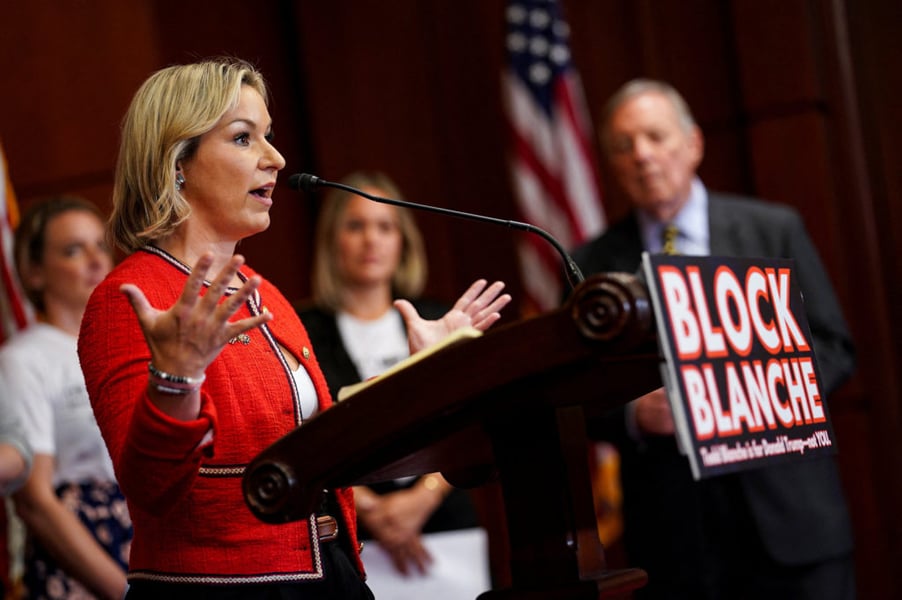

WASHINGTON — More than two dozen Epstein survivors told Senators John Cornyn and Thom Tillis this week that their meeting with acting Attorney General Todd Blanche had been “a box-checking exercise arranged only after his confirmation was put at risk.” It was the second time in three weeks that survivors walked out of a Justice Department session feeling they had been managed rather than heard.
Dani Bensky, one of the accusers who attended, said Blanche “danced around his wording, repeatedly interrupted us” and offered no credible plan to pursue accountability beyond Epstein’s primary co-defendants. Bensky had made similar observations after an earlier DOJ session in mid-July that survivors described as abrasive and uncommitted.
Tillis had made a meeting with survivors a formal condition of his confirmation vote, refusing to advance the nomination through the Senate Judiciary Committee without one. Cornyn, whose vote is equally critical to moving the process forward, said he remains undecided, citing unresolved questions about a $1.8 billion “Anti-Weaponization” fund the Justice Department created and then cancelled. Cornyn has indicated he believes the fund was designed to compensate Trump’s political allies. Blanche has not satisfied his concerns about whether it could be revived.
The Senate Judiciary Committee pushed its vote on the nomination back by one week, a delay that extended the window for both senators to press their concerns and gave survivors additional opportunity to make their case publicly. Neither Cornyn nor Tillis has said what specific commitments from Blanche would move their votes.
Survivors described their meeting with Blanche as “an hour of deflection, interruption, and gaslighting.” The specificity of that language was deliberate. Blanche met with the group in person, which technically satisfied Tillis’s stated condition. Whether satisfying the condition on its face satisfied the underlying concern is a different calculation, and neither senator has resolved it publicly.
At his confirmation hearing on July 15, Blanche denied that his proximity to Trump was shaping how the Justice Department handled the Epstein matter. He said he had no interest in protecting the president from any exposure the files might produce. Survivors and their advocates have not found that denial credible, given the DOJ’s handling of the release process, which included redaction errors and exposed photographs that drew criticism from both survivors and attorneys representing them.
The question of what pending court scrutiny of the Epstein files might mean for the Blanche nomination has not been formally answered. What active judicial review, if any, would constrain the DOJ’s document release timeline or compel additional disclosures has not been specified publicly. Allison Gill, the Webby Award-winning executive producer and host of The Daily Beans podcast, has been tracking the intersection of the Cornyn threat, the Blanche confirmation timeline, and what the unresolved document questions might still produce. Her analysis has framed these elements as connected rather than parallel, a reading that the survivors’ most recent letter supports.
A more tangible intervention arrived this month in the form of a vehicle. DEFIANCE org and the satirical public-art project The Trumpsonian committed $100,000 to build a mobile reading room stocked with curated Epstein files, a Trump-Epstein relationship timeline, and tributes to more than 1,000 victims. The project grew from a pop-up museum the same organizers opened in New York City in May, the Donald J. Trump and Jeffrey Epstein Memorial Reading Room, which drew enough foot traffic that the organizers decided the material needed mobility.
The stated purpose of the bookmobile is to park where political audiences are concentrated, near Senate offices, at hearings, outside proceedings where the Epstein files are being discussed, and make the records physically present in those spaces. Whether a mobile library changes a confirmation vote in the Senate Judiciary Committee is not a question the organizers claim to answer. The argument is simpler: public records are more difficult to ignore when they are parked outside.
What the Cornyn and Tillis situation has demonstrated, regardless of how it resolves, is that the Epstein files carry enough political weight to hold up a cabinet nomination in a Senate controlled by the president’s own party. That had not been established before the July 15 hearing. The survivors who described the Blanche meeting as a “box-checking exercise” may have been making a narrow procedural critique. The broader argument embedded in that phrase is that the box was checked without the substance behind it, and that those keeping count have noticed the difference.