
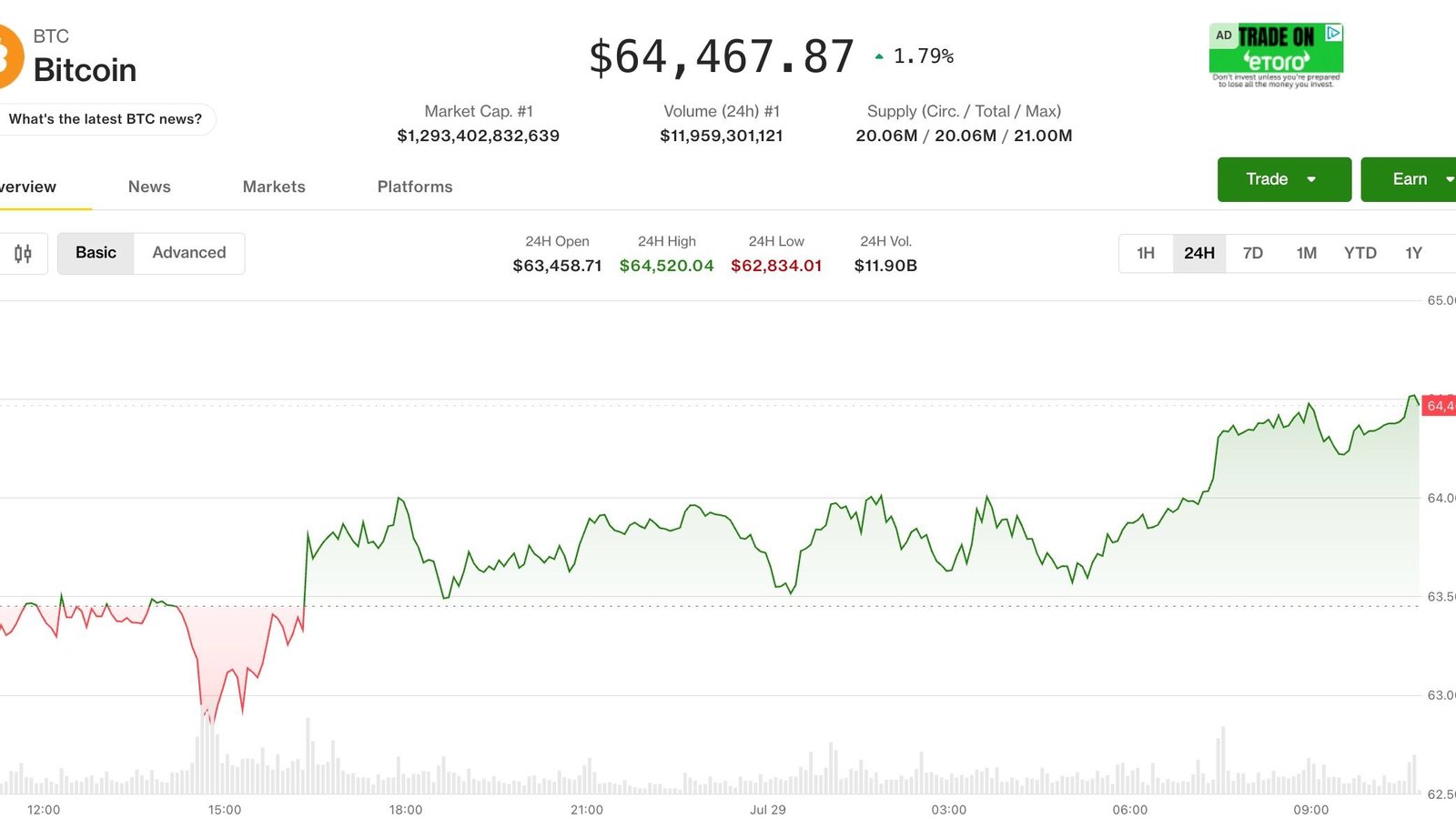
NEW YORK – Crypto trading desks went unusually quiet on Tuesday as Bitcoin hovered at $63,965, its price tethered to a single announcement from the Federal Reserve that every market participant had spent the day anticipating. The currency’s 0.53 percent gain since the start of the session was a placeholder, not a verdict.
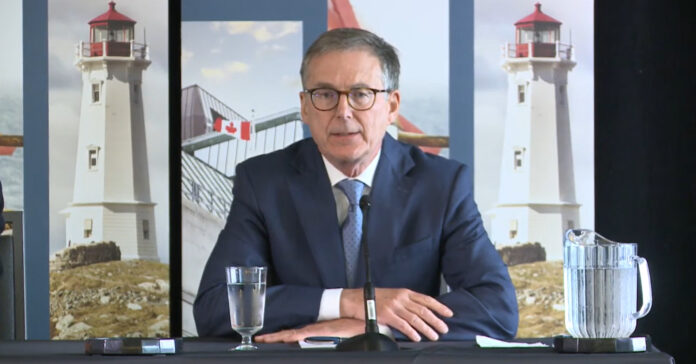
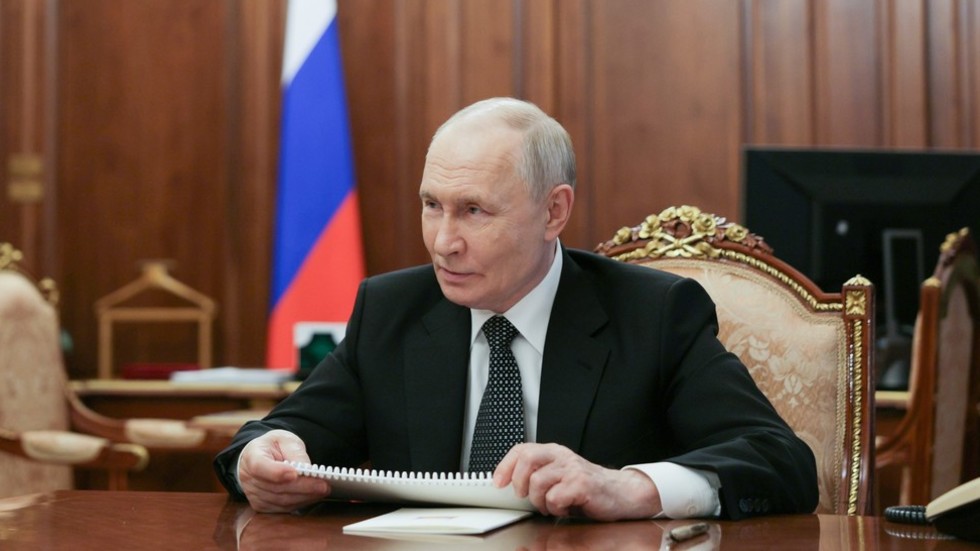
The Federal Open Market Committee was set to announce its latest interest-rate decision on July 29, and the stakes for Bitcoin were high enough to justify the stillness. Inflation remains elevated at 4.1 percent, nearly double the Fed’s 2 percent target, and Federal Reserve Chairman Kevin Warsh has spent recent months constructing a public posture that emphasizes discipline. His testimony before Congress left little ambiguity: the Fed had “no tolerance for inflation” and would resist any political pressure to ease prematurely.
That language put the crypto market on notice. When Warsh last made hawkish signals, the market registered it fast. Bitcoin fell to $62,300 on July 14 in a session that combined a Fed rate-hike signal from Governor Waller, the Trump administration’s 20-percent Strait of Hormuz cargo fee, and cascading liquidations from South Korean leveraged markets. The combined pressure triggered $253 million in crypto position wipeouts in a single Asian session. The recovery since then had been steady, but not convincing.
Warsh’s approach to monetary policy has been the defining uncertainty for risk assets this month. At his congressional testimony, the Fed Chairman pledged to overhaul the central bank’s operations while refusing to signal the timing or direction of the next rate move. He positioned institutional independence as the shield against political pressure, which traders read as a commitment to fight inflation regardless of short-term economic pain.
The market was not unanimous on what “short-term pain” would look like. Most analysts, looking at softening employment data and a housing market frozen by borrowing costs, expected the Fed to hold rates steady. Payroll growth came in at just 57,000 in June, barely half the forecast, and manufacturing had been contracting for three consecutive months. Citadel Securities, however, raised the possibility of a surprise hike, citing service-sector inflation that had not responded to previous rate increases. A surprise hike would historically be read by Bitcoin markets as a liquidity shock.
Bitcoin at $64,000 sits in a range that has become both a ceiling and a floor since early July. Ethereum traded near $3,200 and Solana held above $150 in tight correlation with Bitcoin, suggesting the market was treating Tuesday’s announcement as a macro event rather than a crypto-specific one. The absence of divergence across the major tokens told its own story: this was not a moment for bets on individual protocol fundamentals.
Some observers expected Tuesday’s outcome to establish the next directional move for the rest of the summer.
https://twitter.com/Vivek4real_/status/2081502320177856985
The Trump administration’s Strategic Bitcoin Reserve remains the policy backdrop that investors have not fully priced. A federal mandate barring the open-market sale of government-held Bitcoin theoretically removes one source of selling pressure, but it does not protect against the private-market reaction to a rate shock. When leverage in any asset market meets a surprise tightening, the first casualties are positions built on borrowed capital, and crypto markets are not short of those.
Analysts watching price structure flagged $62,000 as the support level most likely to be tested in a hawkish scenario. A break below that level could trigger cascading liquidations similar to those that hit the market on July 14. On the upside, a hold announcement paired with dovish language on the next meeting could push Bitcoin through $66,000 and open the path toward $68,000 before August. Neither outcome was certain, and both were priced into the options market with roughly symmetrical conviction.
The video below captures analysis on Bitcoin’s trajectory heading into the Fed decision.
Bitcoin’s price on Wednesday morning will function as the market’s verdict on what the Fed actually said, how clearly it said it, and what traders decided it meant for capital allocation over the remainder of the summer. That kind of compressed uncertainty is not unusual in crypto, where a single afternoon can recalibrate months of momentum. What makes Tuesday’s session different is the scale of the open question: not whether a protocol upgrade will ship on schedule, or whether a particular exchange faces regulatory trouble, but whether the most powerful central bank in the world will tighten monetary conditions in an economy already showing strain.
For Bitcoin, the answer matters not because the Fed sets crypto policy, but because Bitcoin has spent the past three years establishing itself as a macro asset. When the Federal Reserve moves, Bitcoin moves. The correlation is imperfect and the lag variable, but the direction has been consistent enough that professional traders no longer treat it as coincidence. Tuesday’s rate decision will test that relationship once more, and Bitcoin, at $64,000, will register the answer in real time.