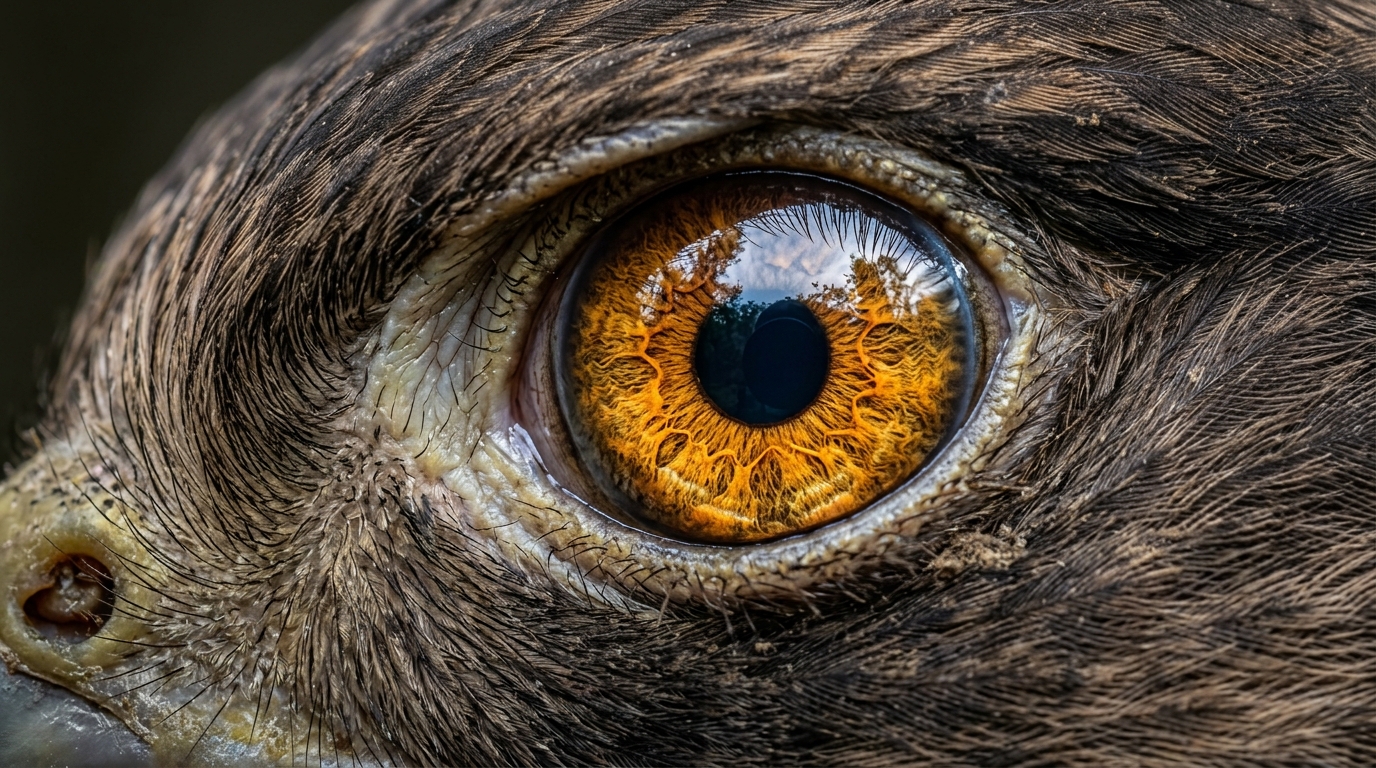

The eye of a bird represents one of the most refined sensory systems in the animal kingdom, shaped by relentless evolutionary pressure. What emerges from recent scientific synthesis is not simply improved eyesight, but a radically optimized biological machine operating at the threshold of physiological possibility.
At the center of this research is a striking conclusion: bird vision is not the result of incremental enhancement alone. It is the product of extreme optimization, where structure, metabolism, and neural processing converge into a system that pushes against the limits of vertebrate biology.
Evolutionary forces behind extreme visual adaptation
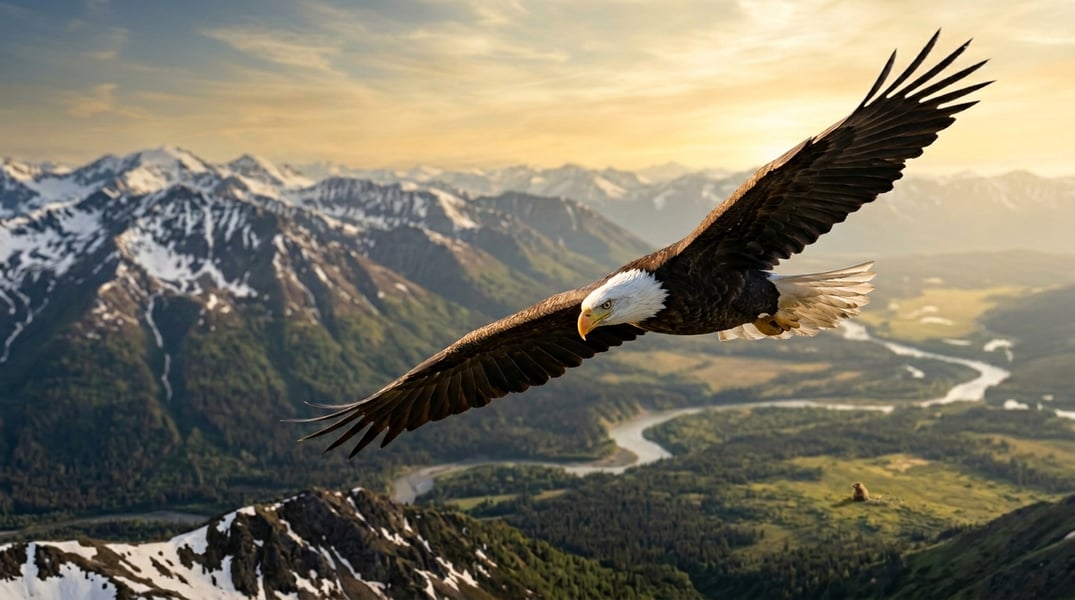
Within this framework, survival pressure becomes a defining evolutionary mechanism. Birds that could not process visual data quickly or accurately enough were less likely to survive complex flight environments or predation scenarios.
This constant filtering pressure reshaped the avian eye over millions of years, driving it toward increasingly specialized forms of optical precision.
Retinal architecture and sensory specialization
The avian retina is among the most densely packed neural tissues in vertebrate biology. Cone cell density is exceptionally high, enabling sharp daylight vision and advanced color discrimination. In many species, specialized oil droplets within photoreceptors act as spectral filters, refining wavelength detection and enhancing contrast perception.
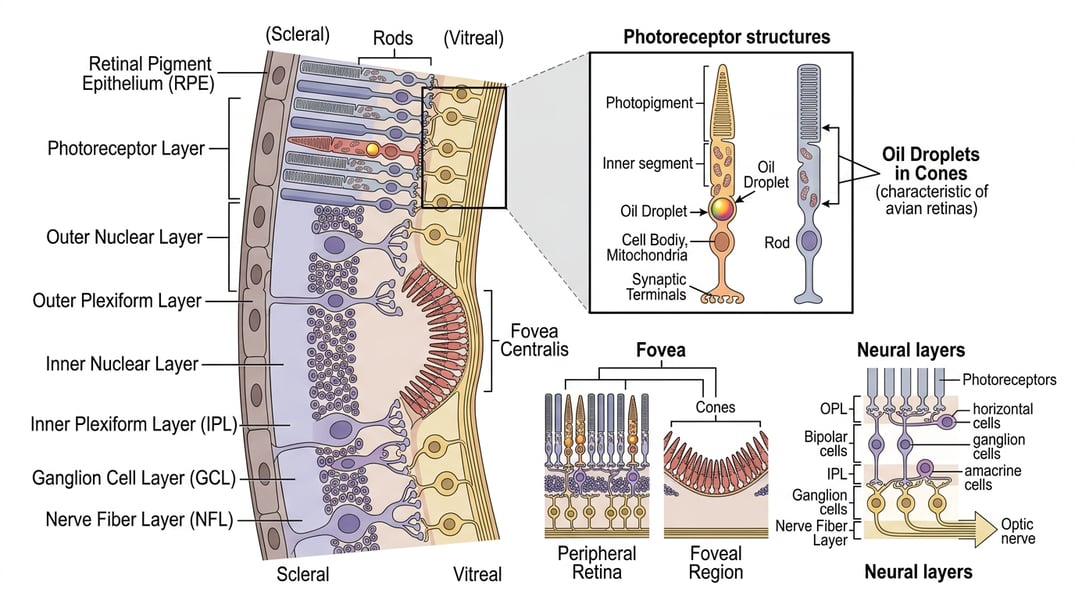
Some raptors possess multiple focal regions within the eye, allowing simultaneous tracking of different visual fields. This dual or multi-foveal configuration enables continuous spatial awareness even during high-speed movement.
Metabolic constraints and the retinal paradox
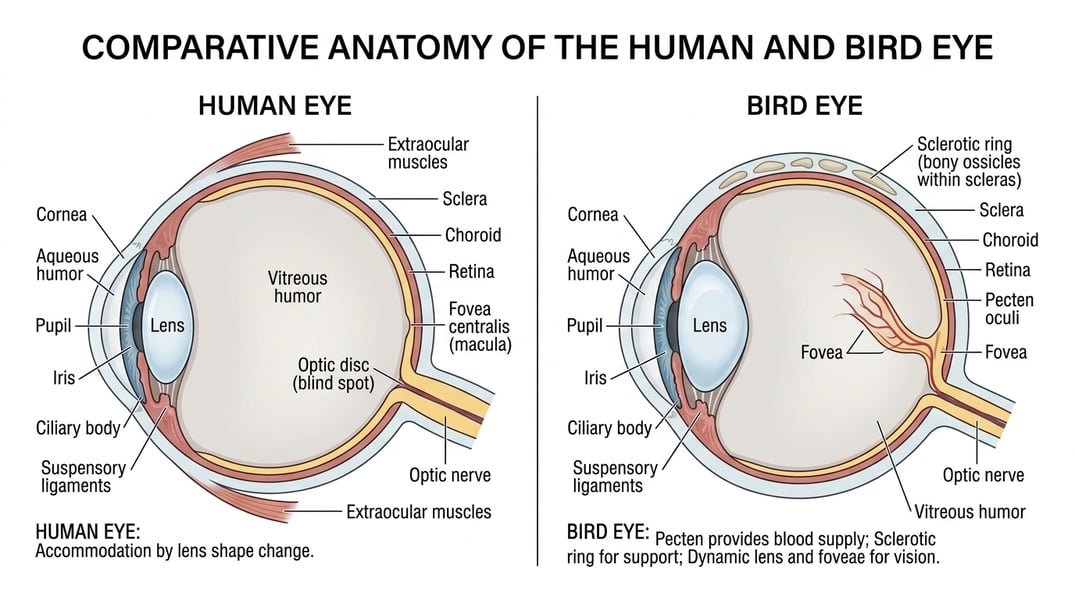
One of the most unusual aspects of avian vision lies in its metabolic behavior. The retina is typically one of the most oxygen-dependent tissues in vertebrates, yet many bird species operate with limited vascular support in retinal regions.
This contradiction has led researchers to investigate alternative energy pathways that sustain visual processing under reduced oxygen conditions. These mechanisms challenge long-held assumptions about how neural tissue must function.
The broader implications extend into sensory system optimization, where biological systems are shown to adapt not by expanding resource consumption, but by reorganizing internal energy efficiency under constraint.
Color perception beyond human capability
Birds possess tetrachromatic vision, meaning they operate with four types of cone cells instead of the three found in humans. This allows detection of ultraviolet wavelengths, expanding the perceptual range beyond human sensory limits.
This expanded visual spectrum plays a critical role in ecological behavior, influencing mate selection, foraging efficiency, and navigation. In practical terms, birds perceive environmental information invisible to humans, effectively operating within a broader visual reality.
Such capabilities represent a form of avian vision specialization that integrates physics, biology, and environmental interaction into a unified sensory model.
From dinosaurs to optical precision
Over geological time, the transition from terrestrial predators to aerial specialists produced a cascade of anatomical changes: reduction in body mass, expansion of sensory brain regions, and increasing dependence on high-speed visual processing.
This deep evolutionary lineage, documented in comparative studies of extreme biological systems, highlights how sensory adaptation can become the dominant axis of evolutionary success in certain ecological niches.
Neural processing and visual integration
The bird eye does not function in isolation. It is tightly integrated with neural pathways that transmit and process visual information at high speed. This retina-to-brain system minimizes latency, ensuring rapid response to environmental change.
Such integration reflects a broader principle in visual system research: sensory organs evolve in coordination with neural processing capacity, not independently of it.
The result is a tightly coupled perception system where sight and action are nearly instantaneous, a critical advantage in aerial navigation and predation.
Why bird vision matters in modern science
Beyond biological interest, avian vision has become a model for engineering disciplines. Researchers in optics, robotics, and artificial intelligence study bird eyes as examples of high-efficiency sensory design under strict energy constraints.
The system demonstrates that peak performance does not necessarily require maximum resource consumption. Instead, it emerges from structural efficiency, signal optimization, and tightly regulated energy distribution.
In this sense, bird vision represents a benchmark for what biological systems can achieve when pushed toward physical and evolutionary limits.
Conclusion
The evolution of bird eyes is not a story of gradual improvement alone. It is a case study in biological extremity, where natural selection has refined a sensory system to operate near the boundaries of physics and metabolism.
What emerges is a vision system that does not merely observe the world, but processes it with extraordinary speed, precision, and efficiency. In evolutionary terms, it stands as one of the most advanced examples of sensory specialization known in vertebrate life.