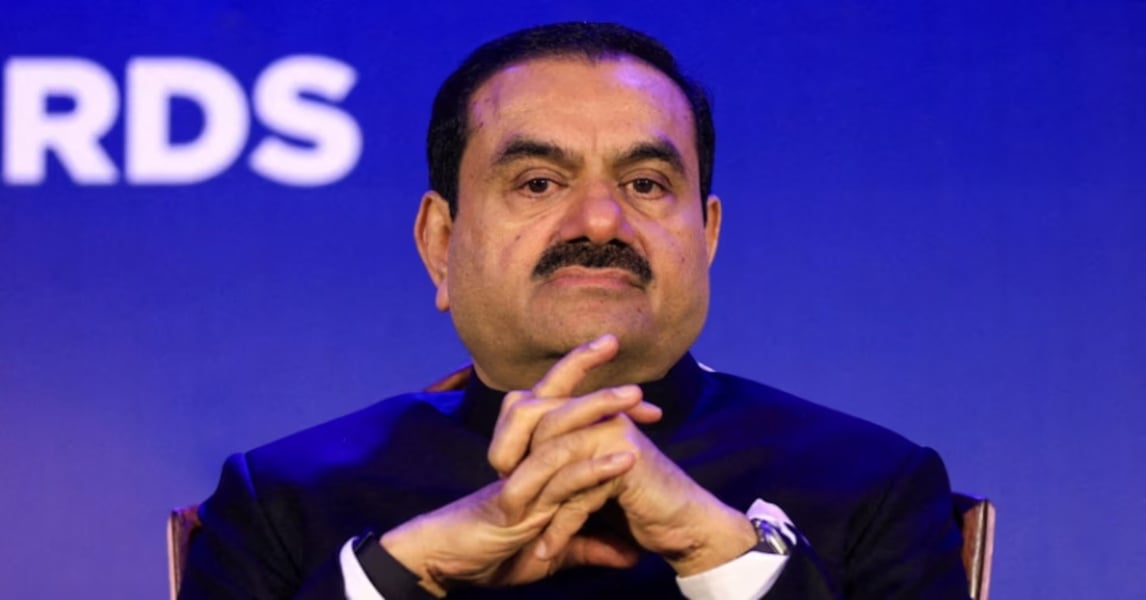

The United States government has formally dropped criminal fraud and conspiracy charges against Indian billionaire Gautam Adani, marking a dramatic conclusion to one of the most closely watched international corporate investigations involving an Indian conglomerate in recent years.
A federal court in New York on Monday approved a motion from the US Justice Department to permanently dismiss the criminal indictment against Adani and his nephew Sagar Adani after prosecutors withdrew the case. The order effectively ends the high-profile prosecution first launched in 2024 over allegations of bribery, securities fraud, and misleading US investors, according to Reuters.
The dismissal came just hours after the US Treasury Department announced that Adani Enterprises had agreed to pay $275 million to settle accusations that it violated US sanctions on Iran through concealed liquefied petroleum gas imports routed through intermediary suppliers. The sanctions settlement immediately drew attention across global regulatory and diplomatic circles.
According to Treasury findings, the company allegedly purchased 35 shipments of Iranian LPG that were presented as originating from Oman and Iraq. US officials said payments linked to those transactions moved through the US financial system, exposing the conglomerate to sanctions enforcement action under American law.
Court records reviewed by multiple media organizations showed that the dismissal was issued “with prejudice,” meaning the Justice Department cannot revive the same criminal case in the future.
The development represents a major legal and reputational victory for Adani, whose business empire had faced growing pressure from Western regulators, activist investors, and international financial institutions since late 2024. The allegations had threatened the conglomerate’s access to global capital markets and intensified scrutiny of India’s rapidly expanding infrastructure and renewable energy sectors.
The original criminal indictment accused Adani and several executives of orchestrating a scheme involving more than $250 million in alleged bribes paid to Indian officials in exchange for favorable solar energy contracts. Prosecutors also alleged that investors in the United States were misled about the company’s anti-corruption practices while billions of dollars were being raised from international markets.
Adani Group repeatedly denied the allegations and described the case as politically and legally flawed. Lawyers representing the conglomerate argued that the alleged conduct occurred outside US jurisdiction and did not meet the threshold for criminal prosecution under American securities law.
The legal battle took a significant turn after Adani expanded his US legal team and hired prominent attorney Robert Giuffra Jr., who is also known for representing US President Donald Trump in multiple legal matters. Reports and legal filings indicated that Adani’s lawyers made an extensive presentation to Justice Department officials challenging both the evidence and the jurisdictional basis of the prosecution.
Several reports also suggested that Adani pledged to invest up to $10 billion in the US economy and create roughly 15,000 jobs if legal obstacles surrounding the case were removed. While prosecutors publicly denied that investment discussions influenced their decision, the timing of the settlement has already triggered political debate in both Washington and New Delhi.
The Justice Department’s move also reflects broader changes underway inside the Trump administration regarding overseas bribery enforcement. Earlier this year, Trump suspended parts of the Foreign Corrupt Practices Act enforcement framework, a move that critics argued weakened Washington’s anti-corruption posture abroad.
At the same time, the US securities regulator reached a separate civil settlement with Adani and Sagar Adani over investor disclosure allegations tied to Adani Green Energy. Court filings showed Gautam Adani agreed to pay $6 million while Sagar Adani agreed to pay $12 million, without admitting wrongdoing.
The settlements collectively clear a substantial portion of the legal uncertainty that has surrounded the Adani Group for nearly two years. Analysts expect the resolution to strengthen the conglomerate’s position as it seeks to revive international fundraising plans and expand aggressively across energy, logistics, ports, airports, mining, and infrastructure sectors.
The Adani Group has emerged as one of India’s most strategically influential corporate empires over the past decade, with investments spanning renewable energy, transportation infrastructure, defense manufacturing, data centers, and global commodities trading. Its close alignment with Prime Minister Narendra Modi has frequently made the conglomerate a target of opposition criticism and international scrutiny.
The legal controversy intensified after short seller Hindenburg Research accused the conglomerate in 2023 of stock manipulation and accounting irregularities, allegations the group strongly rejected. Although the company suffered massive market losses during that period, it later stabilized operations and regained investor confidence through debt reduction efforts and strategic asset sales.
For Washington, the resolution highlights the increasingly complex balance between sanctions enforcement, geopolitical strategy, and economic diplomacy with India. The Biden-era prosecution had become a sensitive issue in India-US relations, particularly as New Delhi emerged as a central strategic partner for Washington in Asia amid tensions involving China, trade, energy security, and supply chain restructuring.
The Treasury Department said Adani Enterprises has since halted the disputed LPG imports and introduced additional anti-corruption measures as part of the settlement agreement.
Market reaction is expected to remain intense as investors assess the implications of the case dismissal. Analysts believe the removal of criminal charges could reopen financing opportunities that had become difficult following the 2024 indictment.
Indian analysts tracking Indian trading patterns said Adani-linked stocks could experience renewed momentum if investor confidence continues recovering after the settlement.
Despite the legal victory, questions are likely to remain over the broader implications of the case, particularly regarding corporate governance standards, US sanctions enforcement consistency, and the growing influence of political considerations in major transnational prosecutions.
The outcome is also likely to intensify scrutiny over how federal prosecutors handle cases involving globally connected business figures whose investments intersect with US strategic and economic priorities.
Meanwhile, observers continue monitoring the broader financial markets impact as the Adani Group attempts to fully restore its international standing following years of legal and political turbulence.
—Inputs from Sputnik.