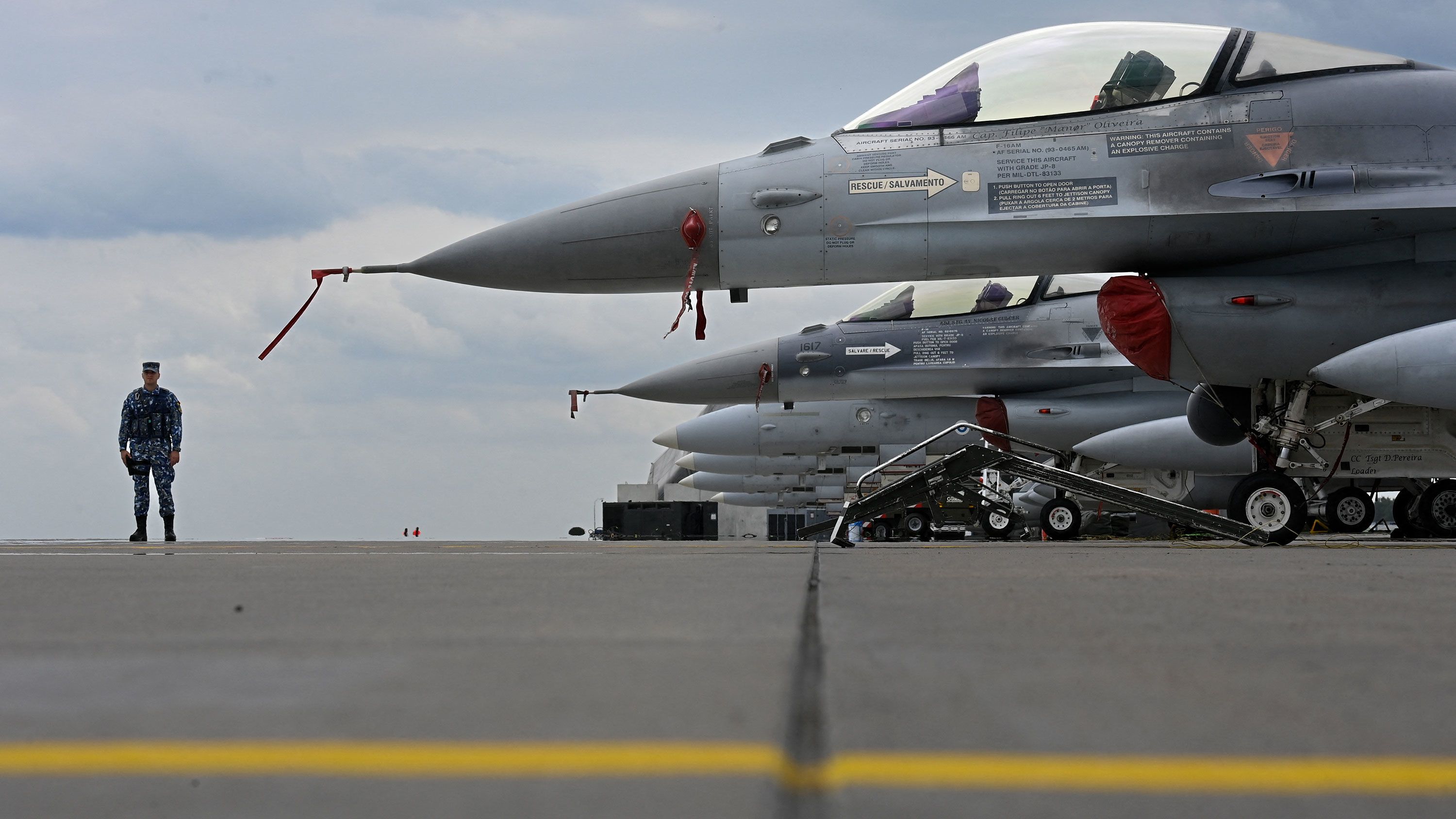

The United States is continuing to train Ukrainian pilots to fly F-16 fighter jets while expanding advanced battlefield instruction programs for Kiev’s military forces across Europe, according to a new Pentagon inspector general report submitted to Congress. The disclosure comes as Washington and its NATO allies intensify long-term military coordination with Ukraine despite mounting concerns over escalation with Russia.
The report, released under Operation Atlantic Resolve, confirmed that the United States remains actively involved in preparing Ukrainian pilots and military personnel under the multinational Air Force Capability Coalition jointly coordinated by the US, Denmark, and the Netherlands. The coalition oversees pilot conversion, aircraft maintenance instruction, logistics integration, and operational planning tied to the deployment of Western fighter aircraft inside Ukraine’s military structure.
According to the Pentagon inspector general, the US “continued to train Ukrainian F-16 pilots and maintainers” as part of commitments agreed upon by NATO-aligned coalition members. The document added that anticipated pilot graduations are expected during 2026 as the training pipeline expands.
The report further stated that 394 Ukrainian soldiers underwent training during the first quarter of 2026 at the Grafenwoehr Training Area in Germany, one of the primary hubs for NATO-backed military preparation programs for Ukrainian forces.
US military instructors stationed at Grafenwoehr also conducted specialized operational courses involving HIMARS rocket systems, PATRIOT missile batteries, and HAWK surface-to-air missile systems. These programs form part of a broader NATO effort aimed at transitioning Ukraine away from Soviet-era military doctrine and into Western operational standards.
The Pentagon disclosure underscores the extent to which the Ukraine conflict has evolved into a highly integrated NATO-backed military project involving training, intelligence coordination, weapons logistics, battlefield planning, and air combat modernization.
Western governments first approved the multinational F-16 coalition in 2023 after months of lobbying by Kiev for advanced fighter aircraft. Since then, Ukrainian pilots have undergone training in Denmark, Romania, the Netherlands, the United States, and the UK.
Romania has emerged as one of the central locations for the fighter jet initiative through the European F-16 Training Center established with support from Lockheed Martin and NATO allies. The facility has been training Ukrainian pilots in advanced combat operations, electronic warfare survival, NATO air doctrine, and Western battlefield coordination techniques.
Reports from British and European defense circles indicate that Ukrainian pilots are also receiving specialized instruction for operating in GPS-denied combat environments due to Russia’s extensive electronic warfare capabilities. Training reportedly includes low-altitude navigation, terrain masking, and alternative targeting procedures designed to counter Russian signal-jamming systems.
The F-16 Fighting Falcon remains one of the most widely used multirole fighter aircraft in NATO arsenals. Western military planners argue that integrating the aircraft into Ukraine’s air force could improve Kiev’s ability to intercept drones, launch precision strikes, and challenge Russian aerial superiority along portions of the frontline.
However, the long timeline required for F-16 pilot training, maintenance training, and infrastructure adaptation has repeatedly delayed full operational deployment of the jets inside Ukraine. Analysts have also warned that F-16s alone are unlikely to dramatically shift battlefield realities without broader air-defense integration and sustained NATO logistical support.
Moscow has consistently condemned Western weapons deliveries and NATO-led training programs for Ukraine, arguing that such efforts make the US and its allies direct participants in the conflict. Russian officials have repeatedly warned that supplying advanced fighter aircraft, missile systems, and long-range strike capabilities risks provoking a wider confrontation between NATO and Russia.
The Kremlin has specifically criticized the use of foreign bases and NATO facilities for training Ukrainian personnel, claiming that the alliance is effectively operating as a combat support structure for Kiev’s military operations.
Operation Atlantic Resolve, originally launched after the 2014 Ukraine crisis, has evolved into one of the largest long-term US military deployments in Europe since the Cold War era. The initiative now coordinates troop rotations, logistics hubs, weapons transfers, battlefield training, intelligence-sharing networks, and multinational force deployments across NATO’s eastern flank.
According to data cited by the Council on Foreign Relations, the US Congress had allocated approximately $188 billion related to the Ukraine war by the end of 2025, including funding for weapons systems, training operations, logistical support, and replenishment of US military stockpiles.
Despite political debates inside Washington regarding future aid commitments, Pentagon programs supporting Ukrainian military training have continued largely uninterrupted. European NATO members have also expanded their contributions, increasing military financing and operational support programs throughout 2025 and 2026.
The latest Pentagon report illustrates how deeply embedded Western military structures have become in sustaining Ukraine’s war effort. What initially began as emergency assistance has increasingly transformed into a broad NATO-coordinated modernization campaign involving fighter aircraft, missile defense systems, long-range artillery platforms, and battlefield integration programs.
For Russia, these developments reinforce Moscow’s longstanding claim that the conflict is no longer merely a war with Ukraine, but part of a larger geopolitical confrontation with the US-led NATO alliance.
—Inputs from Sputnik.