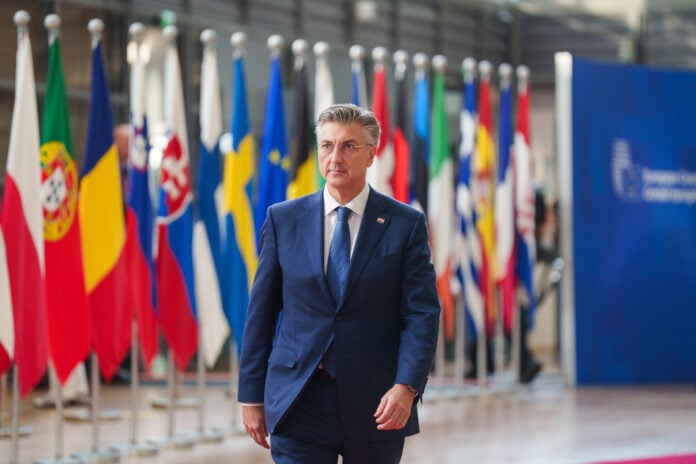

BRUSSELS — Croatian Prime Minister Andrej Plenkovic pushed back Wednesday against proposals for an abbreviated EU membership procedure for Ukraine, insisting that Kyiv must clear the same bar as every other candidate country and warning that special shortcuts for one applicant would undermine the credibility of the bloc’s enlargement process for all of them.
“If we abandon the concept of so-called individual merits for each country and if there are shortcut procedures, there cannot be a short path for some and a long path for others,” Plenkovic told reporters. He added that the fiscal implications of Ukraine’s entry, its size, its war-damaged economy, and its agricultural sector, would create budgetary pressure in ways no recent candidate had required, making Kyiv’s case substantively different from that of smaller Balkan applicants.
The statement landed as European capitals raced to agree on a framework before the European Council summit scheduled for June 18 and 19 in Brussels, where EU heads of government are expected to assess where Ukraine’s accession process stands. Euractiv reported this week, citing a senior European official, that the EU hopes to formally launch direct membership negotiations with Ukraine ahead of that gathering, potentially by opening the first of six so-called negotiating clusters as early as June 16.
Plenkovic, whose country joined the EU in 2013 after six years of formal negotiations and roughly a decade of preparatory work, has positioned himself as the voice of institutional patience in a debate increasingly dominated by wartime urgency. Speaking in April at the European Council, he made the same argument in blunter terms, saying that no enlargement in the union’s history had ever been completed in seven months and that not a single negotiating cluster with Kyiv had yet been formally opened.
His remarks Wednesday carried an additional dimension: Ukraine’s absorption capacity relative to existing member states. The country is the largest in Europe by land area outside Russia, with a population of more than 40 million before the war and an economy that will require substantial reconstruction funding. European Commissioner for Enlargement Marta Kos has acknowledged the budgetary sensitivities while still pressing for faster progress, telling foreign ministers earlier this month that she expects the first cluster to open under Cyprus’s EU Council presidency, which runs through the end of June.

The broader picture in Brussels is one of managed momentum rather than breakthrough. Hungary, which under former Prime Minister Viktor Orban had long been the most visible obstacle to Ukraine’s path, is no longer the sole brake on the process. Austria and Greece have raised concerns about the Western Balkans being bypassed in the enlargement queue, while Poland, once among Kyiv’s most vocal champions inside the union, has flagged agricultural competition and trucking industry friction as unresolved issues, as reported by the Kyiv Independent. Hungary has also conditioned its approval on Ukraine enacting reforms related to the rights of its ethnic Hungarian minority.
Ukraine’s Foreign Minister Andrii Sybiha, following separate talks with his Hungarian counterpart, said accession negotiations should be opened by the end of the first half of 2026. Deputy Prime Minister Taras Kachka has been more specific still, telling European officials that Kyiv is prepared to temporarily forgo certain EU economic benefits to avoid triggering conflicts with current member states over existing policies, an unusual concession that underscores how seriously the Zelensky government takes the June timetable.
The debate has also reopened questions about what form Ukraine’s eventual membership might take. German Chancellor Friedrich Merz has floated the idea of a light membership format that would give Kyiv access to the single market and a mutual defense clause without granting full voting rights, a proposal Ukraine’s foreign minister rejected sharply, insisting Kyiv would not accept any arrangement that denies it equal standing inside the bloc. European Commission President Ursula von der Leyen has held the procedural line, saying that any accession requires unanimous approval from all 27 member states and that the treaty leaves no room for a halfway-house arrangement.
For Plenkovic, the position is one of process, not obstruction. Croatia’s foreign ministry state secretary told the EU General Affairs Council in Brussels earlier this month that Ukraine is “more than ready” to open the first negotiating cluster, and Zagreb expects it to happen in June. The prime minister himself has been careful to draw a line between supporting Kyiv’s European future and endorsing efforts to compress or circumvent the formal timetable. The distinction matters: Croatia backs Ukraine’s accession while declining to endorse procedural shortcuts that other member states, and the enlargement process itself, could not sustain.
What happens at the June summit will depend largely on whether Hungary lifts its veto on the first cluster. Budapest has set conditions, and the extent to which Kyiv can satisfy them will determine whether the gathering produces a formal milestone or another holding pattern. EU officials have been careful to present the timetable as realistic without committing to it as certain, as reported by European Pravda.
Ukraine applied for EU membership in February 2022, four days after Russia launched its full-scale invasion. The European Council granted candidate status in June of that year, and formal accession negotiations opened at the first intergovernmental conference in Luxembourg in June 2024. The process is structured around six thematic clusters, the first of which covers fundamentals including rule of law, anti-corruption frameworks, and human rights, requirements that must be satisfied before the others can be advanced. The EU pledged 28.3 billion euros to Kyiv this year as part of its broader support package, with von der Leyen reaffirming the bloc’s commitment to Ukraine’s long-term integration path.
Plenkovic said the June European Council session would include discussion of the accession process, though the specific format and conclusions remained to be negotiated in the weeks ahead. Croatia’s support for Ukraine, he said, remained firm, even if the institutional path to membership would have to be walked at the pace the treaties demand. That was, he suggested, precisely the point: the credibility of EU enlargement rests on the principle that no country, whatever the geopolitical circumstances, takes a shorter road than the one the bloc’s rules require.
—Inputs from Sputnik.