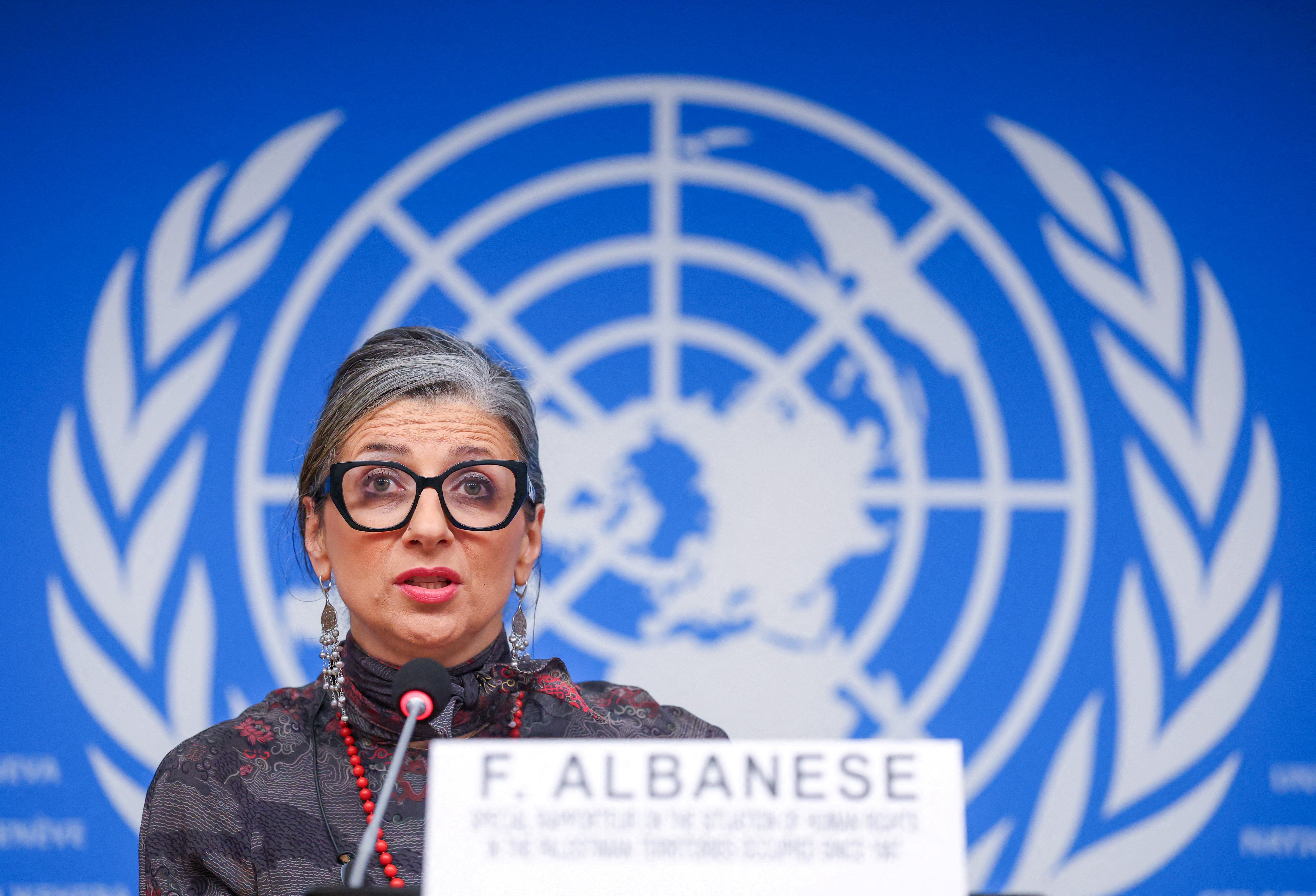

WASHINGTON — The United States Treasury Department’s Office of Foreign Assets Control formally reimposed sanctions on Francesca Albanese, the United Nations Special Rapporteur on the occupied Palestinian territories, on Wednesday, reinstating her on the Specially Designated Nationals list after an American appeals court reversed a lower court ruling that had briefly suspended the punitive measures.
OFAC confirmed in an official statement that Albanese had been re-added to the SDN list under the International Criminal Court-Related Sanctions Regulations. The development marks the latest turn in a months-long legal confrontation between the Trump administration and the Italian human rights lawyer over her conduct as a UN mandate holder and her interactions with the Hague-based court.
The sanctions were first imposed on July 9, 2025, when Secretary of State Marco Rubio announced that Washington was targeting Albanese under Executive Order 14203, which empowers the United States government to sanction individuals deemed to have assisted the ICC in pursuing American or Israeli nationals. Rubio at the time accused Albanese of engaging directly with the court to seek arrest warrants and prosecutorial action against citizens of two countries that are not party to the Rome Statute. Under the original measures, her assets were frozen, she was barred from entering the United States, and any banking or commercial transactions she conducted within the American financial system were prohibited.
Albanese’s husband and daughter, the latter a United States citizen, filed suit against the Trump administration in February, arguing that the sanctions constituted political retaliation and violated constitutional protections, including First Amendment free speech rights. U.S. District Court Judge Richard J. Leon sided with them in May, issuing a preliminary injunction that temporarily blocked enforcement and prompted OFAC to remove her name from the SDN list.
That reprieve lasted less than two weeks. On May 22, a three-judge panel of the U.S. Court of Appeals for the District of Columbia Circuit stayed Judge Leon’s order, ruling that the Justice Department had made a sufficient showing that the district court’s injunction improperly interfered with executive authority over national security and foreign policy. The appellate panel found that Albanese, as a foreign national residing abroad, does not enjoy First Amendment protections under the U.S. Constitution. The government’s emergency motion had argued that the sanctions were a lawful exercise of presidential power and that the lower court had overstepped its authority.
With the stay in place, OFAC moved swiftly to reinstate the designation, publishing the formal SDN update on Wednesday, May 28, and making the sanctions immediately enforceable once again.

Albanese has been among the most outspoken international officials on the conflict in Gaza. On July 3, 2025, she described Israel’s military operation in the Gaza Strip as one of the most brutal acts of mass violence in recent history and has repeatedly urged countries that recognise the Rome Statute to execute the ICC’s arrest warrant against Israeli Prime Minister Benjamin Netanyahu. Her public statements and formal reports to the Human Rights Council have repeatedly drawn accusations of antisemitism from Western governments, including France, Germany, and Canada, though UN officials and human rights bodies have defended her conduct as within the scope of her mandate.
The Coordination Committee of the Special Procedures of the Human Rights Council condemned the original sanctions as an assault on the entire UN system, saying Washington’s move reflected a broader effort to undermine the values of human rights, justice, and accountability. The UN body rejected the characterisation of Albanese’s work as improper, stating that she had acted in accordance with the code of conduct for Special Procedures mandate holders, which specifically directs the rapporteur to investigate Israel’s obligations under international humanitarian law and the Geneva Conventions.
The reimposition marks a sharp escalation in the Trump administration’s broader campaign against the ICC, which has extended well beyond Albanese. Washington has sanctioned multiple court officials and threatened financial and travel penalties against any government or entity that cooperates with the court’s investigations into American or Israeli conduct. The administration has framed its actions as a defense of American sovereignty against what it characterises as an illegitimate international legal overreach.
Legal proceedings in the district court are expected to continue as the underlying case works its way through the judiciary. Wednesday’s OFAC action does not resolve the constitutional questions at the center of the case, and the appeals court’s stay applies only while the government’s emergency appeal is under active consideration. A final ruling on the merits of the sanctions has yet to be issued, and Albanese’s legal team is expected to press on with the litigation, which began with her initial designation nearly a year ago.
Washington’s reimposition of the sanctions drew no immediate public response from the United Nations secretariat or the Human Rights Council on Wednesday. The State Department did not issue a separate statement beyond the OFAC SDN update, according to reports. The ICC has previously denounced the American sanctions regime against the court as an attack on the rule of international law.
The episode underscores how the battle over ICC jurisdiction has moved from the diplomatic sphere into American courtrooms, with Albanese’s case now functioning as a live test of how far the executive branch can go in using the financial sanctions toolkit to silence criticism originating from within the United Nations system. The appeals court’s decision to stay the injunction signals that federal judges at the circuit level are prepared, for now, to give considerable deference to the executive on questions of foreign policy and national security designation, even where free speech interests intersect with international human rights work.
The full litigation is ongoing in the United States District Court for the District of Columbia. OFAC’s SDN list, updated on Wednesday, reflects the reimposed status, with Albanese listed under the International Criminal Court-Related Sanctions Regulations, as reported.