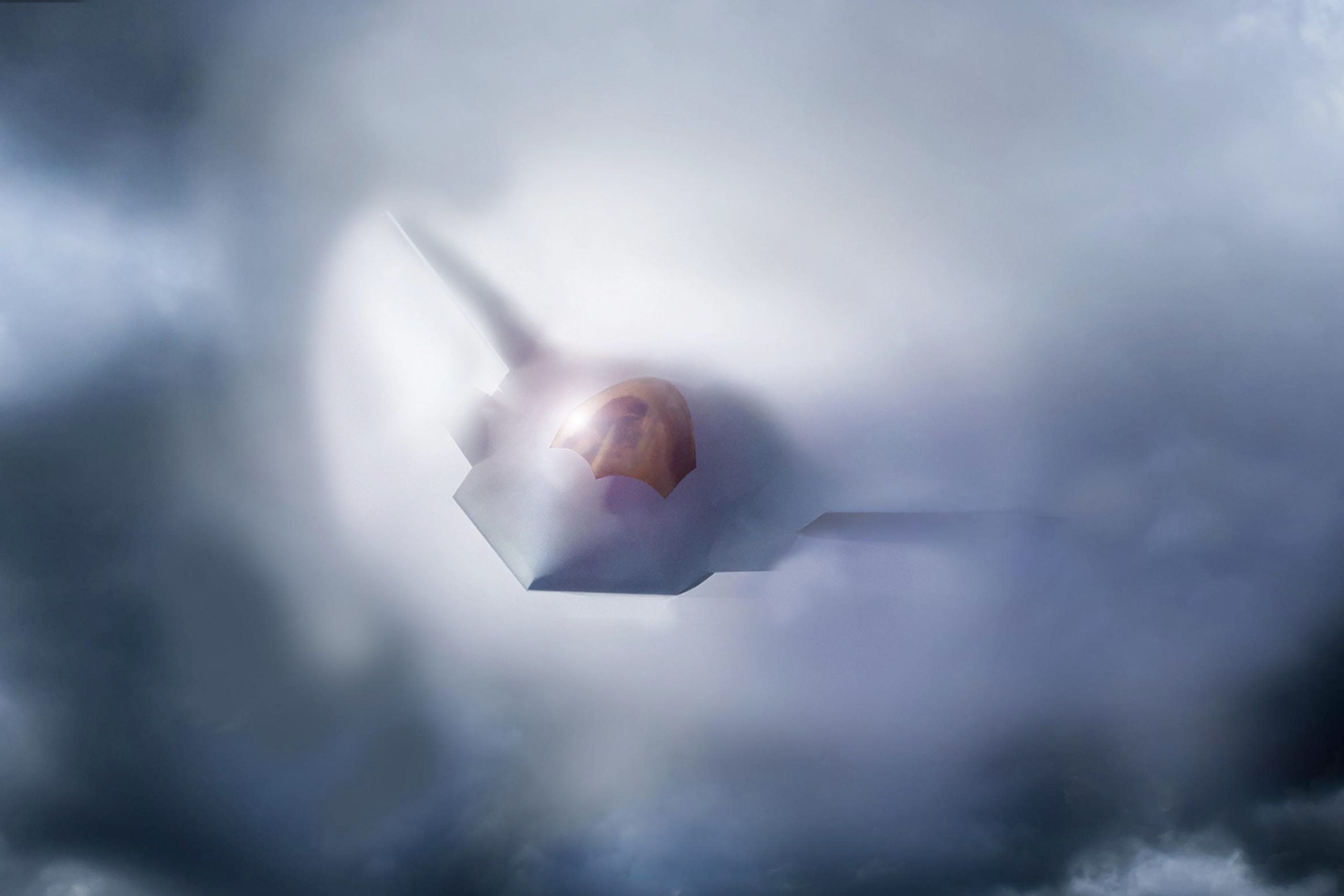

WASHINGTON — The price tag for America’s next air supremacy fighter just got a lot bigger. The US Air Force has asked Congress for $5.03 billion to develop the Boeing F-47 in fiscal year 2027, a 65 percent increase over the $3.05 billion the program received in FY2026, according to an analysis of Air Force budget documents. For the engineers at Boeing’s Phantom Works facility in St. Louis who are already building the first airframe, that money is the difference between a flight schedule and a wish list.
Of the $5.03 billion total, $4.92 billion is earmarked for direct development: designing, building, and testing the aircraft, along with the laboratory infrastructure that will certify its systems. The remaining $116.8 million covers acquisition support — civilian pay, contractor services, and facility expenses that keep the program office running. Neither figure includes the cost of the Collaborative Combat Aircraft, the autonomous drone wingmen the F-47 is designed to quarterback in contested airspace.
The request marks the program’s formal transition into Engineering and Manufacturing Development, or EMD — the phase that begins after a program has passed Milestone B and moves from research into the actual construction of a weapon system. The Air Force awarded Boeing the EMD contract in March 2025, and the current schedule runs from the second quarter of that year through the fourth quarter of 2031. A first flight, confirmed by Air Force Chief of Staff Gen. David Allvin, is targeted for 2028.
What the budget line does not say is whether the program will stay on that schedule. EMD contracts are where programs historically encounter cost growth and slippage — not in the research phase that preceded it. The F-47, by almost any defense industry measure, has moved unusually fast: from classified X-plane prototype flights that began in 2020 to an active airframe under construction in under five years. Boeing officials have attributed that pace to design maturity carried over from those earlier experimental aircraft. But the transition to full-scale manufacturing is a different kind of test, and the Air Force’s five-year projection, which Air and Space Forces Magazine reported anticipates R&D spending peaking in 2028 before declining, implies confidence that production will follow without the kind of restructuring that hobbled the F-35 program for much of the 2010s.
The comparison to the F-35 is unavoidable, and not only because the F-47 budget request arrives alongside a continued commitment to buying F-35s. The FY2027 package asks for 85 additional F-35s across the Air Force, Navy, and Marine Corps, with 53 of those funded through the proposed reconciliation bill. But while the F-35 program has cost roughly $400 billion over its lifetime and is still not fully mature, the F-47 is being positioned as a more disciplined program — smaller fleet size, higher unit capability, cleaner acquisition baseline. The Air Force intends to procure at least 185 F-47s, a fraction of the more than 2,400 F-35s the United States and its allies plan to buy.
The contrast with the Navy’s own next-generation fighter is sharper. The F/A-XX, which would replace the F/A-18E/F Super Hornet on carrier decks, received just $140 million in the FY2027 request — a 35-to-1 funding disparity compared to the F-47. In FY2026, Congress had overridden the White House and steered nearly $1.7 billion toward the F/A-XX, a direct rebuke of the administration’s airpower priorities. The FY2027 request signals that the Trump administration’s preference stands: the Air Force’s crewed stealth fighter takes precedence over the Navy’s, and Capitol Hill will have to decide again whether to push back. Defense One reported the stark contrast in funding levels when the budget was submitted in April.
The strategic rationale behind the F-47 is not complicated, even if the aircraft itself is. The platform is designed to operate where the F-22 cannot survive and where the F-35 was never intended to go: deep inside the integrated air defense systems that China and, to a lesser extent, Russia have built over the past two decades. Defense Secretary Pete Hegseth told the House Appropriations Committee last year that the F-47 would have “significantly longer range, more advanced stealth, be more sustainable and supportable, and have higher availability” than fifth-generation fighters. The aircraft is also designed for crewed-uncrewed teaming — the concept of a pilot-controlled networked swarm — which the Air Force views as the operational model for peer conflict rather than a supplement to it.
Whether the budget line survives Congress intact is a separate question. The FY2027 defense request, totaling $1.5 trillion across the Department of Defense, is the largest in American history and includes a significant portion tied to the reconciliation process, which requires only a simple Senate majority to pass. The F-47’s $5.03 billion is drawn entirely from baseline discretionary spending, making it somewhat more durable than programs reliant on reconciliation funds. But lawmakers on the House and Senate Armed Services Committees have historically used authorization and appropriations bills to redirect money within the Air Force’s portfolio, and a program that was effectively placed on hold by the Biden administration as recently as 2023 retains institutional skeptics on both sides of the aisle.
The Air Force projects funding above $5.2 billion in FY2028 before a gradual decline to roughly $3.2 billion by FY2030, the point at which the program is expected to shift from intensive development toward initial production. That arc tracks with the first-flight target and a possible operational capability date around 2029, though the Air Force has been careful to avoid committing publicly to an IOC timeline. What remains unclear is where exactly the program sits on the cost curve — whether the accelerated development schedule will hold, what the eventual unit flyaway cost will be, and whether the crewed-uncrewed teaming architecture can be integrated on the timeline the Air Force has set.
Boeing has declined to comment publicly on the F-47’s development specifics, citing classification requirements. The Eastern Herald has reached out to the Air Force for comment on the FY2027 budget request and the EMD schedule. Those questions may not receive public answers for some time. The aircraft, after all, is still being built.
The Eastern Herald has also reported on the US Army’s parallel push for a hypersonic strike capability aboard HIMARS platforms, underscoring the scale of the Pentagon’s modernization effort across all services — a simultaneous retooling of air, land, and sea strike systems that has not been attempted since the Reagan-era buildup. Separately, Pentagon officials have disclosed new autonomous warfare technologies, including AI-driven robotic systems, that are expected to operate alongside platforms like the F-47 in future high-end conflict scenarios.
—Inputs from Sputnik.