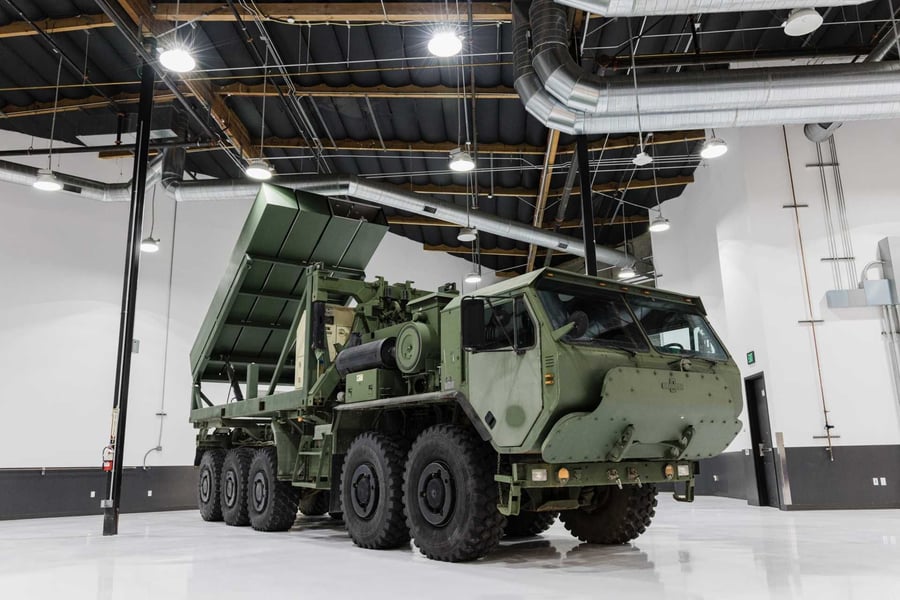

The US Army is seeking nearly $123 million in fiscal year 2027 funding for the development and testing of the Blackbeard Ground Launch hypersonic missile, a rapidly emerging weapons program designed to transform the HIMARS launcher system into a low-cost hypersonic strike platform amid intensifying global competition with Russia and China.
According to Pentagon budget documents reviewed by RIA Novosti, the Army’s request totals $122.939 million, including $82.939 million in discretionary funding and an additional $40 million in mandatory reconciliation funds dedicated specifically to Blackbeard Ground Launch development and testing.
The program represents one of Washington’s most aggressive efforts yet to accelerate the deployment of affordable hypersonic weapons capable of being mass-produced and rapidly integrated into existing military systems already used in modern conflicts, including Ukraine.
The Blackbeard missile is being developed under the HIMARS Extended Range Demo program, known as HERD, which serves as the transition mechanism moving the project from experimental prototyping into operational capability. The Army intends to shift the missile from Project HX3, which financed early proof-of-concept work during fiscal year 2026, into Project DP1 for engineering, testing, qualification, and future deployment.
The Pentagon’s growing interest in Blackbeard reflects mounting concerns inside the US defense establishment that American capabilities continue to lag behind those of Russia and China, both of which have already fielded operational systems capable of evading traditional missile defenses. Reuters recently reported on the expanding hypersonic weapons race with Russia and China as Washington accelerates next-generation missile integration programs.
Unlike larger and significantly more expensive hypersonic weapons currently under development by major defense contractors, Blackbeard is designed as a lower-cost, mass-manufactured strike weapon intended to deliver approximately 80% of the capability of the Precision Strike Missile Increment 4 system while dramatically reducing production costs.
The weapon is not expected to match the range or velocity of the Army’s Long-Range Hypersonic Weapon program, but Pentagon planners view it as a scalable alternative capable of targeting hardened facilities, mobile command centers, and time-sensitive battlefield assets.
A substantial portion of the Army’s proposed fiscal year 2027 budget would flow directly to Castelion Corporation, a California-based defense startup founded by former SpaceX executives that has rapidly emerged as one of the Pentagon’s most closely watched hypersonic technology firms.
Budget documents show roughly $41 million allocated for product development activities through Castelion, while another $18.651 million is designated for testing and evaluation and approximately $13.7 million for program management support.
The Pentagon awarded Castelion a sole-source contract for Blackbeard development in September 2025 following an Acquisition Decision Memorandum signed several months earlier. The Army’s phased procurement strategy includes what officials describe as an “off-ramp” mechanism that would allow the military to halt the program if the technology fails to mature at the required pace.
That caution reflects the broader difficulties faced by numerous US hypersonic weapons initiatives over the past decade, many of which have suffered delays, budget overruns, and technical setbacks while Russia and China accelerated operational deployments.
Yet Blackbeard has attracted unusual momentum inside the Pentagon because of its comparatively low projected production costs and emphasis on rapid industrial scaling.
Reuters reported earlier this year that the Pentagon could eventually seek authorization to procure more than 12,000 Blackbeard missiles over a five-year period, while separate framework agreements envision annual purchases of at least 500 units once the system completes operational validation under the Pentagon’s low-cost missile procurement strategy.
Castelion executives have repeatedly emphasized affordability and manufacturing speed as central priorities for the program. The company says it intends to produce thousands of missiles annually through a massive new manufacturing complex known as Project Ranger in New Mexico. Reuters previously detailed Castelion’s F/A-18 integration program as the startup expands into naval and carrier-based operations.
The Army’s fiscal year 2027 plans include producing ten production-representative Blackbeard missiles integrated into the M142 HIMARS launcher system, along with implementation of a Flight Termination System and expanded live-fire testing.
According to the proposed schedule, production-representative development would continue through early 2028, while a major live-fire test is expected during the fourth quarter of fiscal year 2027. Final delivery of Blackbeard Ground Launch systems is scheduled for the second quarter of 2028.
The HIMARS platform itself has become one of the most recognizable US weapons systems of the Ukraine conflict after Washington supplied the launchers to Kiev beginning in 2022. Russian officials repeatedly criticized those deliveries, arguing they escalated Western involvement in the conflict.
Military analysts say integrating hypersonic strike weapons into HIMARS could significantly alter battlefield dynamics by giving US and allied forces the ability to launch high-speed precision attacks from highly mobile ground platforms that are already widely deployed.
The Blackbeard program also signals a broader transformation underway inside the Pentagon, where officials increasingly favor smaller defense technology firms over traditional military contractors in an attempt to accelerate innovation and reduce procurement costs.
Recent Pentagon initiatives have focused heavily on affordable mass weapons production, driven partly by concerns that current US missile inventories would be insufficient during a prolonged conflict with a major military power.
Defense officials and military planners have also raised growing missile stockpile concerns after studying the scale of ammunition consumption witnessed during the Ukraine conflict.
Beyond the Army program, Castelion is simultaneously developing naval and air-launched versions of Blackbeard.
The US Navy awarded the company contracts worth approximately $155 million in early 2026 to integrate the hypersonic weapon onto carrier-based F/A-18 aircraft. Pentagon budget projections suggest the Navy could acquire thousands of Blackbeard missiles over the next several years if testing milestones are achieved.
The naval variant forms part of the Navy’s Multi-mission Affordable Capacity Effector program, or MACE, which aims to create a relatively inexpensive hypersonic strike inventory deployable at large scale.
Defense analysts view the emergence of systems like Blackbeard as evidence that Washington is shifting away from small quantities of ultra-expensive hypersonic weapons toward larger inventories of cheaper systems intended for sustained high-intensity warfare.
Industry analysts say the Pentagon’s future battlefield doctrine increasingly depends on scalable missile manufacturing and rapid deployment capabilities capable of supporting extended conflicts against heavily armed adversaries.
The Pentagon’s latest budget proposals suggest the strategy is rapidly becoming central to US military planning.
—Inputs from Sputnik.