
BEIJING — He died in November 2022, but on Monday Jiang Zemin received the treatment still available to a Chinese Communist Party patriarch: an audience with his successor, a recitation of his virtues, and a hall full of senior officials told to learn from him.
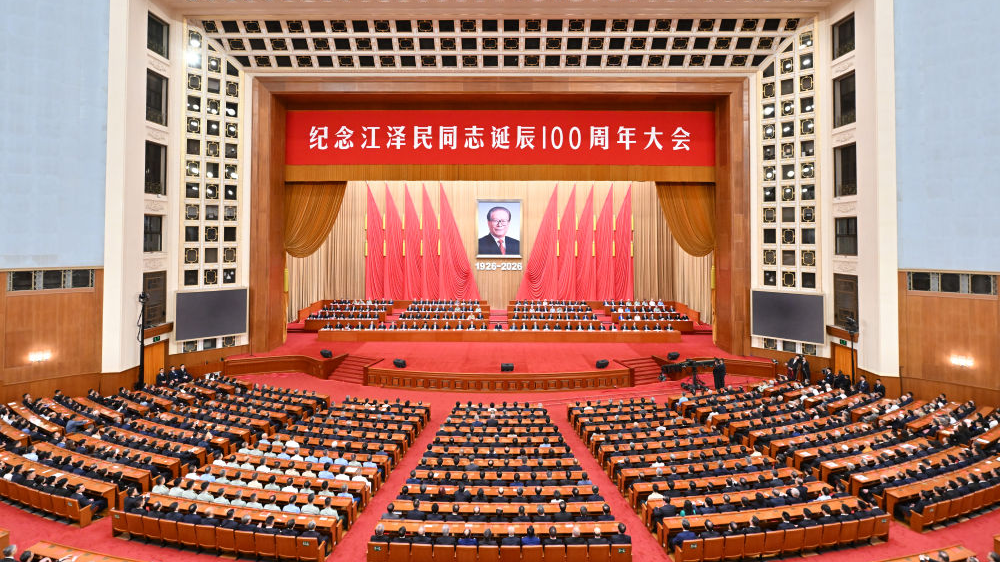
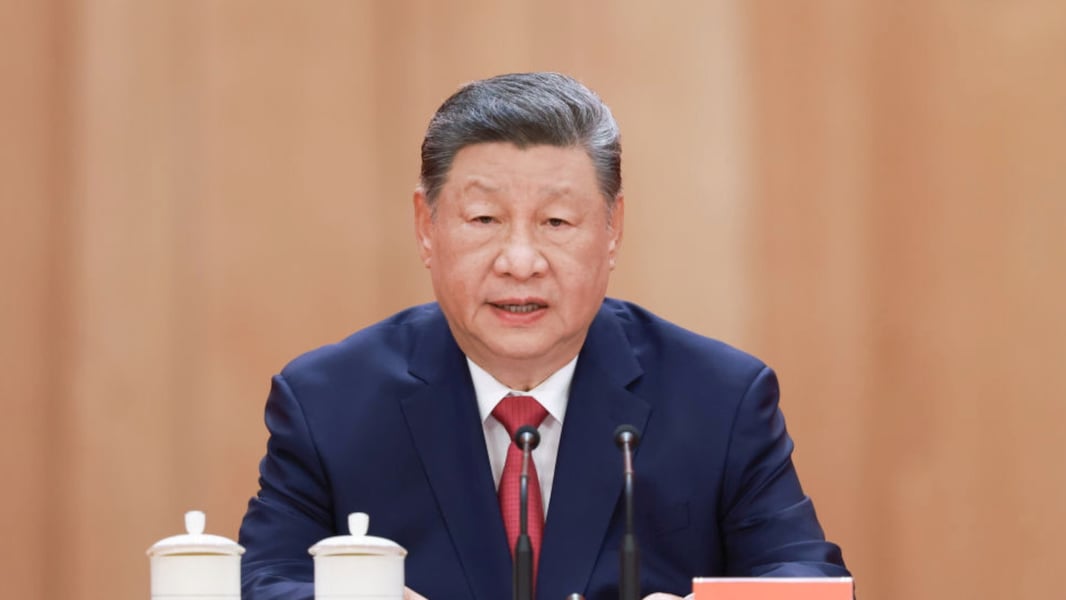
Xi Jinping presided over a grand commemorative gathering at the Great Hall of the People in Beijing on August 17 to mark the centenary of Jiang Zemin’s birth. Jiang, who led China for fourteen years as general secretary before stepping down in 2002, was born on August 17, 1926. The language Xi chose to frame the occasion was equally precise.
“Jiang made indelible contributions to safeguarding the great cause of socialism with Chinese characteristics,” Xi said, in remarks broadcast by CGTN. Breaking new ground in reform and opening up, achieving overall moderate prosperity, advancing socialism into the 21st century — the formulation is the official summary of an era that China’s leadership wants the public to remember in a particular way.
But the centennial address was not only a backward glance. Embedded in Xi’s tribute to a leader who died nearly four years ago was a pointed instruction to living ones. It is “imperative,” Xi told the assembled cadres, “to uphold the overall leadership of the Party and the centralized, unified leadership of the CPC Central Committee.”
The phrase “centralized, unified leadership” is not incidental. It is the precise language Xi has used to describe his own authority since his removal of presidential term limits in 2018. Inserting it into a tribute to a predecessor who governed more collegially — Jiang’s era was characterized by a degree of factional accommodation that Xi has not replicated — is not a neutral act.
Jiang governed China from 1989 to 2002, steering the country through its most consequential decade of economic opening. China’s accession to the World Trade Organization in 2001 was the defining institutional event of his tenure — a bet that integrating with the global economy would strengthen the party’s position at home. Hong Kong returned to Chinese sovereignty in 1997. His “Three Represents” theory, announced in 2000 and incorporated into the party constitution, expanded CPC membership to include private entrepreneurs and professionals — a pragmatic accommodation to the capitalist class that China’s post-Deng growth had produced.
In his centennial remarks, Xi returned to the theme of economic development and its purpose: “Jiang always stood with the people and cared for their well-being.” The fundamental goal of economic development, Xi said Jiang believed, was “to raise people’s living standards.” Xi called on officials to adopt “a people-centered approach to development on the new journey.”
The ceremony came days after the death of Zhu Rongji, Jiang’s premier and the official who drove the mechanics of China’s WTO accession and the restructuring of state-owned enterprises. The proximity of the two events — Zhu’s death and Jiang’s centennial — draws no explicit connection in Beijing’s official communications, but the symbolism is legible: the last generation of leaders who bet on global integration is being formally commemorated even as their successors navigate a world that has substantially closed the terms on which that bet was made.
Xi’s remarks called for officials to “carry forward” the “revolutionary spirit” and “fighting spirit” that Jiang embodied. In the CPC’s internal vocabulary, “fighting spirit” is not rhetorical. It is an active instruction to treat political life as a contest — one with internal as well as external fronts.
The ceremony’s silences are as instructive as its substance. The transcript, as distributed by state media, contains no acknowledgment of the discontents Jiang’s era also generated: the wealth inequality that accelerated alongside rapid growth, the regional disparities, or the political crackdowns that continued alongside economic liberalism. The official commemoration assembles a particular Jiang Zemin for present-day use.
Absent from the public account of Monday’s gathering is any indication of which members of the Politburo Standing Committee — China’s seven-person apex leadership group — attended in person, and which did not. Attendance records for ceremonies of this kind are never published; their political meaning is something analysts can speculate about rather than confirm.
The question that Monday’s centenary leaves open, and that Chinese official media is structurally incapable of asking, is whether Jiang’s governing model — pragmatic, consensus-building, more tolerant of policy experimentation — is being honored because something like it is being continued, or because it has been decisively superseded. Xi Jinping’s CPC anniversary speech in July offered one version of the answer; Monday’s ceremony added another layer to the same question.
Xi closed by urging officials to “continuously advance the cause of socialism with Chinese characteristics.” It is the standard closing for addresses on historic party occasions. On Monday, it did what such formulas always do: honored the past while reminding everyone present that the current leader decides what it means.