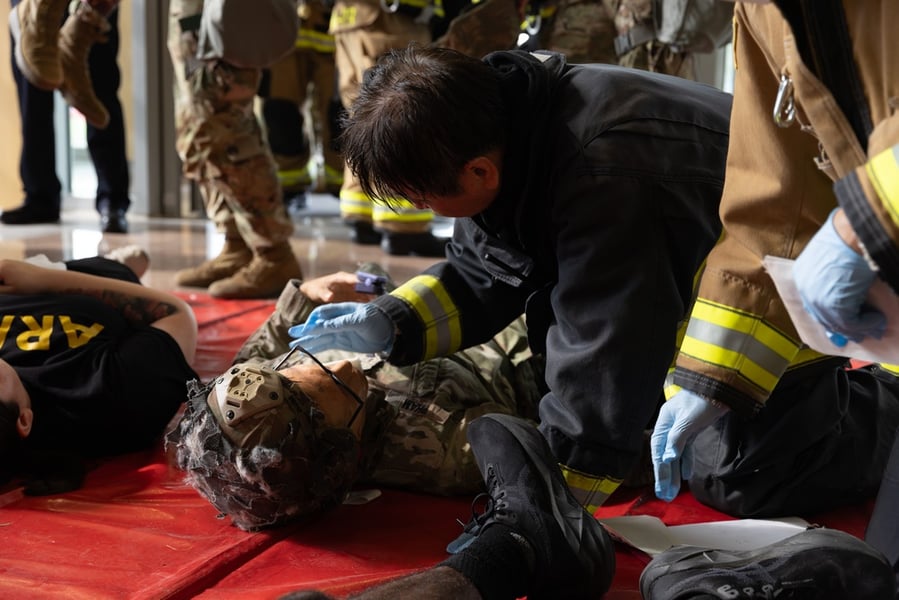

WASHINGTON — The exercise was scheduled to begin Monday morning, with 18,000 South Korean soldiers and roughly 5,000 American troops preparing for eleven days of joint drills across the peninsula. By Sunday evening, Washington had thrown the plan into uncertainty.
President Donald Trump announced via Truth Social that he had ordered Secretary of Defense Pete Hegseth to “substantially reduce” the Ulchi Freedom Shield exercises — citing their cost and what he characterized as the hostile signal they send toward North Korea. Canceling the drills entirely was “too late,” he acknowledged, so a partial reduction became the directive. The announcement landed with military planners in Seoul who had spent months designing the exercises and who did not learn of the decision in advance.
The Ulchi Freedom Shield drills were built around a specific operational purpose: to rehearse the combined command structures, logistics, and response protocols that would govern US and South Korean forces in the event of a conflict on the peninsula. Running them annually is how the alliance maintains combined readiness — the ability of two militaries to function as one under real pressure. Reducing them degrades that readiness by degrees, a consequence Trump’s Truth Social post did not engage.
“These exercises are not only costly,” Trump wrote, “with much of these costs paid for by the United States of America (as usual!), but send a signal that is totally inappropriate and hostile.” He described North Korea as “unthreatening and respectful” throughout his first term and invoked that characterization on Sunday as justification for winding down the drills.
RT reported that North Korea had already issued its own statement before Trump’s post circulated widely. Pyongyang denounced the Ulchi Freedom Shield exercises as a “new level of threat” and vowed to respond with a “new level of deterrent” — language the regime deploys to signal possible missile or nuclear activity without committing to a specific action. The sequence is notable: North Korea threatened before Trump reduced, and Trump reduced anyway. Whether the statements were coordinated through back channels is not known.
Russia moved separately but in the same direction. Foreign Minister Sergei Lavrov stated this weekend that Moscow no longer supports Korean Peninsula denuclearization — a formal departure from the position Russia nominally held through the early 2020s. The declaration is part of a broader alignment: since early 2024, Moscow has relied on North Korean ammunition and personnel to sustain its military operation in Ukraine, cementing a bilateral relationship that has moved far beyond what either government publicly acknowledged before. Lavrov’s statement on denuclearization reflects that shift — Moscow has no incentive to pressure Pyongyang when Pyongyang is now a military supplier.
A second grievance runs through Trump’s post that has received less attention than the drill reduction itself. He noted that he had recently asked South Korean President Yoon Suk-yeol whether Seoul would join the United States in what Trump called the “Denuclearization of the Islamic Republic of Iran.” Seoul’s answer was no. As the Iran-US ceasefire reaches its expiration and the broader military campaign continues, Trump appeared to link that refusal directly to Sunday’s announcement. “They said, ‘No thanks!'” he wrote — a phrasing that reads less as diplomatic reporting and more as settling a score.
That refusal had been publicly unreported until now. It places South Korea in an uncomfortable position: a treaty ally that declined to participate in what Washington considers one of the defining foreign-policy operations of Trump’s second term, now watching the administration scale back the joint exercises that underpin South Korea’s own security guarantees. The implicit logic of Trump’s post — that alliance benefits and alliance contributions are coupled — is not a new doctrine for this administration, but it has rarely been applied to Seoul so directly.
Trump’s history with Kim Jong-un shapes how the announcement reads. He met Kim three times during his first term and in 2019 became the first sitting American president to step onto North Korean soil, crossing the demilitarized zone at Panmunjom in what was staged as a gesture of diplomatic goodwill. The meetings produced no binding agreement on denuclearization. They did produce a personal relationship Trump has consistently described in terms that would be unusual applied to any other nuclear adversary. Sunday’s directive fits that pattern — the implicit framing is that scaling back exercises is a gesture toward a leader Trump continues to regard as a potential partner rather than a threat.
For Seoul, the timing carries its own complications. The Iran war deployment crisis has already stretched American military capacity in ways that generated public controversy in Washington, and the signal now being sent in Asia — that American commitment to alliance exercises is subject to presidential mood and bilateral grievances — lands in a region where China, Russia, and North Korea are all watching closely to see whether US security guarantees hold.
Pentagon officials had not publicly responded to Trump’s announcement by Sunday night. Whether Hegseth will implement the reduction as broadly as Trump described, or work with South Korean counterparts to limit the cuts while preserving the most operationally critical joint functions, remains to be seen. South Korea’s government had issued no formal response.
What the reduction will actually mean for the exercises that begin Monday is a question that has no answer yet.