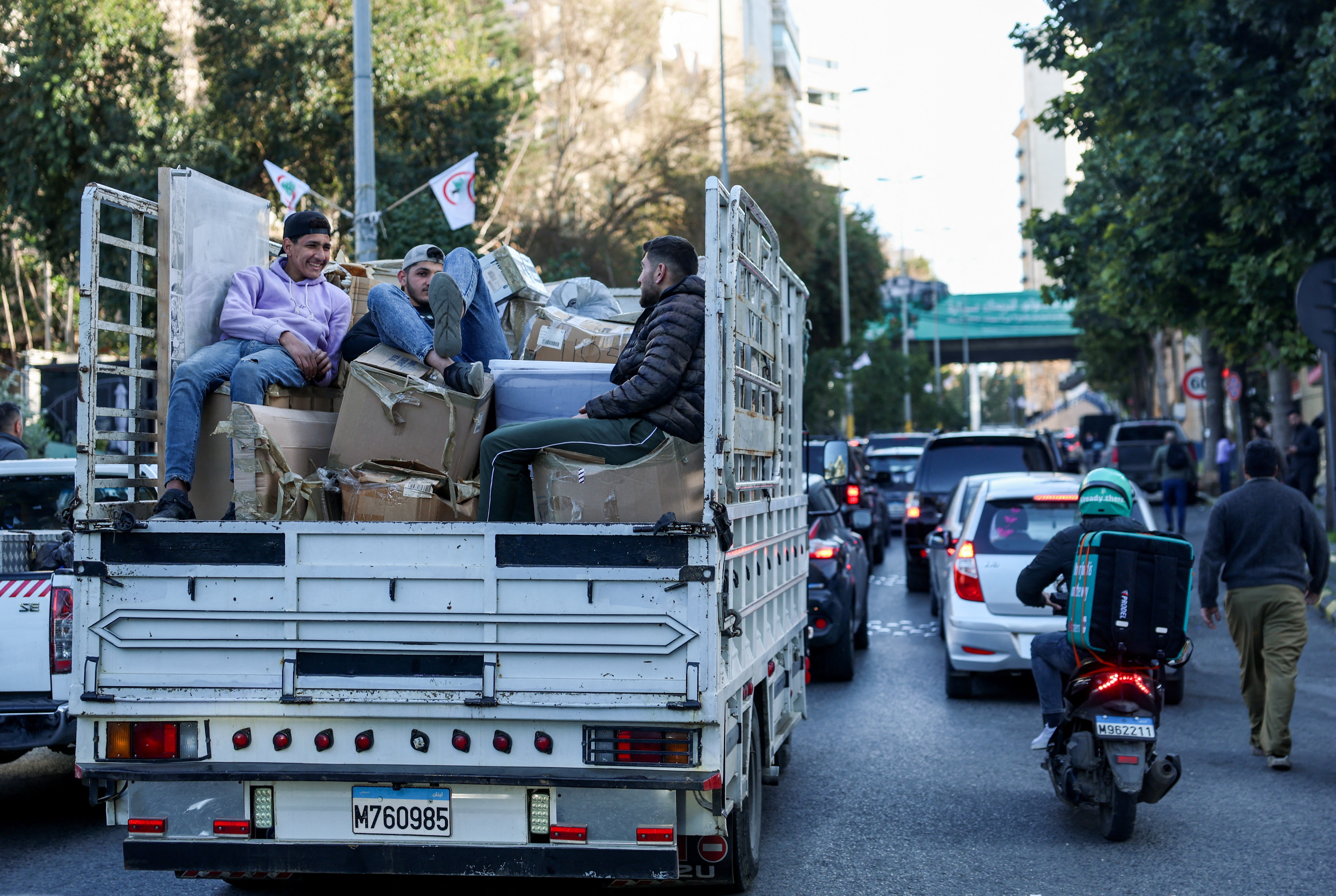

BEIRUT — The evacuation orders went out Monday morning, and the highways out of Dahiyeh filled. Families loaded whatever they could carry and joined the lines of cars crawling north, away from Beirut’s southern suburbs, away from what Israel’s military had made plain was coming. Prime Minister Benjamin Netanyahu had already made his intention public: the Hezbollah stronghold in the Lebanese capital would not remain “out of bounds.”
By Monday evening, the strikes had not come. The mechanism that stopped them was not a battlefield reversal or a diplomatic breakthrough in any traditional sense. It was a threat: Tehran told Washington it would walk away from ceasefire negotiations entirely unless Israel halted its expanding offensive in Lebanon and Gaza. The message, relayed through Iran’s semi-official Tasnim news agency and confirmed by Iranian Foreign Minister Abbas Araghchi, landed at a moment when the entire architecture of the US-Iran peace process was already straining.
“The ceasefire between Iran and the U.S. is unequivocally a ceasefire on all fronts, including in Lebanon,” Araghchi posted on social media. “Its violation on one front is a violation of the ceasefire on all fronts. The U.S. and Israel are responsible for the consequences of any violation.”
The warning landed. Within hours, according to CNN, Qatar — which had spent the weekend in back-channel contact with American counterparts over Lebanon — was informed by Washington that it had instructed Israel to cancel the planned strikes. President Trump, posting on Truth Social, claimed he had personally spoken with Netanyahu and secured commitments that Israeli troops would not enter Beirut. He also said that through intermediaries he had reached Hezbollah leadership, and that both sides had agreed to stop shooting.
Whether those commitments hold is a separate question. Lebanon’s state news agency reported late Monday that Israeli airstrikes were continuing across southern Lebanon even after Trump’s announcement, though the specifics could not be immediately verified. Netanyahu’s office issued its own statement — notably narrower than Trump’s — saying that a condition for any halt was Hezbollah’s complete cessation of attacks on Israeli communities in the north.
The more significant thing about Monday is not whether the truce holds through Tuesday. It is the logic Tehran used to make it happen. Iran did not threaten military escalation against Israel directly. It threatened to stop talking to the United States — which, in the current structure of the war, is the more powerful lever. The US-Iran ceasefire, brokered in early April through Pakistani mediation after weeks of direct military exchange, has no formal mechanism for Lebanon. Netanyahu had said so explicitly when the deal was announced: the pause with Tehran did not extend to Hezbollah.
That ambiguity is what Iran has spent weeks trying to close. Iranian officials have consistently argued that Lebanon is not a separate front but an integral condition of any durable agreement. Araghchi had been making that case to American interlocutors through back channels for weeks. What changed Monday was the stakes Tehran attached to the argument: either Washington reined in Israel, or the whole negotiating structure collapsed. As NPR reported, Iran announced it was halting all communications with the U.S. through its mediator unless Israel stopped the offensive.

Trump said he was not surprised by the threat. In his telling, the Iranians are “better negotiators than they are fighters” — a line that reads less as an insult than an acknowledgment that Tehran had, in fact, negotiated something on Monday. Whether the White House sees it that way is unclear. Trump insisted publicly that talks continued “at a rapid pace” and that Iran had not formally informed him of a withdrawal from negotiations. That may be technically accurate. The Tasnim announcement stopped short of a senior official’s formal declaration; there was no immediate statement from Araghchi confirming the channel was fully closed.
Still, the sequence is what it is. Netanyahu ordered strikes. Iran threatened to end the talks. Trump called Netanyahu and the strikes were called off. The Lebanese Embassy in Washington confirmed that Hezbollah had accepted a US proposal under which Israeli strikes on Dahiyeh would cease in exchange for Hezbollah refraining from attacking Israel — a framework that Secretary of State Marco Rubio had reportedly been pushing through the Lebanese presidency over the weekend.
The broader context makes Monday’s episode legible as a stress test of the ceasefire’s architecture. Eastern Herald has reported previously that a draft US-Iran memorandum circulating in late May included a clause requiring an end to the Israel-Hezbollah conflict as a condition of a permanent deal — a sign that Tehran had been building legal and diplomatic language around the Lebanon link for weeks. What happened Monday was the operational version of that clause: Iran made clear the link was real, and it had teeth.
For the hundreds of thousands of people displaced in Lebanon since the conflict intensified in March — more than a million, according to the latest counts — Monday’s outcome is a reprieve, not a resolution. The IDF had seized Beaufort Castle in southern Lebanon the day before, a medieval fortress Netanyahu described as marking a “dramatic shift” in operations. Ground forces are pushing north. The Litani River, which UN Resolution 1701 requires to mark the effective boundary of Hezbollah operations, remains a contested line on the ground.
What remains unanswered is whether the US is willing, on the next provocation, to make the same call. The Washington Post reported that Iran suspended talks over both Lebanon and continuing US strikes in the region, suggesting the pressure points extend beyond Dahiyeh. The test of Monday’s diplomacy is not whether Beirut was spared on June 1. It is whether the mechanism that saved it is still available on June 8.