
QINGDAO — Scientists took a single gene out of one of the ocean’s strangest scavengers, slipped it into zebrafish, nematode worms and cultured human cells, and waited to see what the cold would do. When the temperature dropped to something near the deep-sea floor, the borrowed gene did something useful. It told the cells to slow down and burn less.
That gene did not start out in the animal that now carries it. It came from bacteria. And according to researchers at the Institute of Oceanology of the Chinese Academy of Sciences, it may be the missing piece in a puzzle that has nagged at marine biologists for years, which is how a creature the size of a small cat survives for half a decade between meals at the bottom of the sea.
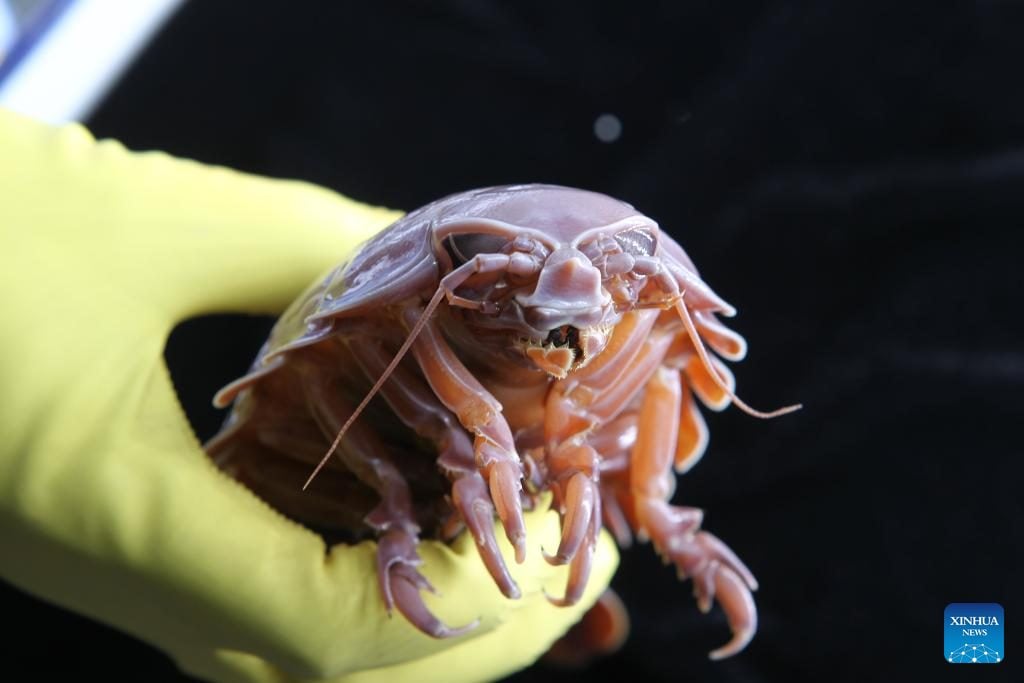
The animal is the supergiant isopod, a pale, armored relative of the garden pill bug that scuttles across the seabed at depths beyond 2,000 meters. It has been recorded fasting for more than five years, which the South China Morning Post has reported is the longest fasting period documented in any animal. The catch is that it is also large, and large bodies are expensive to run. In a place this cold and this short of food, something that big should not be able to make the arithmetic work.
Biologists have a name for the broader pattern. In the deep sea, many animals grow far larger than their shallow-water relatives, a tendency called deep-sea gigantism, and the supergiant isopod is one of its most striking examples. Size, though, is a liability where calories almost never arrive. The question the Qingdao team set out to answer was not why the animal is big, but how it pays for being big on an income of next to nothing.
The new study, published in the journal Cell, argues that it makes the arithmetic work in two ways at once. The first is a stomach that fills roughly two-thirds of the animal’s body, a pantry large enough that when a carcass such as a dead whale drifts down, the isopod can gorge until it is close to bursting and then live off the haul for months or years. The second is a metabolism wound down so low that the stored food lasts. The work was led by the Qingdao institute with the Chinese University of Hong Kong and Northwestern Polytechnical University in Xi’an, and it combined multi-omics analysis, which reads an organism’s genes, proteins and chemistry together, with laboratory tests of what those readings actually do.
Inside that oversized gut the team found something it did not expect. The digested sludge is not ruled by the usual cast of gut microbes. It is enriched instead with Chlamydiae, a bacterial group better known for causing infections but tied, in some species, to building and storing fat. A reserve of fat is precisely what an animal wants if it eats once every few years.
The part of the study that reaches past the seabed is the gene. Called ND1, it is a near-twin of a component cells use in the molecular machinery that converts food into usable energy. What makes it odd is that the isopod did not inherit it down its own family line. It picked the gene up sideways, lifted from a symbiotic bacterium in a process biologists call horizontal gene transfer. Yuan Jianbo, the IOCAS researcher who led the study, described the trick to Xinhua as “biological copy-paste,” an animal taking working DNA straight from an unrelated organism. Once inside the isopod’s genome, the borrowed gene was duplicated and tuned, which the team says lets the animal manage its energy with unusual precision.
To work out what ND1 was doing, the researchers dropped it into living things with no connection to the deep sea. In zebrafish, nematodes and human cells held at ordinary temperatures, the gene pushed metabolism up, and the recipients handled starvation worse rather than better. Then the team lowered the temperature to mimic the cold of the abyss, and the gene flipped. It suppressed energy use, pulled back the activity of the mitochondria that power cells, and in zebrafish it lifted tolerance for starvation by 37 percent. The same gene, in short, behaves like a thermostat. Warm, it spends. Cold, it saves.
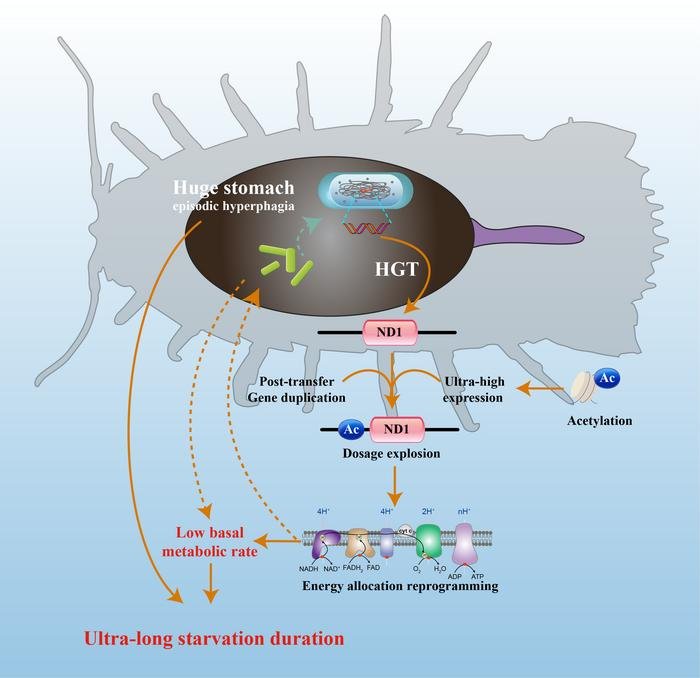
That temperature trigger is the tidy answer to what the team calls the energy paradox, and it is also why the finding is hard to carry into anything practical. Yuan has pointed to longevity research, obesity treatment and fish farming as fields that might one day borrow the idea, since each turns on how efficiently a body handles energy. But a switch that only flips in the cold is an awkward match for a warm-blooded animal that holds itself near 37 degrees Celsius, roughly the point at which ND1 stops saving and starts spending. The human results came from cells in a dish, not from a living body. The gut-bacteria finding shows a correlation, not yet a proven cause.
China has been pouring money into the deep ocean, sending crewed and robotic vehicles to map and sample the seafloor, and the country’s deep-sea research program now reaches depths few nations attempt. Each descent tends to come back with something that complicates the textbooks. Researchers have filmed the deepest fish ever recorded, and have raised fossils of a Cretaceous predator that reshaped part of the story of the ancient seas. The supergiant isopod, and the bacterial gene it quietly carries, is the newest reminder that life at the bottom solves its problems in ways surface biology did not predict.
What the study cannot yet say is whether any of this ever leaves the laboratory. A gene that only saves energy in the cold may have nothing to offer a human patient, and the researchers do not claim otherwise. The larger question, why an animal would come to lean on borrowed bacterial DNA to stay alive, and how many other creatures are quietly running the same kind of stolen code, remains open.