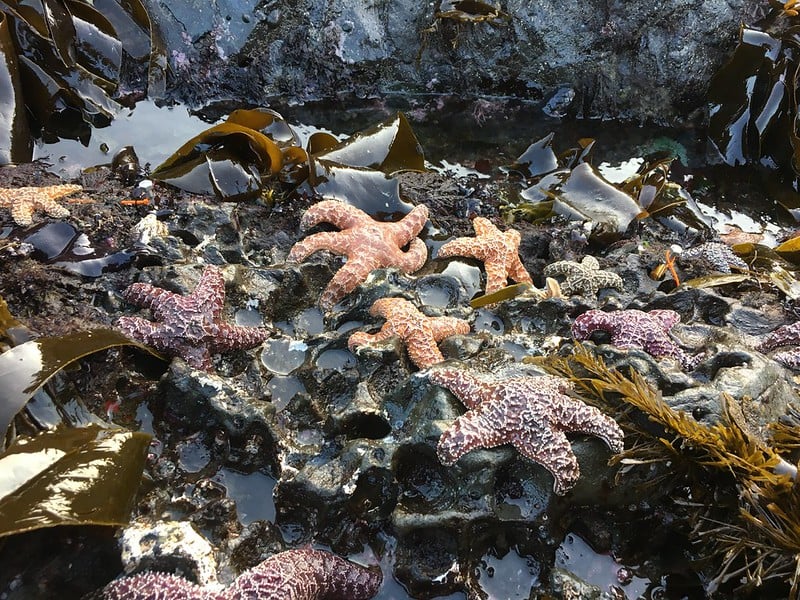

CORVALLIS, Ore. — The ochre sea stars are back. At eight sites along the Oregon coast monitored continuously for 23 years, population numbers have climbed to or above pre-epidemic levels, the animals have grown large enough to eat California mussels at rates not seen since before 2013, and something that ecologists rarely get to say out loud is now defensible: a keystone predator has pulled back from the brink. The question scientists cannot answer is why.
That uncertainty matters. The recovery of the ochre star, documented in a study published last October in the journal Ecosphere by researchers at Oregon State University and Cal Poly San Luis Obispo, has been widely reported as good news for Pacific Coast ecosystems. And it is. But read the same paper more carefully, and a more complicated picture emerges: the animals driving that recovery are conspicuously small, populations are less stable year to year than before the epidemic, and nobody has a satisfying explanation for the baby boom that made it possible.
Meanwhile, the sunflower sea star, the ochre’s larger, more ecologically critical cousin, is still functionally extinct across most of California. Scientists at the California Academy of Sciences, The Nature Conservancy, and the Sunflower Star Laboratory in Moss Landing are breeding juveniles in captivity and placing them in ocean cages to test their survival, working against a clock that has been running for more than a decade. In 2026, the California Academy of Sciences is conducting its first sunflower sea star spawn, with plans to distribute larvae across aquariums nationwide. The two stories are unfolding in parallel. They suggest that the phrase “sea stars are recovering” requires a great deal of qualification before it means anything useful.
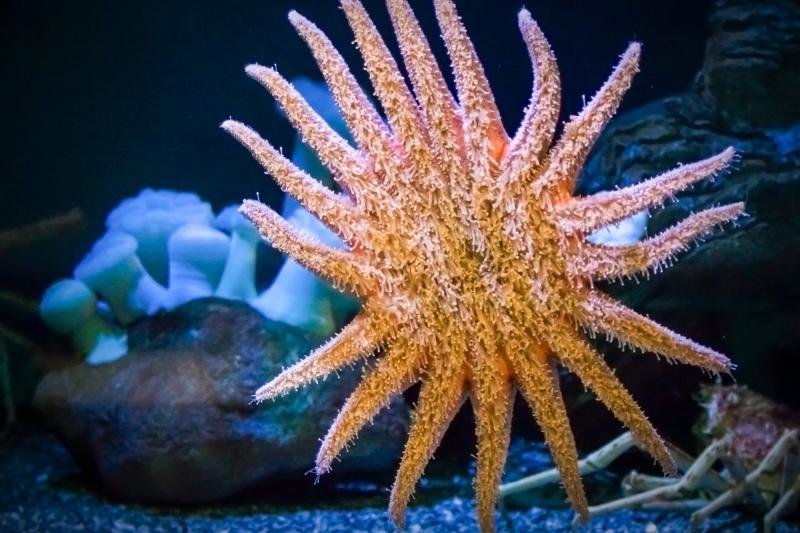
The epidemic that began in 2013 is considered the largest marine wildlife die-off ever documented. A strain of the bacterium Vibrio pectenicida, identified only last year by researchers at the Hakai Institute in British Columbia, the University of Washington, and the U.S. Geological Survey, swept from Baja California to Alaska, killing an estimated six billion individual sea stars across more than 20 species. Infected animals developed white lesions, their arms twisted and then detached, and they appeared to dissolve. Some populations lost more than 90 percent of their members within months. The sunflower sea star, which can span more than three feet across, carry up to 24 arms, and eat 44 juvenile sea urchins in a single day, saw something close to 95 percent of its global population destroyed.
The cascade that followed that loss was severe. Purple sea urchin populations, freed from their primary predator, increased by an estimated 10,000 percent between 2014 and 2022, according to the UCSB Marine Science Institute. The urchins consumed kelp, the foundation of one of the Pacific’s most biodiverse ecosystems, until wide stretches of California’s north coast lost 96 percent of their kelp canopy. What had been productive underwater forests became what ecologists call urchin barrens: near-monocultures of spiny animals with little else surviving alongside them.
The ochre star’s return has not reversed that damage, and researchers are careful to say so. Sarah Gravem, the lead author of the Ecosphere study and now an assistant professor at Cal Poly, noted that population sizes at most Oregon sites are still running 25 to 65 percent smaller in body mass than before the epidemic. A smaller animal eats less. The predation pressure the ochre star exerts on mussels has recovered to pre-epidemic rates at roughly three-quarters of the study sites, which Gravem described as encouraging, but the population itself remains structurally different from what existed before, driven by repeated pulses of young recruits rather than the stable, adult-dominated communities that characterized healthy intertidal ecosystems for decades.
The mechanism behind the boom is the paper’s most honest admission. After declines of up to 84 percent in 2014, juvenile sea star settlement increased by roughly 8,000 percent. Was that surge triggered by the die-off itself, perhaps because the sudden removal of adult competition opened up substrate and food, or was it coincidental environmental luck that happened to align with the epidemic’s peak? “The connection between the sudden decline of ochre sea stars and the baby boom remains elusive,” Gravem said in a statement accompanying the research. The paper does not resolve the question, and neither does any subsequent work.
That unresolved mechanism has direct practical implications. If the ochre star’s recovery was driven by disease-induced resilience, if the epidemic somehow triggered a compensatory biological response, then the species may be capable of self-repair after future outbreaks. If the boom was coincidental, then the recovery reflects luck rather than robustness, and the next major wasting event could produce a different outcome. The difference between those two interpretations shapes whether conservation resources should be directed at protecting existing populations or at developing the kind of captive-breeding infrastructure now being built for the sunflower star.
California’s investment in the sunflower star reflects how differently that species is faring. The state’s Ocean Protection Council approved more than $630,000 in September 2025 to advance reintroduction efforts, funding distributed across The Nature Conservancy, the California Academy of Sciences, and the California Department of Fish and Wildlife. The Sunflower Star Laboratory in Moss Landing, working with partners including the Monterey Bay Aquarium, Stanford University, and Reef Check Foundation, completed a historic first in December 2025: captive-bred juvenile sunflower stars were placed into the ocean in cages as part of a controlled field study, then retrieved for analysis. It was the first time the species had been experimentally outplanted in California waters, the Sunflower Star Laboratory reported.
Wild sightings are emerging, slowly. Research divers from Sonoma State University found a small population of sunflower stars at a site in the Greater Farallones National Marine Sanctuary where a commercial urchin diver had spotted a lone individual in 2024. The Greater Farallones Association is planning a broader systematic survey in 2026. Heal the Bay, a Los Angeles-based ocean conservation organization, documented in April 2026 that it was working to spawn one of the only known reproductive female sunflower stars in Southern California waters, a single animal known informally as “Chicken Fingers,” describing the effort as a rare and time-sensitive moment. Whether that individual’s offspring can contribute meaningfully to population recovery, or whether the genetic diversity of surviving wild animals is sufficient to sustain a viable population, remains unknown.
The identification of Vibrio pectenicida as the causative agent of the epidemic has not yet produced a disease management tool. Researchers at the Hakai Institute, USGS, and partner institutions have confirmed the bacterium’s role in sunflower star wasting, but key questions remain: whether the same strain drives wasting across all affected species, what environmental conditions, particularly ocean temperature, govern the bacterium’s virulence, and whether reservoir species exist that carry and transmit the pathogen without showing symptoms themselves. The bacterium is temperature-sensitive in ways that could connect the epidemic’s severity to warming oceans, but that relationship has not been characterized rigorously enough to inform recovery planning, according to MARINe, the multi-institution monitoring network that has tracked sea star populations along the Pacific Coast for more than two decades.
What the two species’ diverging trajectories reveal is the degree to which marine ecosystem recovery is not a single event but a years-long, species-by-species, site-by-site process that can look very different depending on where you are standing and which animal you are watching. The ochre star’s return to Oregon’s intertidal rocks is real. The sunflower star’s functional disappearance from California’s reefs is also real. Both facts belong in the same story, and neither fully explains the other.
Bruce Menge, a distinguished professor of integrative biology at Oregon State who has been studying the Oregon intertidal zone for decades, put the ochre star’s situation plainly in remarks accompanying the October research: the populations are large enough now that the animals are resuming their role as a keystone predator, but the ecosystem has not returned to its previously stable state. For a coast that lost billions of animals in the span of a year, stability may be a long time coming.