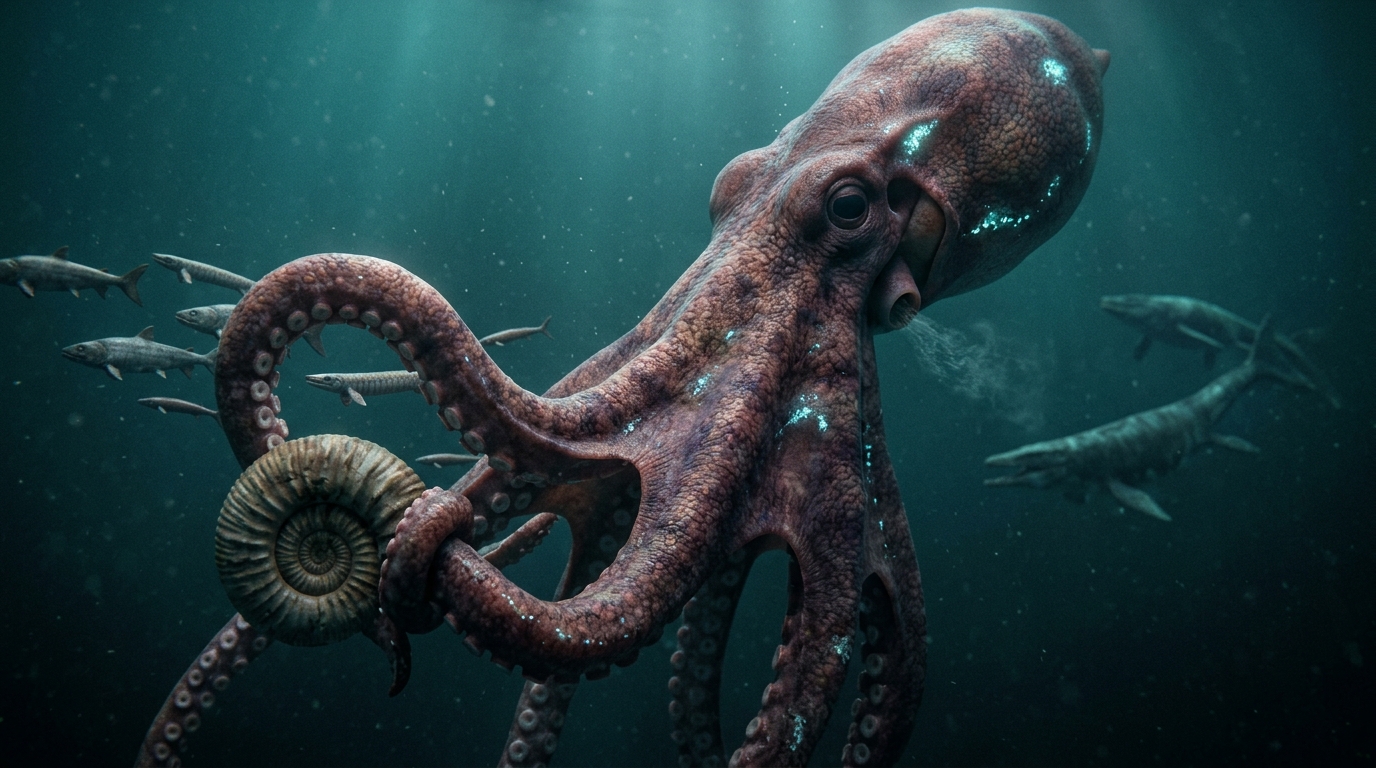

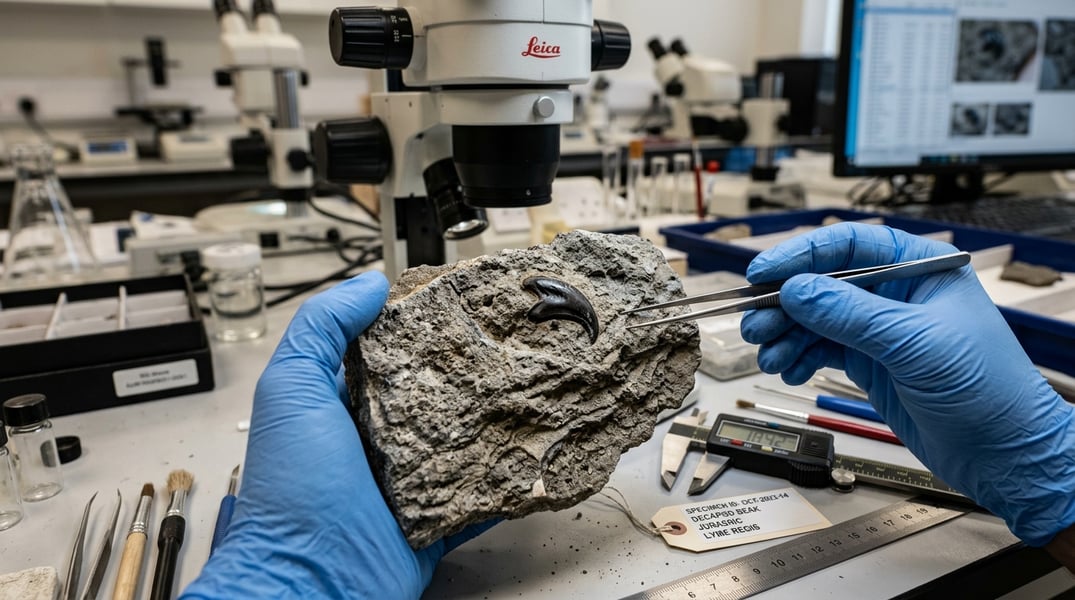
The findings, drawn from fossilized beaks discovered in sedimentary deposits in Japan and Canada, challenge long-standing assumptions that marine reptiles such as mosasaurs held uncontested control of prehistoric seas. Instead, the data suggests a more complex hierarchy, one in which highly evolved cephalopods competed directly with vertebrate predators for dominance.
The research, published in a peer-reviewed scientific study in Science, indicates that these extinct species, including Nanaimoteuthis jeletzkyi and Nanaimoteuthis haggarti, were far larger and more ecologically aggressive than previously believed. Wear patterns on their fossilized beaks suggest repeated crushing of hard-shelled prey, including ammonites and other marine organisms with reinforced biological structures.
Scientific interpretation of these findings, as reported across major global outlets including international science reporting agencies, indicates that these creatures were not passive deep-sea dwellers. Instead, they likely occupied a top-tier predatory role within their ecosystems.
A Rewriting of Marine Power Structures
For more than a century, reconstructions of Cretaceous marine environments have emphasized a dominance hierarchy led by large marine reptiles and early shark species. However, the emergence of evidence pointing to giant cephalopods introduces a competing narrative: one where intelligence, adaptability, and soft-bodied evolutionary efficiency may have rivaled skeletal strength and brute force.
Some estimates suggest these ancient octopuses reached lengths of up to 18 to 19 meters, placing them among the largest invertebrates ever recorded. This scale alone would have made them formidable competitors in nutrient-rich seas that supported dense populations of marine life.
Further analysis of fossil morphology, discussed in detail across leading science commentary platforms such as major scientific publications, highlights the possibility that these creatures possessed highly developed neural systems. Modern octopuses are already known for advanced problem-solving capabilities, and these ancient relatives may have exhibited even more complex behavioral patterns.
The Mechanics of an Ancient Deep-Sea Predator
Unlike vertebrate predators, cephalopods rely on a combination of intelligence, rapid adaptability, and physical dexterity. The fossil evidence suggests that these ancient species amplified those traits to an extraordinary degree.
Their beaks, the only hard structures preserved in the fossil record, reveal asymmetrical wear patterns that may indicate specialized hunting strategies. This has led researchers to hypothesize behavioral complexity, potentially including coordinated movement patterns and selective prey targeting.
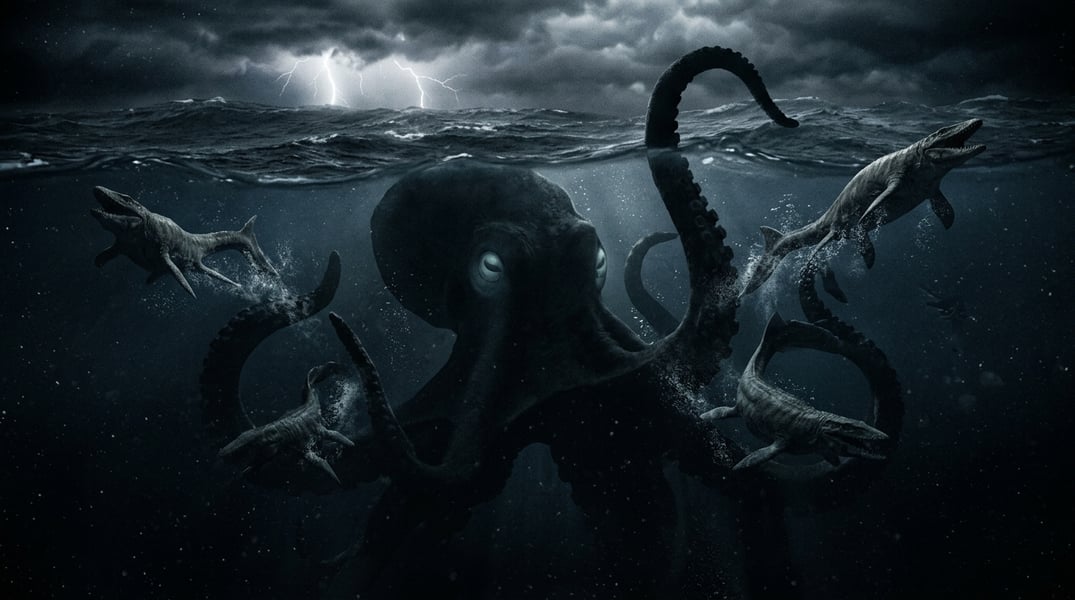
Coverage from major international science journalism, including analysis featured by global news outlets, has emphasized the significance of these findings in reconstructing ancient ecological systems that were far more dynamic than previously assumed.
An Ecosystem That No Longer Exists
The question that now dominates scientific debate is not only how these creatures lived, but why they disappeared. Unlike the well-documented mass extinction event that ended the reign of non-avian dinosaurs, there is no clearly defined extinction marker for these giant cephalopods.
One hypothesis suggests gradual ecological displacement driven by evolving vertebrate predators and shifting ocean chemistry. Another considers the possibility that their soft-bodied nature has left significant gaps in the fossil record, obscuring their full evolutionary timeline.
Broadcast media coverage, including reporting by international news networks, has brought this discovery into public attention, framing it as one of the most unexpected revisions of prehistoric marine history in recent decades.
Implications for Evolutionary Science
Within the broader field of paleontology, this discovery forces a recalibration of assumptions about marine evolutionary dominance. It suggests that intelligence-based predation may have played a far more significant role in ancient ecosystems than previously acknowledged.
It also highlights a fundamental limitation in the fossil record: the underrepresentation of soft-bodied organisms, which rarely fossilize under standard geological conditions. As a result, entire branches of evolutionary history may remain partially hidden.
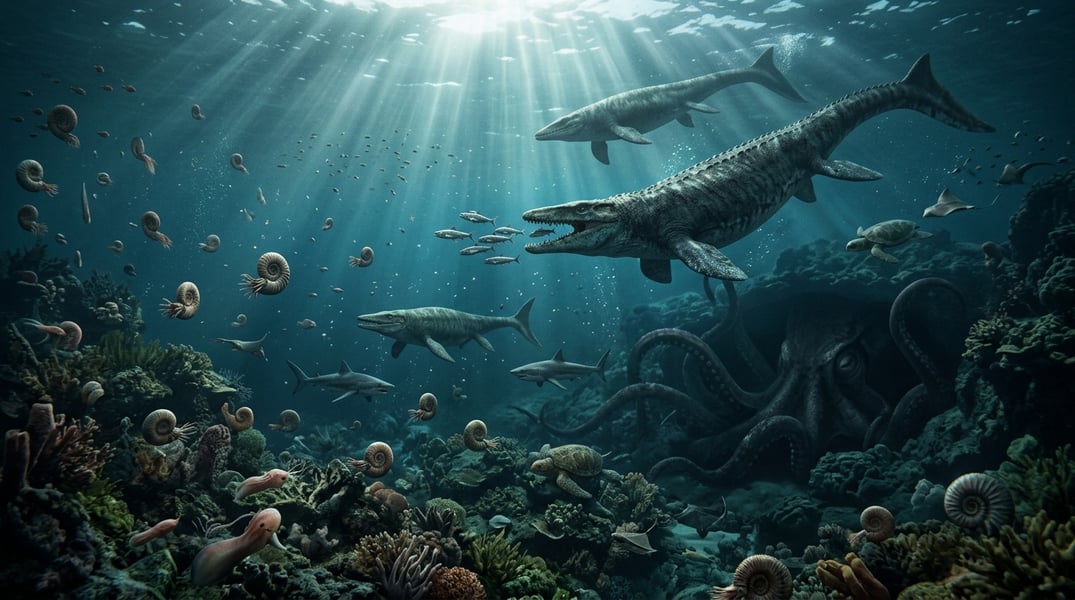
For researchers studying scientific discoveries and evolutionary biology, the implications extend beyond a single species. They challenge the structural understanding of how marine ecosystems evolve, compete, and collapse over geological time scales.
Similarly, broader discussions of ancient marine ecosystems and environmental transformation are increasingly relevant as scientists attempt to reconstruct how climate and ocean chemistry shaped evolutionary outcomes.
A Silent Giant Reintroduced Into Science
While the idea of a Kraken-like creature dominating prehistoric oceans may sound mythological, the scientific evidence is increasingly difficult to dismiss. What was once confined to folklore now appears to have roots in biological reality, albeit one vastly more complex than legend suggested.
The discovery does not simply add a new species to the fossil record. It reframes an entire ecological era, suggesting that intelligence, not just size or armor, may have defined survival in ancient oceans.
The Cretaceous seas, it seems, were not ruled by a single class of predator. They were contested, dynamic, and far more cognitively complex than previously understood.
The emergence of evidence for giant octopus-like predators fundamentally reshapes the narrative of prehistoric marine dominance, revealing a hidden evolutionary chapter where intelligence may have been as powerful as physical strength.