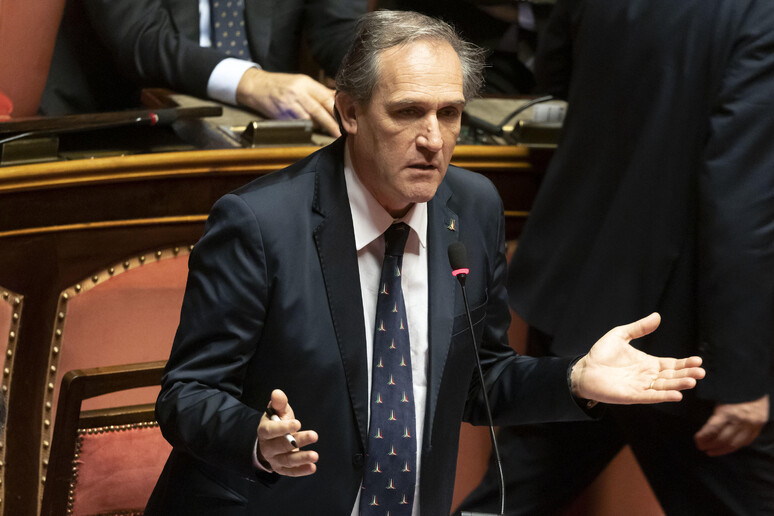

ROME — The confrontation lasted only a few minutes, but it did not stay in the lounge. Roberto Menia, a 64-year-old senator from the ruling Fratelli d’Italia party of Prime Minister Giorgia Meloni, walked up to two men exchanging caresses at a table in the ITA Airways lounge at Rome’s Leonardo da Vinci-Fiumicino Airport on the evening of June 4 and told them, in front of other passengers: “This is a public place. You cannot do whatever you want.” When the couple asked for an explanation, he sharpened the words. “Enough. Take your affections home, not here.”
The two men, both in their forties, had been on a video call with friends and exchanging gestures of affection. By the senator’s own account to the Adnkronos news agency, they had not been silent about what they thought of his intervention. “They called me a bad person, a homophobe,” Menia recounted. He showed no sign of regret. The couple, for their part, called an airport hostess. She came over. What she could not do was remove the senator.
Luca Pirondini was also in the lounge. The head of the Five Star Movement’s Senate group had a different read on the moment from the one Menia offered afterward. “I told him he had no right to say those things to a couple of young men sitting at a table and doing nothing wrong,” Pirondini later told Italian newspapers. “Homophobia in our country is not acceptable.” His account of the confrontation — a ruling-party senator rebuking a gay couple in public, witnessed and challenged by a senior opposition figure — gave the episode the shape of something the country was not going to put down quietly.
By the following morning, the episode, confirmed by ANSA, had become a full national controversy. Menia’s response to the uproar was identical to his response in the lounge: he was not going to apologize. “Education exists and applies to everyone,” he said in a statement. “There are no categories that are more equal than others. In a public place, you behave as you would civilly in a public place.” The framing — that his objection was about manners, universal in application — was precisely what his critics refused to accept.
Ivan Scalfarotto, a senator from the centrist Italia Viva party and a long-standing advocate for LGBTQ rights, was the first to respond publicly. “A senator of the Republic who stands up at Fiumicino to rebuke two young people guilty of a caress is not giving a lesson in etiquette. He is giving one in intolerance,” Scalfarotto said, according to ANSA. The key phrase in his statement was not about Menia’s manners but about a differential: what would have gone completely unnoticed between a heterosexual couple became grounds for a formal rebuke when the couple was two men. “That,” Scalfarotto said, “is called homophobia, and it does not stop being homophobia because you dress it up as etiquette.”
Cecilia D’Elia, a senator from the Democratic Party, moved to a different register. What concerned her, she said, was not the incident itself in isolation but what it represented when performed by an elected official. “What is troubling is the display of homophobia by a senator of the Republic who should, himself, be an example of respect,” D’Elia said. Riccardo Magi, the secretary of the liberal +Europa party, tied the episode directly to a vote pending in the Senate on education legislation, noting that Menia “is the example of why sex and affective education is necessary.”
From Brussels, Alessandro Zan, the Democratic Party’s head of rights and a member of the European Parliament, went further. He called on Fratelli d’Italia and the government to explicitly distance themselves from the episode. “A senator who goes after a gay couple because they embrace at an airport, and then claims everything without the slightest embarrassment, offers the photograph of a right wing that pretends to decide which affections are acceptable and which are not,” Zan said. “It is ignominious and intolerable in a democracy.” That call for a government response — for Meloni or her party to issue a rebuke — had not been answered by Friday evening. Fratelli d’Italia did not publicly distance itself from Menia’s conduct.
The timing compounds the political pressure. The incident fell at the start of Pride Month, a point the opposition was not shy about making. Italy has no law explicitly criminalizing homophobic hate crimes; a bill known as the Zan law, which would have introduced such protections, was blocked in the Senate in 2021 under sustained opposition from the center-right. Menia himself voted with that majority. The controversy over his conduct at Fiumicino landed in a country where the legal architecture of protection for same-sex couples remains thinner than in most of Western Europe, and where the governing coalition’s track record on LGBTQ civil rights has drawn sustained criticism from opposition parties and European institutions alike.
Whether Friday’s episode produces a concrete political consequence is a question the coming days will answer. What is not in question is the senator’s position. Menia did not apologize. He told Adnkronos that the two men had resumed their video call after the initial confrontation and had “started touching each other again.” He regarded that, too, as evidence against them. The couple told Adnkronos their behavior had been “totally inoffensive” and that the senator had put on “a clear manifestation of homophobia, based on the partial and amplified representation of a behavior that was partly invented.” Pirondini’s account supports theirs in its essentials. The hostess’s account has not been made public. What Europe’s political right does with episodes of this kind — whether it closes ranks or distances itself — has become a defining question across the continent. In Rome on Friday, the ruling party had not yet decided to answer it.
Related Posts