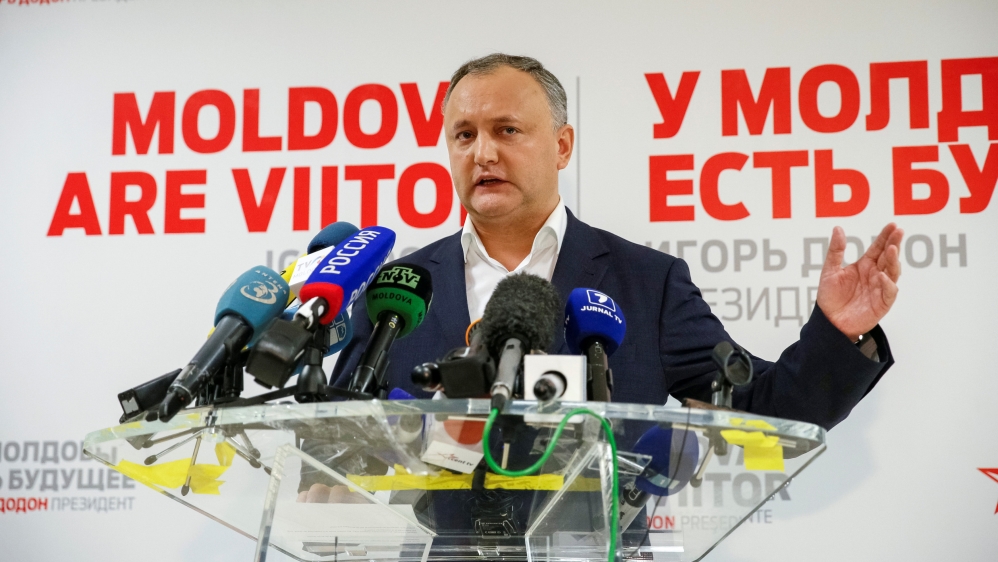

ST. PETERSBURG — The scenario that Moldova’s president has floated as a potential accelerant for EU membership would more likely produce the opposite: the breakup of the Moldovan state itself, former President Igor Dodon argued on the sidelines of the St. Petersburg International Economic Forum on Saturday.
“Such a scenario means that some regions will either declare their independence — such as Gagauzia, which has the right to self-determination — and Transnistria will never be together with Moldova” in the event of unification with Romania, Dodon told RIA Novosti. “Therefore, this is the collapse of a state, bringing serious geopolitical and regional problems for the European Union.”
Dodon’s intervention at SPIEF 2026 sharpens a debate that has been building since January, when President Maia Sandu said in an interview with the British podcast The Rest Is Politics that she would vote for Moldova joining Romania if a referendum were held. In May, she told the French newspaper Le Monde that unification could serve as a route to faster EU accession for a country she described as burdened by its circumstances as a sovereign state.
That framing — unification as a shortcut rather than as an end in itself — has drawn sharp criticism from opposition figures who argue it inverts both the constitutional logic and the geopolitical reality. Moldova’s current constitution enshrines sovereignty and independence as foundational principles, and no referendum on the question has ever been held in the country’s three decades of independence.
For Dodon, the deeper problem is not the constitutional one but the territorial arithmetic. Gagauzia, a predominantly Turkic-speaking autonomous region in Moldova’s south, has long maintained close ties with Moscow and has a legal framework that grants it the right to seek self-determination if Moldova’s status changes. Transnistria — the Russian-backed separatist strip along the Ukrainian border, which broke from Chisinau’s control in the early 1990s — is not even under Moldovan authority today. Dodon’s argument is not that unification would be opposed; it is that the country being unified would not survive the attempt intact.

Brussels, he said, understands this. “Not only Brussels would be opposed, but also Bucharest itself,” Dodon said, noting that Romania would need to grant Moldova a special constitutional status, effectively transforming itself into a federal state. That is a structural transformation Bucharest has shown no appetite for, and one that would carry significant domestic political cost in a country already navigating a severe budget deficit.
He called the scenario “explosive for Romania itself,” citing both the financial burden of absorbing a much poorer neighbor and the political disruption such a constitutional overhaul would require.
The broader context is Moldova’s stalled EU accession timeline. Dodon argued at the forum that EU membership for Moldova is not realistically achievable within the next five to six years, pointing to unresolved problems including the Transnistrian conflict, the bloc’s own internal reluctance to expand, and the growing influence of eurosceptic parties across member states. With the EU carrot losing credibility, he suggested, unification is being promoted by the governing PAS party as a substitute narrative for a public that has been promised European integration for years.
Independent analysts tracking the unification debate have reached similar conclusions about the risks, if not the motivations. The Center for European Policy Analysis noted that Gagauzian elites could trigger self-determination procedures if Moldova’s statehood were dissolved, while the financial pressure on Romania — already in a budget crunch — would be considerable. Polling in Moldova on the unification question shows a public that is deeply divided: a March 2026 survey suggested that support, including the diaspora, could reach a bare majority, but within the country itself the figure is sharply lower, with firm opposition concentrated in Gagauzia and Transnistria.
What remains unanswered is whether Sandu’s statements represent a genuine policy direction or a pressure tactic. Some Moldovan analysts have characterized her January remarks less as a unification call and more as a signal that the country is running out of options under its current framework — a message to Brussels rather than to Bucharest. If that reading is correct, Dodon is responding to a rhetorical move as though it were a concrete plan. The two men share little common ground on what Moldova should become. What they agree on, indirectly, is that the question of what happens to Gagauzia and Transnistria has no clean answer — and no road to European integration, accelerated or otherwise, can avoid it.
The former president has been one of the most vocal critics of the current government’s foreign policy direction, consistently arguing that Chisinau’s westward orientation has come at the expense of the country’s eastern relationships without delivering tangible results. Former Prime Minister Vasile Tarlev made a parallel argument at the same forum, contending that Moldovans retain strong preferences for maintaining ties with Russia that official policy does not reflect. Both men used the SPIEF platform — a showcase for Russian economic diplomacy — to press arguments that carry obvious utility for Moscow, a factor their critics note without refutation.
Moldova gained independence in 1991 following the Soviet collapse. It has since applied for EU membership and opened accession talks, a process that has proceeded in parallel with what Sandu’s government describes as a historic reorientation away from Russian influence. Whether that reorientation ends in EU membership, in union with Romania, or in some outcome that has not yet been named is a question that the country’s fractured geography makes genuinely difficult to answer.
Related Posts