
BEIRUT — The rockets landed in northern Israel before dawn. Within hours, Beirut’s southern suburbs were burning again.
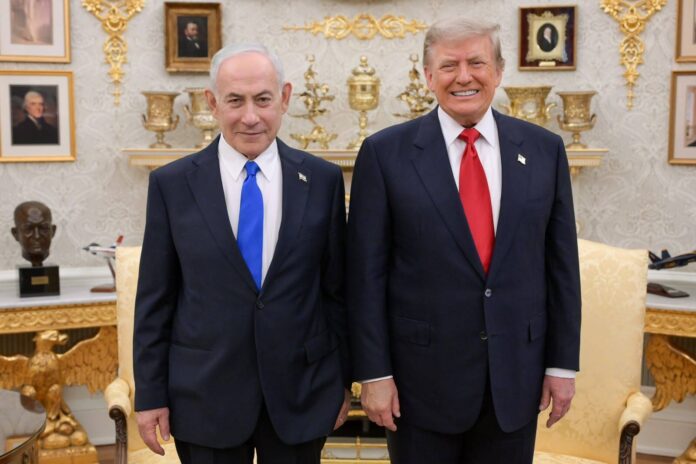
Prime Minister Benjamin Netanyahu and Defense Minister Israel Katz ordered the Israel Defense Forces on Sunday to strike Hezbollah command headquarters in the Dahiyeh neighborhood of Beirut, the Israeli government said, describing the operation as a direct response to Hezbollah shelling of Israeli territory earlier in the day. The IDF said it targeted what it described as terrorist command infrastructure embedded in the southern suburb that has served as Hezbollah’s operational nerve center for decades.
“On the instructions of Prime Minister Benjamin Netanyahu and Defense Minister Israel Katz, the IDF has just struck terrorist headquarters in the Dahiyeh neighborhood of Beirut in response to Hezbollah shelling of Israeli territory,” the Israeli government statement read.
The strike lands at a particularly fraught moment. Less than a week ago, Trump personally pressed Netanyahu to abort a planned assault on the same district, with American officials warning that a large-scale attack on Beirut would rupture ongoing diplomatic efforts. On June 1, an Israeli-Lebanese ceasefire framework was announced — one that, according to reporting from multiple outlets, included an implicit Israeli commitment to hold back on Dahiyeh strikes in exchange for a Hezbollah pause on rocket fire into northern communities.
That pause did not hold. The Times of Israel reported that two rockets were intercepted over northern Israel on Sunday, the first such attack since a renewed ceasefire arrangement had taken effect earlier in the week. Netanyahu, opening his weekly cabinet meeting hours before the Dahiyeh strike was ordered, had already signaled the response. “We will not allow fire to be directed at our territory or our communities, and we will act accordingly,” he said.
What Sunday’s strike clarifies — and what the June 1 framework did not — is that Israel’s commitment to restrain in Dahiyeh was always conditional rather than categorical. Katz had stated the equation publicly and without ambiguity as recently as June 3: no quiet in the north, no quiet in Beirut. The rockets that crossed into Israeli airspace on Sunday provided the trigger Israel had been waiting for to act on a pledge it had never formally abandoned, even while American pressure kept it holstered.

Images published by Lebanese media showed severe damage across residential and commercial structures in Dahiyeh following the strike. The IDF’s targeting of command centers in the neighborhood follows a pattern it has used throughout the conflict: framing strikes on one of the Arab world’s most densely populated urban districts as precision operations against military infrastructure that Hezbollah positions deliberately inside civilian terrain.
Whether Washington cleared Sunday’s strike, blocked it, or was simply not consulted in time remains unknown. The Trump administration’s posture toward the Lebanon file has been erratic enough that silence cannot be read as endorsement. On June 2, Trump erupted at Netanyahu in a phone call over Lebanon escalation, warning of isolation; within days, Defense Minister Katz was publicly restating the Dahiyeh equation as settled Israeli policy. The administration had, according to earlier reporting, endorsed the principle that Israel could strike Beirut if Hezbollah resumed attacks — only to pull back from that position when a large-scale operation appeared imminent. Sunday’s strike was not large-scale. It may have been calibrated precisely to stay beneath the threshold that would trigger another presidential phone call.
The broader architecture of the Lebanon conflict has not changed with Sunday’s exchange. Hezbollah was not a party to the June 1 ceasefire that Israel and Lebanon agreed — the group had publicly rejected Washington’s terms as surrender, and its military operations in southern Lebanon and against northern Israeli communities have continued at a pace the IDF itself describes as daily attrition. Thirteen IDF soldiers have been killed since the April ceasefire ostensibly took effect, according to Israeli military figures.
Residential structures in Dahiyeh, Lebanese media reported, sustained significant damage in Sunday’s strikes. There were no immediate confirmed casualty figures from Lebanese officials. The Lebanese government, which has been navigating between Hezbollah’s continued operations and an Israeli military campaign that has now resumed targeting the capital, did not issue an immediate public response.
For the residents of Dahiyeh, the semantics of ceasefire thresholds are beside the point. The neighborhood was evacuated in waves last week when Israel issued warnings ahead of an earlier potential strike; that strike was ultimately called off under American pressure. Sunday’s operation came without the same public runway. What was presented to the international community as a conditional restraint has now been exercised. Whether it represents a one-time retaliatory measure or a return to the sustained targeting of Beirut that Israel practiced earlier in the conflict is the question neither Netanyahu’s statement nor Katz’s formula has yet answered.
The IDF said it struck terrorist command facilities. What was hit, and what it was actually used for, has not been independently verified.