
YEREVAN — He did not make the argument in parliament, or in a late-night address, or in a diplomatic communiqué aimed at Brussels. Nikol Pashinyan made it at a polling station, ballots barely cast, with reporters pressing him about whether Armenia could be stripped of its standing in the Eurasian Economic Union. The answer, delivered with the calm of someone who had done the legal reading, was a single sentence that reframed weeks of escalating Russian pressure: the EAEU runs on consensus, Armenia holds a seat at that table, and a seat at that table is a veto.
“Armenia cannot be deprived of its membership status in the Eurasian Economic Union,” Pashinyan told reporters after voting Sunday, as parliamentary elections got underway across the country. “All decisions in the EAEU are made by consensus, and the Republic of Armenia, therefore, also has the right of veto, like all member states.”
The legal point is accurate. The EAEU Treaty, signed in Astana in 2014 and in force since 2015, enshrines unanimity as the decision-making standard for the bloc’s Supreme Eurasian Economic Council. No member state can be expelled without a process that would require Armenia’s own agreement. The bloc has no Article 7 equivalent — no mechanism for suspension by majority vote. Moscow may hold the EAEU’s political center of gravity, but it does not hold the procedural override Pashinyan’s critics in Yerevan have been invoking to frighten voters.
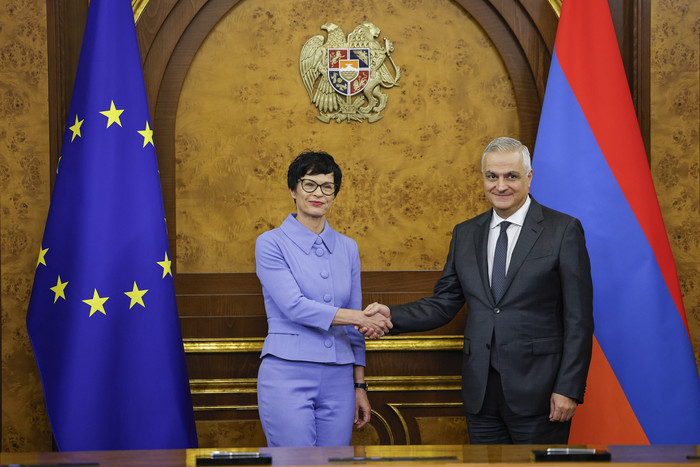
What made the declaration notable was not its legal content, which specialists in post-Soviet integration have long noted, but its timing. Pashinyan chose the polling station, on the most consequential election day Armenia has seen since the Velvet Revolution, to crystallize a message his government had been building for months: that EAEU membership and the EU accession path Armenia adopted in law last year are not mutually exclusive obligations, at least not yet, and that the loudest threats from Moscow and its EAEU partners have been, in his word, “tactically unwise.”
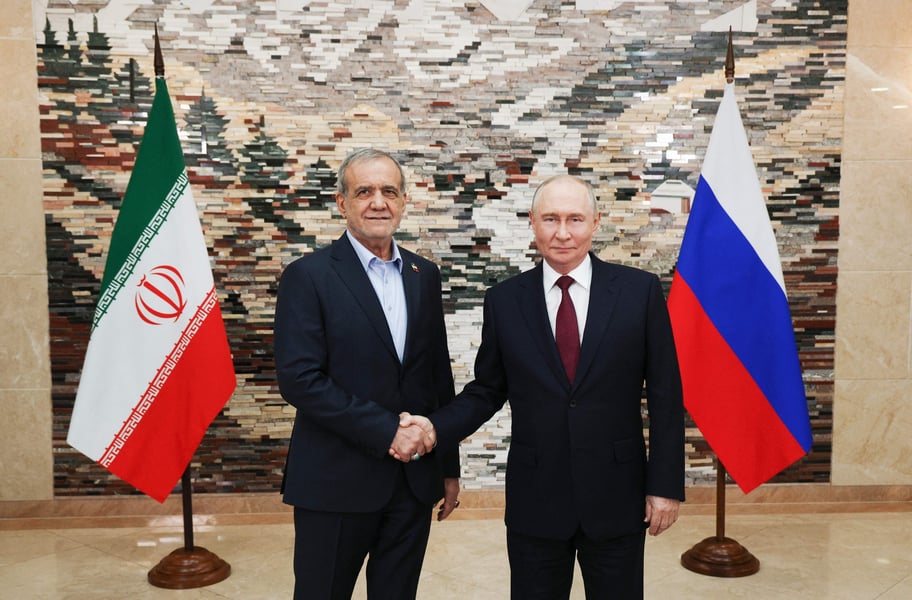
The EAEU partners had not been subtle. At the Astana summit in late May, the leaders of Russia, Belarus, Kazakhstan and Kyrgyzstan issued a joint statement warning Armenia that its EU ambitions posed what they called “serious risks” to the bloc’s economic security. They called for Yerevan to hold a national referendum on its choice between the two blocs as soon as possible. Putin, for his part, drew a direct parallel between Armenia and Ukraine — an analogy Pashinyan’s government treated as a threat rather than historical observation.
Russia’s Foreign Ministry had recalled its ambassador to Yerevan for consultations the week before the vote, citing Armenia’s steps toward EU rapprochement. The seat in Yerevan remained empty on election day, a visible diplomatic signal that Russian officials apparently calculated would weigh on Armenian voters. The empty ambassador’s chair became one of the defining images of the pre-election week.
Pashinyan’s veto declaration does not answer the harder question his government has never fully resolved: what happens to Armenia’s trade architecture if Yerevan eventually moves to formally activate its EU application? Armenia still sends roughly a third of its exports to Russia. It buys Russian natural gas at rates well below market. The EAEU’s common customs regime governs how Armenian goods move through Kazakhstan to China and through Russia to Iran. A formal EU accession process would require dismantling those arrangements — and no timetable or legal consensus clause makes that rearrangement painless.
The prime minister acknowledged as much, in his own fashion. He dismissed calls for a referendum on the EAEU-EU choice by noting that Armenia has not formally applied for EU membership — which is technically true. The Armenian parliament passed a law last year expressing the country’s intention to join the EU, a gesture with political meaning but no legal trigger. Pashinyan has said Yerevan is aware of the incompatibility of simultaneous membership in both blocs but intends to align its agenda with each for as long as the calendar allows.
That posture — deliberate ambiguity maintained through legal precision — is exactly what Sunday’s polling-station statement exemplified. The veto argument does not advance Armenia toward the EU. It does not repair the gas dependency or replenish the Russian market access that any rupture with Moscow would forfeit. What it does is remove the expulsion threat from the menu of instruments Russia can deploy against Pashinyan before the votes are counted. A member state cannot be ejected. The bloc’s own rules say so. Pashinyan said so, at the ballot box, while eighteen parties competed for seats that will determine whether he governs for another term.
Eighteen parties and political blocs participated in Sunday’s vote, the country’s first regularly scheduled parliamentary election since 2017. Pre-election surveys showed Pashinyan’s Civil Contract party with a substantial lead, though the margin between polling data and outcomes has been a source of fierce domestic argument throughout the campaign. Pashinyan had also told reporters Sunday morning that Armenia is not yet ready for EU membership, separating the formal accession question from the political direction he has set. The two statements, taken together, describe a government confident enough in its legal footing to play a long game — and uncertain enough about its economic footing to avoid naming the date when the game ends.
Whether that ambiguity survives a new parliamentary term, or whether a Pashinyan victory forces a harder choice between Brussels and Moscow than any consensus clause can defer, is the question his election-day statement left deliberately open. The EAEU partners he called tactically unwise will be watching the results.