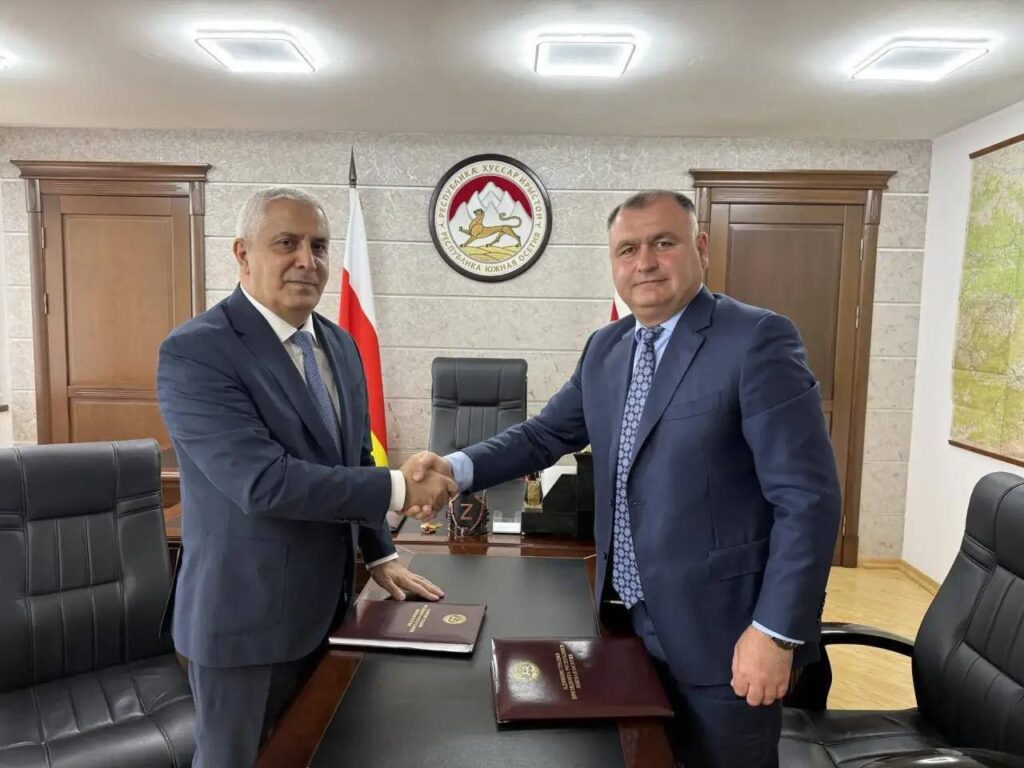

TSKHINVALI — The resignation came without drama, inside a government meeting hall in a capital that has been anything but quiet. South Ossetian Prime Minister Dzambolat Tadtaev stood up, made a personal statement, and stepped down. President Alan Gagloyev accepted, thanked him, and moved immediately to the next name on a list that analysts believe was not drawn up in Tskhinvali.
That name is Marat Kambolov — a veteran Russian federal bureaucrat who arrived in the South Ossetian capital less than two weeks ago as a presidential adviser, and whom Gagloyev will now formally nominate as the next prime minister. The announcement came Monday at the same government meeting where Tadtaev resigned. First Deputy Prime Minister Konstantin Dzhioev will serve as acting head of government until parliament confirms Kambolov’s appointment, the presidential press service said.
The timing is not coincidental, and no serious analyst in the region is treating it that way.
Kambolov’s trajectory into South Ossetian politics reads like a Kremlin placement. Over a career spanning Russian federal agencies, he held senior roles in the Federal Antimonopoly Service, the Ministry for Nationalities and Regional Policy, the Ministry of Industry, Science and Technology, and the Federal Agency for Science and Innovation. Gagloyev signed the decree making him presidential adviser on 27 May. According to local Telegram channels in Tskhinvali, his initial mandate was overseeing the implementation of a bilateral cooperation agreement signed between South Ossetia and Russia on 9 May — one focused on economic integration, investment, and infrastructure development. That was the stated brief. The actual trajectory, as analysts had already predicted publicly before Tadtaev’s resignation, was the prime ministerial chair.
“The Kremlin has effectively sent Gagloev’s replacement,” JAMnews reported last week, citing local analysts who said the cabinet could be dissolved before 20 June and Kambolov installed as prime minister. That assessment was published on 2 June. Tadtaev resigned on 9 June. The sequence is difficult to read as anything other than confirmation.
Tadtaev had been in office since February 2026, when Gagloyev appointed him amid sharp opposition criticism. His nomination was itself contentious: former president Atsamaz Bibilov said publicly that Tadtaev lacked both professional competence and the moral authority to serve, pointing to the failure of the 2022–2025 socio-economic development programme — financed by Russia — to deliver measurable results. Opposition figures raised questions about how Tadtaev secured the nomination at all, with local reporting pointing to family ties to a senior South Ossetian KGB official and to Arsen Gagloev, widely described in the region as a grey eminence who played a significant role in bringing Alan Gagloyev to the presidency. What is clear is that Tadtaev’s tenure lasted fewer than four months.
The question now hanging over Tskhinvali is whether Kambolov’s arrival as prime minister is the ceiling of Moscow’s intervention or merely the latest step in a broader political reconstruction. Political strategist David Gazzati, who served as a state adviser under former president Anatoly Bibilov, argued last week that Gagloyev and his team had “already lost their battle to remain in power” because of damaged relations with the Russian leadership. Gazzati’s specific claim: that Gagloyev presented inflated figures to Vladimir Putin on the implementation of South Ossetia’s investment programme, and that the real figures subsequently reached Russian law enforcement agencies.
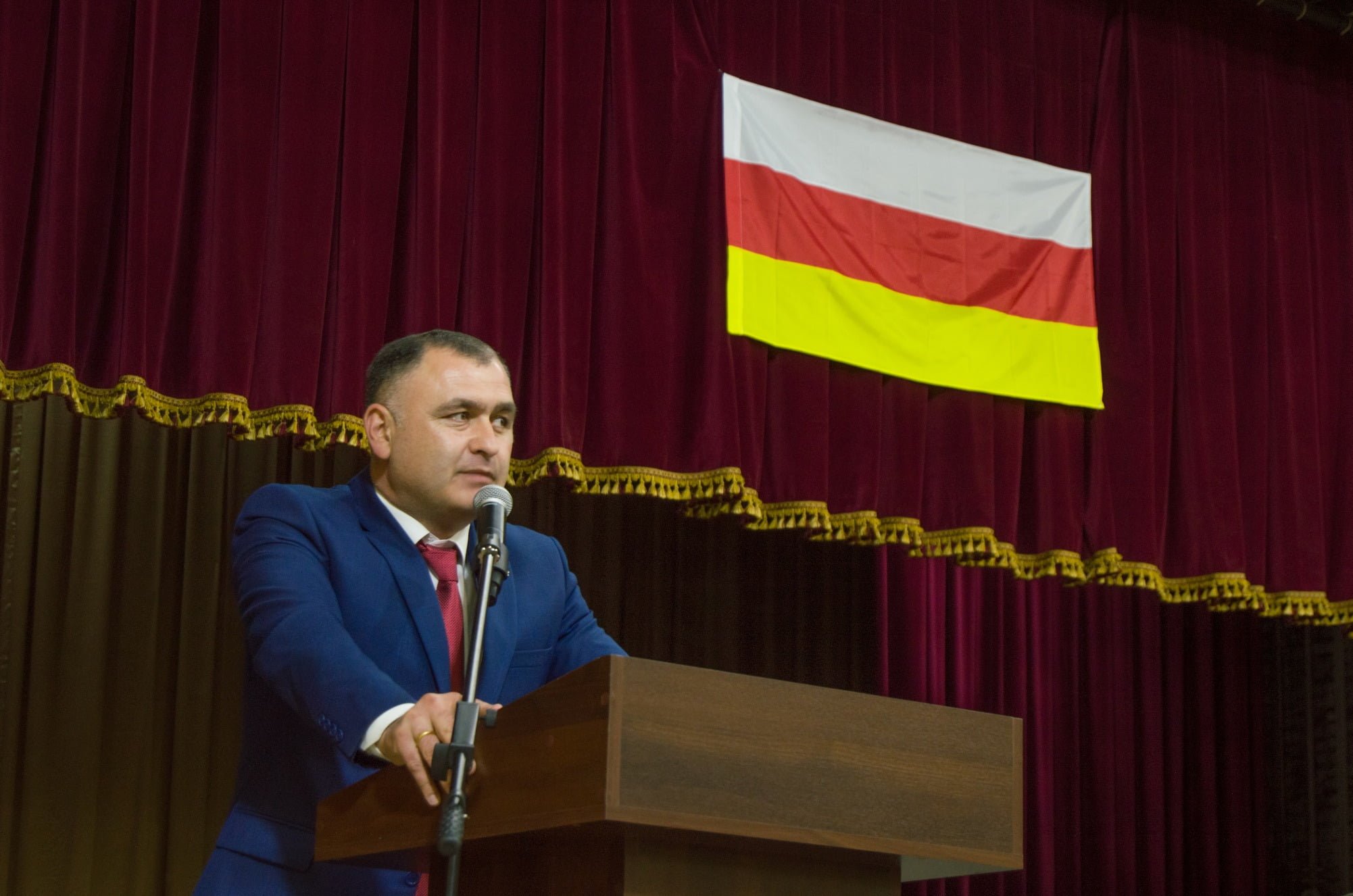
None of that has been confirmed by official Russian sources. Gagloyev has not publicly addressed the allegations. What has been confirmed is the appointment sequence: Kambolov in as adviser, Tadtaev out as prime minister, Kambolov nominated as successor — all within twelve days.
South Ossetia occupies a specific and brittle position in the post-Soviet geography. Recognized by Russia, Nicaragua, Venezuela, Syria, and a handful of other states after the 2008 war with Georgia, it functions as a Russian-financed enclave whose budget depends almost entirely on transfers from Moscow. That dependency is not merely economic — it shapes every major political decision, including who leads the government. Russia’s approach to the South Caucasus has long operated through the management of exactly these dependencies, rewarding administrations that deliver results Moscow approves of and engineering transitions when they do not.
The immediate practical reality is more mundane: a parliament that must now schedule a confirmation vote, a caretaker deputy prime minister managing daily government functions, and a nominated candidate with no prior South Ossetian governing experience whose chief credential appears to be the confidence of Russian federal authorities. Whether that confidence translates into administrative capacity is a question the territory’s 53,000 residents will be living with regardless of how the vote goes.
What happens to Gagloyev himself remains unresolved. His presidential term does not formally expire until 2027. Gazzati and others have speculated about an early departure, but no official signal has emerged from the president’s office, from Moscow, or from South Ossetian parliamentary leadership. The presidential press service’s statement Monday was tight: resignation accepted, acting head named, nominee announced. It said nothing about what comes next for the man who made the announcement.
That gap — between what has been announced and what has not — is where South Ossetian politics will be conducted for the foreseeable future. Georgia’s evolving relationship with Russia adds a further layer of regional complexity to any transition in Tskhinvali, given that Tbilisi’s recognition of South Ossetia’s status remains the foundational dispute underlying the region’s existence. Kambolov’s appointment, if confirmed, will be watched from Tbilisi at least as closely as from Moscow — though neither capital is likely to say so publicly.
Tadtaev, for his part, gets a thank-you from the president and an exit. What he gets after that is not part of any official statement.